WASHINGTON, — May 22, 2026 : The U.S. Naval Air Systems Command has awarded General Atomics a $15.58 million contract modification to continue corrective engineering work on the Electromagnetic Aircraft Launch System (EMALS) aboard the future USS Enterprise (CVN-80), as the U.S. Navy continues refining critical launch technologies for its Ford-class aircraft carrier fleet.
The modification, announced on May 21, 2026, focuses on resolving power-conversion reliability issues, launch-system integration deficiencies, and network modernization requirements affecting sortie generation capability and aircraft readiness aboard the carrier. The award forms part of the long-running contract framework under contract N0001914C0037, originally initiated in May 2014 for long-lead EMALS and Advanced Arresting Gear (AAG) procurement for both USS John F. Kennedy (CVN-79) and CVN-80.
Contract Scope and Engineering Work
According to the Navy, the latest modification funds several critical engineering activities tied to the EMALS architecture aboard CVN-80. These include the migration of the launch system’s network architecture toward a single-mode fiber infrastructure, correction of deficiencies involving the Prime Power Interface Subsystem transformer rectifiers, associated hardware installation aboard the carrier, and management of hardware storage through April 2028.
Work under the contract will be performed in San Diego, California (70.7 percent), Boston, Massachusetts (18.9 percent), Tupelo, Mississippi (9.1 percent), and Lakehurst, New Jersey (1.3 percent). The Navy obligated $15,575,652 in shipbuilding and conversion funds at the time of award.
The modification continues a multi-year sequence of corrective engineering contracts issued for both EMALS and Advanced Arresting Gear systems. Previous awards included $36.4 million in May 2021 for AAG Water Twister Mod-II shipsets, $9.63 million in September 2021 for Generation 3 EMALS position sensor blocks, $42.85 million in January 2023 for hardware and software integration work aboard CVN-79 and CVN-80, and $27.96 million in December 2023 for additional position sensor blocks and transformer rectifier engineering support.
Transition From Steam Catapults to EMALS
EMALS represents the most significant transition in U.S. Navy carrier launch technology since the introduction of the C-13 steam catapult aboard Cold War-era carriers. Steam catapult systems achieved high operational maturity aboard Nimitz-class carriers but required extensive steam piping, large freshwater generation capacity, and intensive maintenance support.
Navy studies associated with the CVN-21 program determined that steam systems conflicted with reduced crew objectives and future requirements for launching lighter unmanned aircraft due to limitations in launch-force modulation.
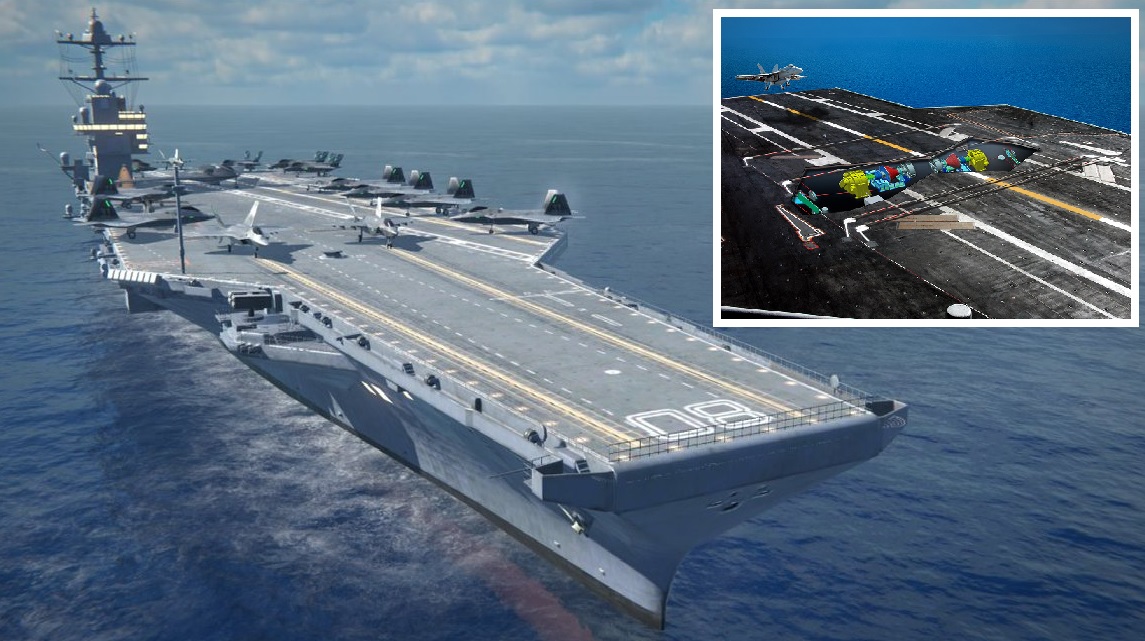
Integrated directly into the Ford-class electrical architecture, EMALS replaces steam propulsion with electromagnetic acceleration generated through a linear induction motor. The launch architecture consists of four principal subsystems: the linear induction motor, energy storage subsystem, power conversion subsystem, and digital control subsystem.
The launch track functions as a linear electric motor approximately 91 meters long. Energy is stored kinetically through four rotating disk alternators, each generating 121 megajoules, providing a combined storage capacity near 484 megajoules. During launch operations, stored rotational energy is converted into electrical output while cycloconverters regulate voltage and frequency to sequentially energize stator coils that accelerate the aircraft shuttle.
The system can accelerate aircraft weighing up to 45 tonnes to speeds approaching 240 km/h within two to three seconds, while maintaining recharge intervals near 45 seconds between launches. Unlike steam catapults that apply relatively fixed acceleration curves, EMALS continuously adjusts tow force using closed-loop digital feedback, improving launch precision while reducing structural stress on aircraft.
Reliability Challenges and Operational Testing
Despite its technological advantages, EMALS has faced significant reliability challenges throughout development and operational deployment.
Developmental testing conducted at Joint Base McGuire-Dix-Lakehurst recorded 201 failed launches out of 1,967 attempts during a 2013 test sequence. Operational evaluations aboard USS Gerald R. Ford (CVN-78) later identified recurring issues involving transformer rectifiers, launch motor durability, synchronization software faults, overheating electrical components, braking chopper systems, and repeated position sensor failures.
A January 2021 assessment by the Director, Operational Test and Evaluation measured achieved reliability at 181 Mean Cycles Between Operational Mission Failure (MCBOMF) following 3,975 launches conducted between November 2019 and September 2020. This remained substantially below the Navy’s target requirement of 4,166 MCBOMF.
Subsequent evaluations by the Government Accountability Office concluded that EMALS and AAG reliability goals were unlikely to be fully achieved before the 2030s because several subsystems still required redesign and configuration refinement.
However, operational performance has gradually improved. By June 2022, EMALS and AAG systems aboard CVN-78 had completed more than 10,000 launch and recovery cycles, although corrective modifications affecting transformer rectifiers, launch motors, braking systems, and sensors continued.
USS Enterprise (CVN-80) Construction Status
The USS Enterprise (CVN-80) is currently under construction at Huntington Ingalls Industries Newport News Shipbuilding in Virginia and is the third vessel in the Ford-class carrier program.
Steel cutting for the carrier began in August 2017, while keel laying occurred on April 5, 2022. CVN-80 is also the first Ford-class carrier designed entirely within a fully digital manufacturing and design environment from the beginning of fabrication.
The ship’s delivery timeline has experienced repeated delays. Originally scheduled for delivery in March 2028, the date later shifted to July 2030 before being revised again to March 2031. Navy officials attributed the delays to sequence-critical material shortages, supply chain disruptions, dry dock availability constraints, and the complexity associated with integrating advanced launch and combat-support systems during construction.
Once completed, CVN-80 will displace approximately 100,000 tonnes at full load and measure 337 meters in length with a 41-meter beam. Propulsion will be provided through two Bechtel A1B nuclear reactors driving four shafts.
The carrier is designed to support an embarked air wing of more than 75 aircraft depending on mission configuration. Compared with Nimitz-class carriers, Ford-class vessels aim to increase sortie generation rates by approximately 25 percent while operating with several hundred fewer personnel through increased automation and digital integration.
Naval Heritage and Program Evolution
The new carrier also preserves substantial U.S. naval heritage linked to previous vessels bearing the Enterprise name. Builders are integrating four original portholes recovered from the World War II-era USS Enterprise (CV-6) into the ship’s structure. In addition, sixteen tonnes of steel recovered from the decommissioned USS Enterprise (CVN-65) are being recycled into CVN-80 during construction.
Although CVN-80 shares the same baseline architecture as CVN-78 and CVN-79, the carrier incorporates nearly a decade of corrective engineering improvements derived from operational testing and fleet experience. These modifications include revised EMALS hardware baselines, updated network architecture, modified power electronics, altered installation sequencing, and expanded digital integration between shipyard workflows and onboard systems.
The broader Ford-class program has experienced persistent schedule and integration challenges because several advanced technologies — including EMALS, Advanced Arresting Gear, Advanced Weapons Elevators, Dual Band Radar systems, and the A1B reactor architecture — entered serial production while still undergoing developmental refinement.
As a result, the continuing engineering modifications awarded across the Ford-class program have transformed the Navy’s next-generation carrier launch and recovery systems into a long-term iterative modernization effort focused on improving operational reliability, launch efficiency, and future carrier air wing integration.
——— End of Article ———