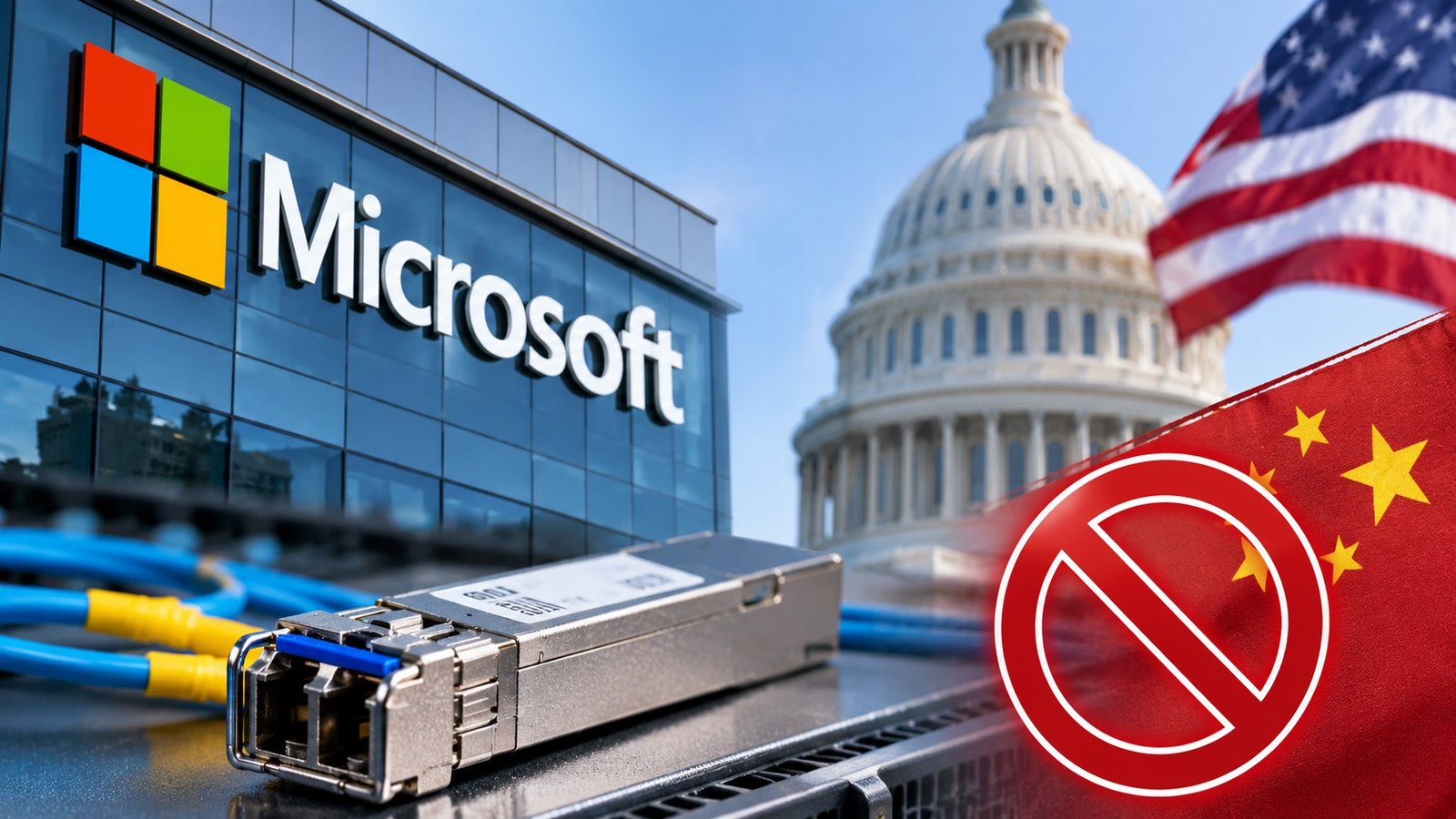
WASHINGTON, — Microsoft is urging the Trump administration to abandon a proposed ban on Chinese-made optical transceivers, warning that restrictions could delay US AI data center construction and affect America's position in the global artificial intelligence industry.
Optical transceivers convert electrical signals into optical signals and back, enabling high-speed data transmission through fiber-optic cables. They connect servers, switches and AI processors inside large data centers.
The Federal Communications Commission (FCC) is preparing restrictions on new Chinese transceiver models over national security concerns. US officials fear the equipment could potentially be used for data theft, malware installation or disruption of critical infrastructure.
Microsoft Raises Supply Chain Concerns
Microsoft and other technology companies met officials from the White House Office of Science and Technology Policy and the National Security Council in September to explain the potential impact of restrictions.
The Information Technology Industry Council (ITI) has also opposed the proposed ban. Its general counsel, John Miller, warned that restrictions could "grind" the US data center rollout to a halt. He noted that companies have already purchased expensive AI processors, which could remain unused without enough transceivers to connect them.
China Controls Two-Thirds of Global Supply
According to Counterpoint Research, China accounts for approximately two-thirds of the global optical transceiver market. Chinese manufacturers Zhongji Innolight and Eoptolink are among the leading suppliers. Zhongji Innolight also appears on the Pentagon's list of Chinese military companies.
US manufacturers Coherent and Lumentum produce competing equipment but lack the manufacturing capacity to immediately replace Chinese suppliers.
FCC Considers Limited Restrictions
One option under discussion is to restrict only next-generation transceivers capable of handling 3.2 terabits per second.
According to an October research note from Morgan Stanley, production of these advanced components is not expected to increase significantly until 2028, with wider industry installation projected for 2029. This could give US and allied manufacturers time to expand production before restrictions take effect.
Microsoft's Data Center Expansion
The issue is important for Microsoft, which has 35 data centers under construction in the United States and another 134 in the planning stages, according to market intelligence firm Cleanview.
Microsoft declined to comment on the discussions. The White House, FCC and Chinese embassy in Washington did not immediately respond to requests for comment.
The administration has not announced a final decision. The debate highlights the challenge of balancing national security with supply chain availability as the United States expands its AI infrastructure.
——— End of Article ———