PARIS, — U.S. defence company General Atomics Electromagnetic Systems (GA-EMS) has unveiled two long-range unmanned underwater vehicles (UUVs), Ranger and GA-Ray, at the Euronaval 2026 exhibition in Paris. The platforms are designed for intelligence, surveillance and reconnaissance (ISR), mine deployment and strike missions, with the aim of extending underwater operational reach and reducing reliance on manned nuclear-powered attack submarines.
Ranger and GA-Ray Specifications
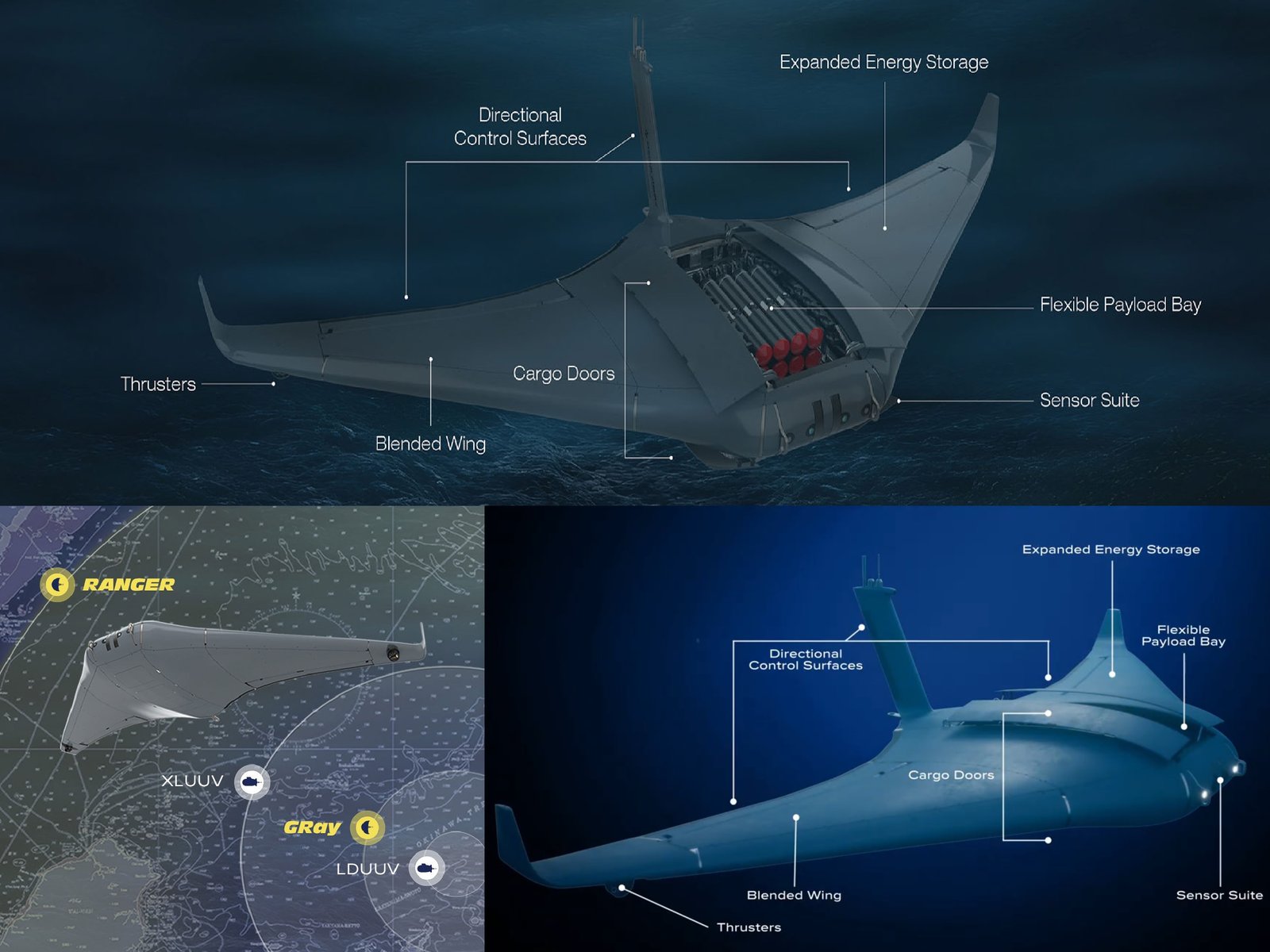
Both vehicles use a blended-wing, buoyancy-driven glider design for improved underwater efficiency and long endurance.
The larger Ranger, classified as an Extra-Large Unmanned Underwater Vehicle (XLUUV), measures 100 to 135 feet and is designed for multi-year operations. One configuration includes a cargo bay comparable in size to a standard CONEX shipping container.
The smaller GA-Ray (GRay) is a Large Displacement Unmanned Underwater Vehicle (LDUUV), measuring 22 feet. It offers endurance ranging from weeks to months and is being used for risk reduction, concept development and testing smaller underwater drones. General Atomics plans to scale the technology for Ranger.
Payload and Drone Deployment
Both platforms feature modular, open-architecture designs that support different mission payloads, autonomy software, acoustic sensors and quantum-enabled sensors. Depending on configuration, they can carry between 16 and 96 smaller underwater drones. Ranger can also transport two large-displacement UUVs or a containerised payload.
At Euronaval, General Atomics showed footage of a successful test in which a quadcopter UAV launched from a tube carried by a smaller UUV. The smaller underwater vehicles can therefore deploy additional aerial and underwater systems.
Long-Range Operations and Navigation
The vehicles are designed for covert operations in contested maritime environments. They feature near-silent propulsion, no mast or snorkel and no routine surface exposure.
Navigation systems include an Inertial Navigation System (INS), Doppler Velocity Log (DVL), optical communications and emerging quantum-enabled sensors, allowing operations in GPS-denied waters.
General Atomics' concept graphics show potential deployment from Okinawa and Guam, with operational reach extending to First Island Chain chokepoints and coastal waters near mainland China. Depending on configuration, the company says the platforms can achieve tens of thousands of nautical miles of endurance.
Testing and US Navy Hedge Force Strategy
Rolf Ziesing, Vice President of Maritime Programs at GA-EMS, confirmed that submerged testing has lasted up to 70 days to simulate extended missions. He also said a power and energy system under development is intended to support multi-year operations or ranges of tens of thousands of kilometres.
The Ranger and GA-Ray are designed to support the US Navy's Hedge Force Strategy, outlined by Chief of Naval Operations Admiral Daryl Caudle. The concept combines unmanned systems with crewed warships, aircraft and submarines to counter specific threats.
Their planned roles include persistent surveillance, mine deployment, anti-submarine operations and strike missions. General Atomics said the programme and its payload technologies have attracted interest from multiple defence organisations. Some details about the energy systems and mission payloads have not yet been publicly disclosed.
——— End of Article ———