WASHINGTON — The U.S. Navy has awarded three competitive Prototype Other Transaction (OT) agreements to Conrad Shipyard LLC of Orange, Texas; Master Boat Builders Inc. of Coden, Alabama; and Saronic Technologies of Brownsville, Texas, to build prototype Landing Craft, Utility (LCU) 1700 vessels.
The awards, announced on September 15, 2026, carry an initial construction obligation of $280,521,389. Under the agreements, the three shipyards will build two or three prototype craft and refine their manufacturing plans to support future high-rate production. Master Boat Builders will initially build three hulls, with an option for a fourth.
Navy Expands LCU 1700 Production Base
The Navy said the decision to use three shipyards is intended to expand U.S. shipbuilding capacity and establish multiple sources for LCU 1700 production.
“By selecting three distinct shipyards, the Navy is expanding its shipbuilding industrial base capacity and building a resilient ‘second source’ of supply for landing craft,” said William F. Mahan, who is performing the duties of Assistant Secretary of the Navy for Research, Development and Acquisition. “Other Transaction prototype authority allows the Navy to move at the speed of relevance.”
The acquisition effort is funded by the One Big Beautiful Bill Act and uses prototype authorities under 10 U.S.C. § 4022. The Navy said the approach is intended to speed delivery of littoral capabilities, validate the production-ready Technical Data Package (TDP) through actual fabrication, and establish parallel production lines.
LCU 1700 to Replace LCU 1610
The LCU 1700 is being developed to replace the Navy's legacy LCU 1610-class landing craft, which have an average of more than 50 years of active service.
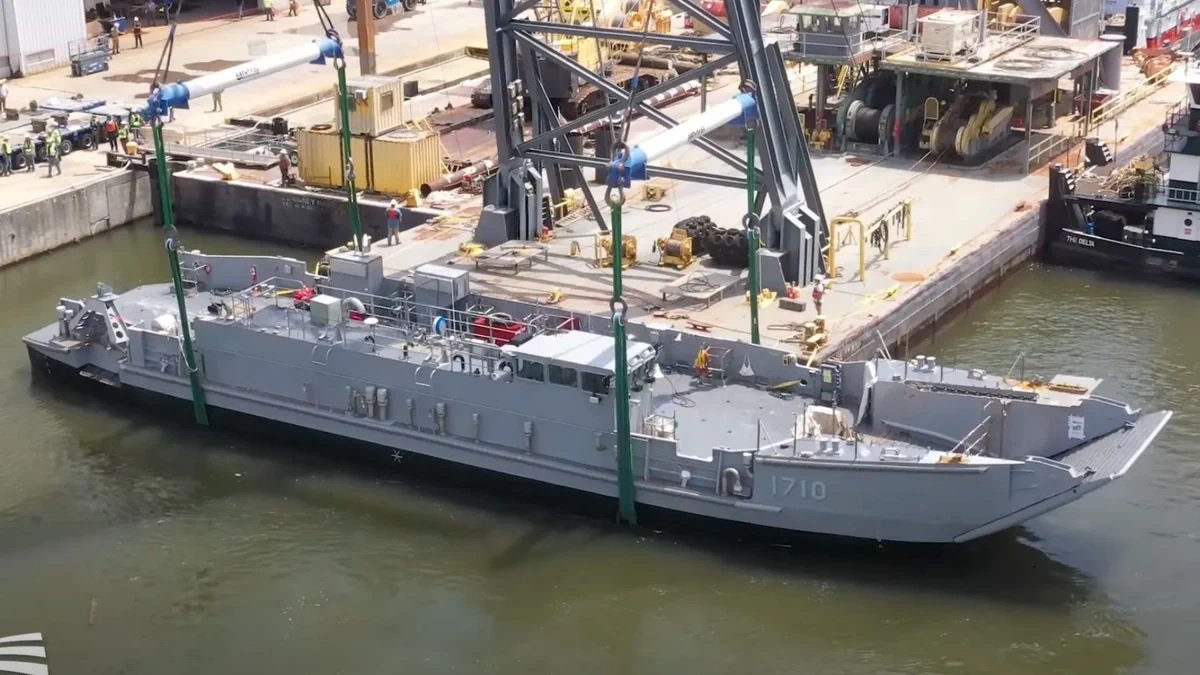
The new craft are approximately 139 feet long with a 31-foot beam. They are designed with improved reliability, increased payload capacity of about 170 short tons, extended operational reach and compatibility with the Navy's amphibious warfare ships.
The LCU 1700 has a stated top speed of 11 knots and a range of about 1,200 nautical miles at 8 knots, with a crew of 13. Its payload capacity is sufficient for two M1A1 tanks or approximately 350 combat troops, according to the information provided for the program.
The vessels are intended to transport troops, vehicles and cargo between ships and shore, between shore locations, and back to ships. They will support amphibious operations as well as other logistics missions.
Austal USA Already Delivered First LCU 1700
The new agreements follow the Navy's receipt of its first LCU 1700-class landing craft, LCU 1710, from Austal USA in Mobile, Alabama, in August 2026. Austal holds contracts for additional hulls under an earlier agreement.
The Navy's latest awards are intended to add three more shipyards to the production effort and introduce different construction processes across the yards. The prototype work will also allow the Navy to validate the technical data package through actual construction before higher-rate production begins.
Three Shipyards to Build Prototype Craft
Conrad Shipyard will construct its vessels at its facility in Orange, Texas.
Master Boat Builders, based in Coden, Alabama, will initially construct three LCU 1700s and has an option for a fourth vessel. The company described the award as a major milestone after 45 years of shipbuilding work.
Saronic Technologies plans to build its LCU 1700 vessels at Port Alpha, its planned next-generation shipyard facility in Brownsville, Texas. The LCU 1700 work is expected to be among the first construction activities at the site.
Deliveries Expected From Late 2028
Deliveries of the prototype craft from the three newly selected shipyards are scheduled to begin in late 2028 and continue through 2029.
The Navy's LCU 1700 program of record calls for 32 craft overall. The multi-shipyard approach is intended to establish a broader production base and provide a path toward higher-rate construction of the remaining vessels.
——— End of Article ———