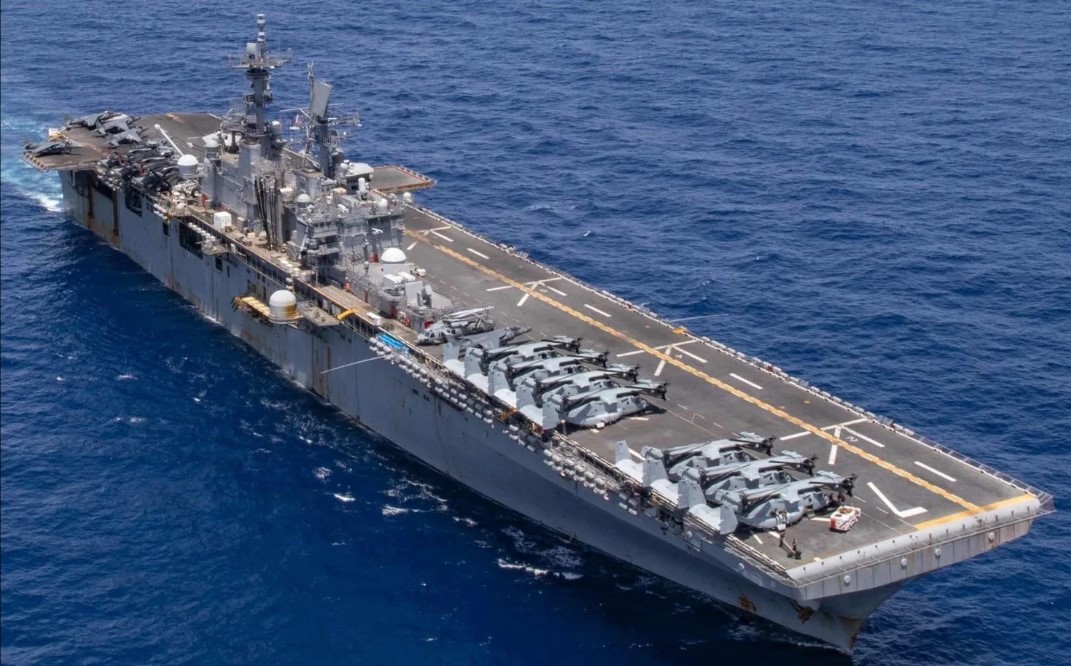
WASHINGTON — May 26, 2026 : The U.S. Navy has approved a $17.45 million contract modification for the Fiscal Year 2026 Selected Restricted Availability (FY2026 SRA) of the Wasp-class amphibious assault ship USS Iwo Jima (LHD-7), extending a major maintenance and modernization effort designed to support long-term F-35B Lightning II operations and preserve the ship’s operational readiness into the 2030s.
The modification, announced on May 22, 2026, exercises options under a Naval Sea Systems Command contract awarded on January 8, 2026 to BAE Systems Maritime Solutions Norfolk. The original contract carried a base value of $204.16 million and a cumulative potential value of $255.88 million, with maintenance work scheduled to continue through May 2028 in Norfolk, Virginia.
Maintenance Program and Contract Scope
The FY2026 SRA is categorized as a Chief of Naval Operations maintenance period and is being conducted primarily pier-side rather than through a major overhaul or drydock modernization. The availability combines depot-level repairs, structural restoration, combat systems modernization, aviation support upgrades, and lifecycle extension work intended to sustain USS Iwo Jima’s operational effectiveness after more than two decades of service.
The contract covers labor, supervision, testing, certification, facilities use, engineering support, and production activities required to restore material condition and improve shipboard capabilities. Planned work includes corrosion repair, steel replacement, preservation coatings, propulsion plant inspections, electrical distribution maintenance, and overhauls of pumps, valves, piping systems, ventilation systems, and auxiliary machinery.
F-35B Modernization and “Lightning Carrier” Transition
A central objective of the modernization effort is preparing USS Iwo Jima for sustained F-35B Lightning II operations as the U.S. Marine Corps transitions away from the legacy AV-8B Harrier II fleet toward fifth-generation expeditionary aviation.
The upgrades support the Navy and Marine Corps’ “Lightning Carrier” concept, under which amphibious assault ships embark larger F-35B air wings to supplement conventional aircraft carrier operations. In this configuration, Wasp-class ships can conduct sea-control missions, expeditionary advanced base operations, and distributed maritime warfare while increasing strike capacity during regional contingencies.
Traditionally, USS Iwo Jima embarked a mixed aviation detachment that included six AV-8B Harrier II or six F-35B aircraft, four CH-53E Super Stallion helicopters, four AH-1 attack helicopters, three to four UH-1 utility helicopters, and 12 MV-22B Osprey tiltrotors. Under the Lightning Carrier model, however, Wasp-class vessels can embark between 16 and 20 F-35B aircraft, substantially increasing sortie generation and operational flexibility.
Aviation Infrastructure and Engineering Upgrades
To support sustained F-35B operations, the ship is undergoing modifications to aviation infrastructure and engineering systems. Because the F-35B generates significantly greater thermal stress during short takeoff and vertical landing operations, reinforced flight deck sections and thermal spray non-skid coatings are being installed to protect landing areas from heat-related degradation.
The modernization package also includes upgrades to electrical power distribution systems and expanded cooling capacity required to sustain the increased technical demands associated with stealth fighter operations. Aviation maintenance facilities and support spaces are being strengthened to support higher operational tempos and larger embarked fighter detachments.
Additional improvements include modernization of JP-5 aviation fuel systems, fueling stations, aviation ordnance handling equipment, logistics support areas, and maintenance infrastructure necessary for prolonged F-35B deployment cycles.
Secure digital infrastructure compatible with the aircraft’s sustainment ecosystem is also being incorporated, including networking systems supporting the Autonomic Logistics Information System (ALIS) and the Operational Data Integrated Network (ODIN), both required for mission planning, diagnostics, software support, and maintenance management.
Combat Systems and Shipboard Modernization
Alongside aviation-focused improvements, USS Iwo Jima is receiving combat systems upgrades intended to improve command, communications, and battlespace awareness.
Modernization efforts include upgrades to Consolidated Afloat Networks and Enterprise Services (CANES), replacing segmented information systems with integrated shipboard networking architecture. The ship is also receiving Ship’s Signal Exploitation Equipment (SSEE) Increment F enhancements intended to improve signals intelligence processing, electronic surveillance, and electromagnetic battlespace awareness.
The availability further addresses long-term material wear accumulated during extensive deployments across the Atlantic, Mediterranean, Fifth Fleet, and U.S. Central Command areas of operation.
USS Iwo Jima: Service History and Capabilities
Commissioned on June 30, 2001, USS Iwo Jima is the seventh and final conventionally powered Wasp-class amphibious assault ship in U.S. Navy service. The vessel displaces approximately 40,500 tons at full load and measures 257 meters (843 feet) in length with a beam of 31.8 meters. Powered by two steam turbines generating approximately 70,000 shaft horsepower, the ship can sustain speeds of roughly 22 knots.
USS Iwo Jima features a full-length flight deck, hangar deck, aircraft elevators, aviation fuel systems, and a well deck for amphibious landing craft, enabling simultaneous aviation and amphibious operations. The vessel can embark roughly 1,900 Marines alongside armored vehicles, helicopters, MV-22B Osprey tiltrotors, landing craft, and fixed-wing aircraft.
Since entering service, the ship has participated in operations connected to Afghanistan and Iraq following the September 2001 attacks and deployed with the 26th Marine Expeditionary Unit across the Mediterranean Sea, Red Sea, and Arabian Gulf during 2003 and 2004. In 2005, USS Iwo Jima served as a sea-based aviation, logistics, medical, and command platform during Hurricane Katrina relief operations near New Orleans. The ship later supported Operation Odyssey Dawn near Libya in 2011 and conducted repeated Atlantic and Fifth Fleet deployments involving MV-22B Osprey operations and F-35B interoperability activities.
Most recently, on January 3, 2026, USS Iwo Jima participated in Operation Absolute Resolve, during which Nicolás Maduro and Cilia Flores were transferred aboard the vessel before transportation to the United States in connection with federal narcoterrorism-related charges issued in 2020.
Industrial Base and Fleet Readiness
The modernization effort draws on technical experience developed during previous F-35B integration work aboard sister ships including USS Wasp, USS Essex, USS Bataan, USS America, and USS Tripoli. Work is being carried out by BAE Systems Maritime Solutions Norfolk, one of the Navy’s principal private-sector maintenance facilities on the U.S. East Coast.
The availability also reflects broader pressure on the U.S. naval industrial base, where amphibious ship maintenance must compete for skilled labor, facilities, and technical resources alongside aircraft carrier overhauls, submarine maintenance programs, and Columbia-class ballistic missile submarine construction.
Once completed, the FY2026 Selected Restricted Availability is expected to preserve USS Iwo Jima’s amphibious readiness while strengthening its ability to support higher-capacity F-35B operations and expanded expeditionary strike missions in future maritime operations.
——— End of Article ———