FORT BRAGG, N.C. — The U.S. Army’s XVIII Airborne Corps tested an autonomous drone “mothership” capable of launching smaller drones while airborne during the Scarlet Dragon 26-3 experimentation exercise at Fort Bragg, North Carolina.
Held from September 11 to 17, 2026, the exercise brought soldiers and defense companies together to test emerging technologies against large numbers of unmanned aircraft.
Modalic Mothership Tested
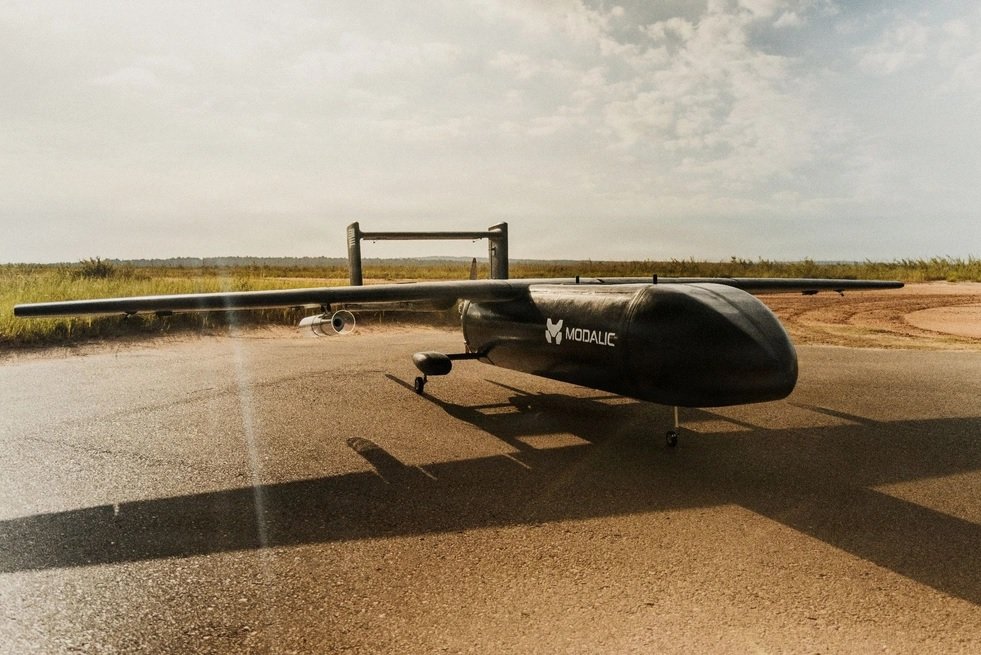
The Autonomous Swarm Mothership, developed by defense technology company Modalic, successfully launched a rack of smaller drones while in flight.
The Army tested whether soldiers and defensive networks could track the parent aircraft, distinguish it from the smaller “daughter” drones and identify the larger threat as multiple aerial contacts appeared on radar.
Modalic also presented its production version, called Chariot. Company co-founder and CEO Zack Fishbein said on September 16 that the aircraft weighs 200 pounds (91 kg) and can carry a payload of up to 100 pounds (45 kg). Flight testing of the Chariot is scheduled to begin in November.
Counter-Drone Network Tested
Scarlet Dragon 26-3 used coordinated drone swarms involving 25 to 100 aircraft to stress the Army’s counter-drone systems.
Rather than testing individual systems separately, soldiers evaluated how sensors, artificial intelligence, electronic warfare, autonomous systems, battle-management software and traditional air-defense weapons worked together against saturation attacks.
“The Scarlet Dragon exercise has become a validation exercise in the dirt with Soldiers doing integrated, real-world operational-type tasks,” said Col. Tom Monahan, director of the XVIII Airborne Corps’ Joint Innovation Outpost.
According to an XVIII Airborne Corps report published by the U.S. Department of War on September 21, the exercise focused on protecting command posts, logistics nodes, air-defense positions and maneuver forces from large numbers of small unmanned aircraft.
Col. Rob Kenny, the Corps’ chief of fires, said the testing showed that no single sensor can solve the counter-drone problem alone. Radar, acoustic detection, autonomous technologies and other sensors need to provide information to command-and-control systems that can rapidly distribute targeting data.
Other Technologies Tested
The exercise also evaluated a dual-mode air-ground light tactical vehicle built on an off-road utility terrain vehicle chassis. It was tested for its ability to transition between ground movement and flight without a runway or fixed infrastructure, with potential applications in reconnaissance, resupply and casualty evacuation.
At Holland Drop Zone, soldiers also launched coordinated swarms of small unmanned aircraft from a single location to test their ability to self-organize and fly in formation.
Scarlet Dragon is a recurring XVIII Airborne Corps exercise that brings soldiers and industry together to test emerging technologies. The September event was the third iteration in the current cycle, following exercises in December 2025 and earlier in 2026. An August event at the Joint Innovation Outpost brought more than 50 companies to evaluate counter-drone sensors.
The Army has not announced whether it will procure Modalic’s mothership or when any of the tested systems could enter service.
The XVIII Airborne Corps plans to continue testing the technologies during Scarlet Dragon 27-1 in April 2027, ahead of the larger Summit Strike exercise scheduled for September 2027 at Fort Drum, New York.
——— End of Article ———