Washington — The U.S. Army has selected five companies to build and operate nuclear microreactors at five U.S. military installations under the Janus Program, with up to $2.2 billion in combined funding. The program, announced August 26, is being conducted in partnership with the Department of War Innovation Unit and aims to move advanced nuclear technology from testing into sustained operation at military sites.
The contracts cover fiscal years 2027 through 2031 and use fixed-price, milestone-based Other Transaction Authority agreements. They cover design, construction and the first year of operations, with companies also expected to provide significant private investment. The Army's main target is to have at least one commercial microreactor producing usable electricity by September 30, 2028.
Five Companies and Initial Sites
The selected companies and installations are:
- Antares Nuclear, Inc. — Fort Bragg, North Carolina
- BWXT Advanced Technologies, LLC — Fort Campbell, Kentucky
- General Atomics Electromagnetic Systems — Fort Hood, Texas
- Radiant Industries, Inc. — Fort Benning, Georgia
- Westinghouse Government Services — Fort Drum, New York
The five sites were selected from nine finalists identified in November 2025. The installations not selected were Fort Wainwright, Alaska; Holston Army Ammunition Plant, Tennessee; Joint Base Lewis-McChord, Washington; and Redstone Arsenal, Alabama.
The Army expects that private investment combined with government funding could eventually support more than 20 microreactors across Department of War installations.
Reactor Plans
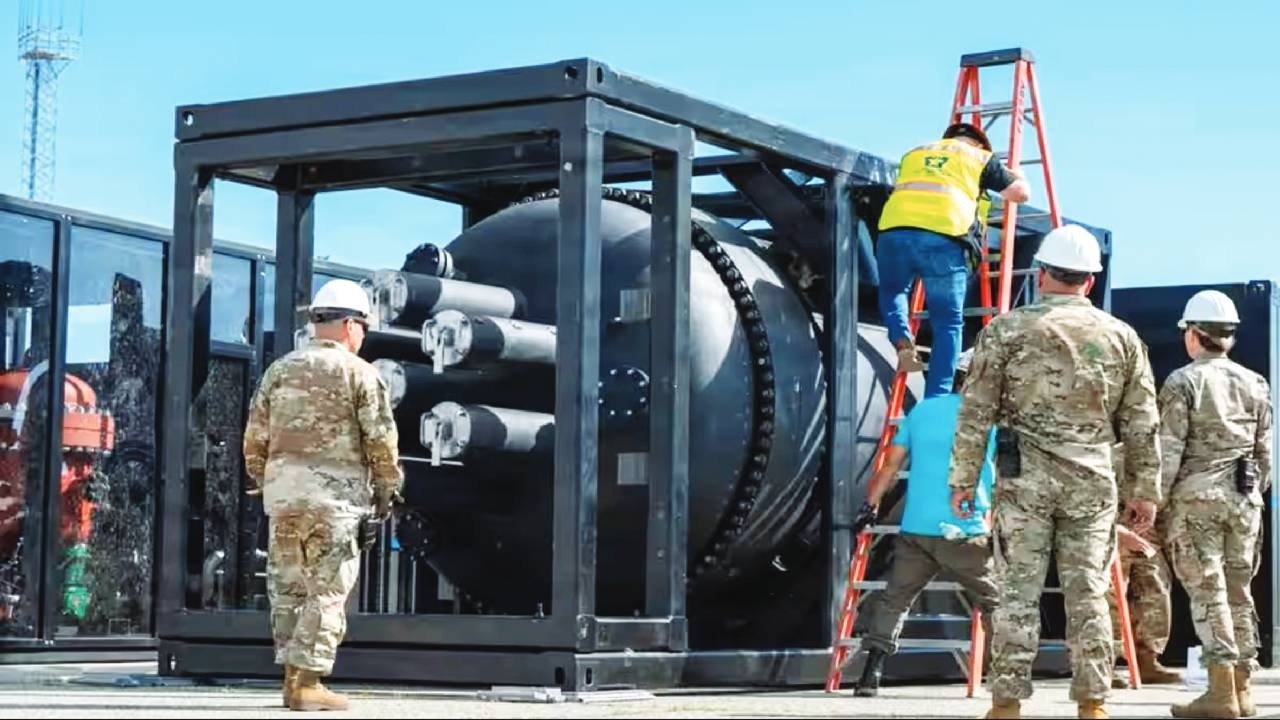
The planned systems will produce between 1 and 20 megawatts of electricity, depending on the design, and occupy less than five acres. They are intended to provide localized power for critical military infrastructure while remaining connected to existing commercial grids. They will not supply all of a major military installation's electricity.
Radiant Industries has disclosed the largest individual award, worth up to $750 million, for 15 factory-built 1-megawatt Kaleidos microreactors by 2030, beginning with three units at Fort Benning. The transportable reactor uses TRISO fuel and is designed for about five years of operation before refueling, with a 20-year operating life.
Westinghouse Government Services will provide its eVinci heat-pipe microreactor at Fort Drum. Westinghouse says the system can provide electricity for eight years without refueling and uses TRISO fuel with high-assay low-enriched uranium and passive heat-pipe cooling. The company recently completed a zero-power criticality test of the design at a National Nuclear Security Administration facility.
Antares Nuclear will deploy its R1 microreactor at Fort Bragg in three-unit groups. The sodium heat-pipe-cooled reactor uses TRISO fuel and is rated from 100 kilowatts to 1 megawatt per unit. Its related Mark-0 test reactor achieved criticality at Idaho National Laboratory in June 2026. Antares plans to generate electricity from a test unit in 2027 and begin military deployments in 2028.
BWXT Advanced Technologies will deploy a 20-megawatt-electric BANR reactor at Fort Campbell. The high-temperature gas-cooled reactor uses TRISO fuel and nitrogen coolant. Initial work includes site selection, Army regulatory processes and TRISO fuel fabrication. Construction is targeted for late 2028, with operations planned for the early 2030s.
General Atomics Electromagnetic Systems will develop, test and conduct site planning for its GA-TES at Fort Hood. The liquid-metal-cooled reactor has a baseline output of about 5 megawatts electric and can scale to about 20 megawatts. It uses uranium-zirconium hydride fuel, natural-circulation cooling, has a 40-year design life and is modular for transport by truck or rail.
Safety, Regulation and Waste
The reactors will be owned and operated by the contractors, not the Army. They will be regulated by the Army rather than the U.S. Nuclear Regulatory Commission, while following environmental and safety requirements applicable to commercial reactors. The Army is aligning its regulatory processes so companies can later seek NRC approval for civilian markets.
None of the reactors will use highly enriched, weapons-grade uranium. Several designs use 19.75% HALEU. Spent fuel will not be permanently stored at the installations, and the program requires nuclear waste and radiological materials to be removed from military sites within two years after a reactor shuts down. The Pentagon plans to develop a unified waste-management solution.
From Project Pele to Janus
Janus follows the Pentagon's earlier Project Pele, which focused on developing a portable reactor in the 1-to-5-megawatt range. Janus instead focuses on commercial reactor systems capable of providing long-duration baseload power at operational military installations.
Army officials have stressed that not all five companies are expected to have operating reactors by 2028. Dr. Jeff Waksman said the Army nevertheless believes there is a practical path to having at least one reactor producing usable electricity by September 30, 2028.
Army Secretary Dan Driscoll said the contracts are intended to provide safe and reliable baseload power for military installations and strengthen energy resilience. Jason Craft, Janus Program director, said the Army is leading efforts to expand nuclear capability through the program.
Waksman said the broader objective is to move from experimental designs to reliable commercial hardware that can operate for years and eventually serve non-military customers. The program is also intended to strengthen the domestic industrial base for advanced nuclear energy.
——— End of Article ———