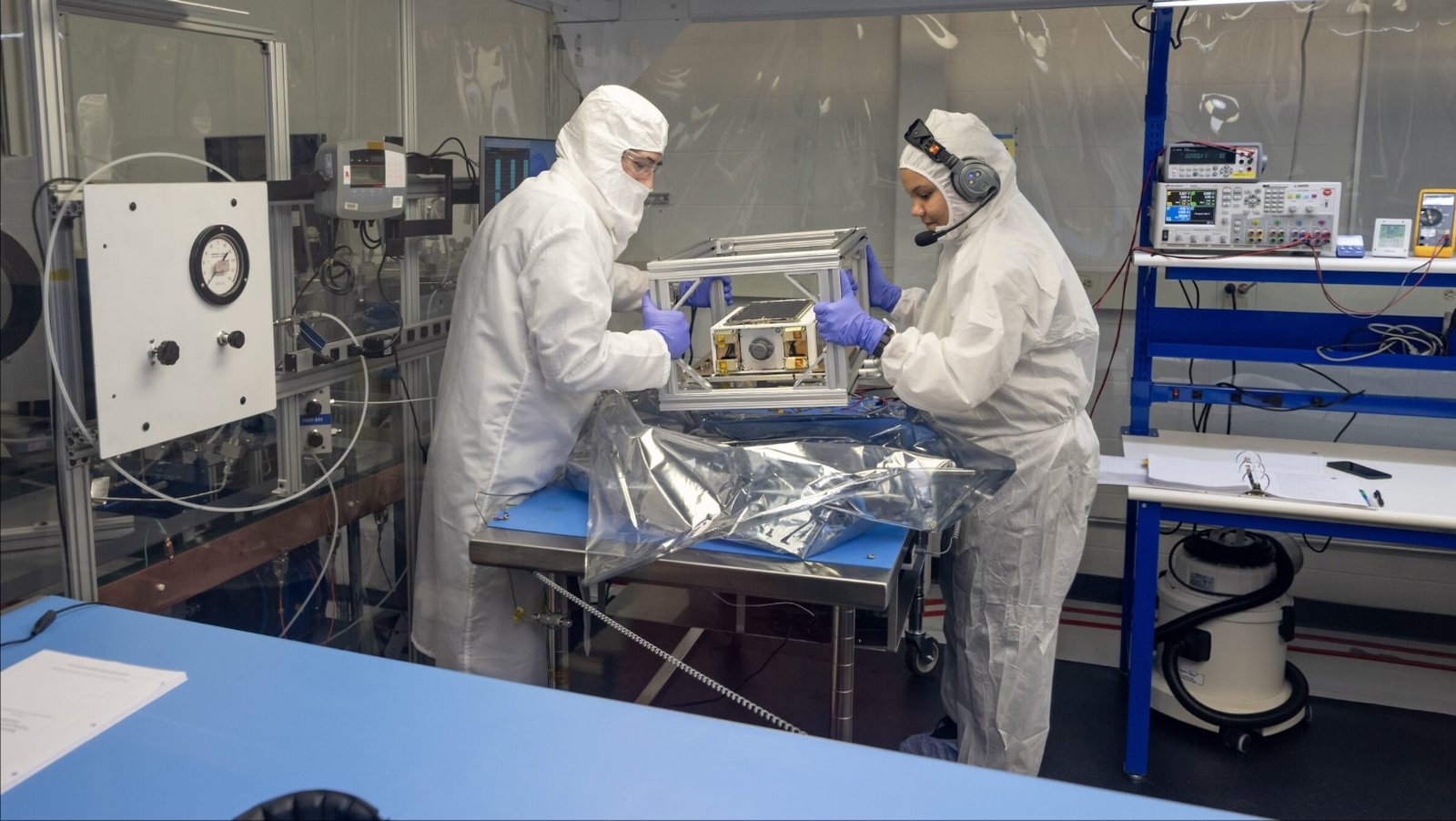
EDWARDS AIR FORCE BASE, Calif. — The U.S. Air Force Research Laboratory (AFRL) has demonstrated a spacecraft propulsion architecture that combines chemical and electric propulsion in a single system using a shared propellant tank and feed system.
The ground test was conducted under the Propulsion Optimization UNifying Chemical and Electric (POUNCE) program at AFRL’s Space Propulsion Environment Facility at Edwards Air Force Base, California. The demonstration validated the feasibility of Modular Multimode Propulsion (MMP).
MMP is designed to allow both high-thrust chemical thrusters and high-efficiency electric thrusters to operate from the same propellant supply. This can reduce the need for separate tanks, valves, regulators, feed lines and other hardware normally required when a spacecraft carries both propulsion types.
Chemical propulsion provides high thrust for rapid maneuvers, while electric propulsion offers much higher fuel efficiency but produces relatively low thrust. The combined system allows the propellant supply to be used for rapid maneuvers when necessary and for longer-duration, fuel-efficient orbital operations.
ASCENT propellant
The demonstration used Advanced Spacecraft Energetic Non-Toxic (ASCENT), previously designated AF-M315E. Developed by AFRL, ASCENT is a hydroxylammonium nitrate-based ionic liquid propellant that can be used as a chemical monopropellant and in electrospray electric propulsion.
AFRL states that ASCENT provides approximately 50 percent higher density specific impulse than hydrazine and has lower handling hazards. It is classified as Department of Transportation Class 1.3C, with Class 1.4 for shipping, allowing simpler ground handling than hydrazine.
ASCENT has previously flown on NASA’s Green Propellant Infusion Mission and Lunar Flashlight.
Commercial partners
Three companies supplied major components for the demonstration. Flight Works provided the composite conformal tank and propellant feed system, Igneon Aerospace supplied the chemical thrusters, and Revolution Space provided its PALOMINO ion-array electrospray thruster for electric propulsion.
The testing was performed in a high-vacuum facility simulating orbital conditions. AFRL evaluated whether the feed lines and valves could reliably switch between the chemical and electric propulsion systems under representative operating pressures.
The concept of combining high-thrust and low-thrust propulsion has been studied since the 1960s, but practical implementation has been limited by challenges involving propellant compatibility and shared feed systems.
The POUNCE architecture uses modular interfaces that can allow propulsion components to be exchanged or reconfigured without redesigning the spacecraft's core propulsion system. AFRL’s related Modular Propulsion (ModProp) effort uses the Propulsion Unit for Modular Applications (PUMA) approach with ASCENT and focuses on standardized interfaces for applications including sustained maneuvering, tactically responsive space, and space mobility and logistics.
Dr. Javier Urzay, chief of AFRL’s Rocket and Space Propulsion Division, said the objective is to accelerate the development of integrated propulsion capabilities for dynamic space operations.
AFRL and its industry partners will use data from the Edwards AFB testing to further refine the system as the technology progresses toward potential on-orbit flight testing.
——— End of Article ———