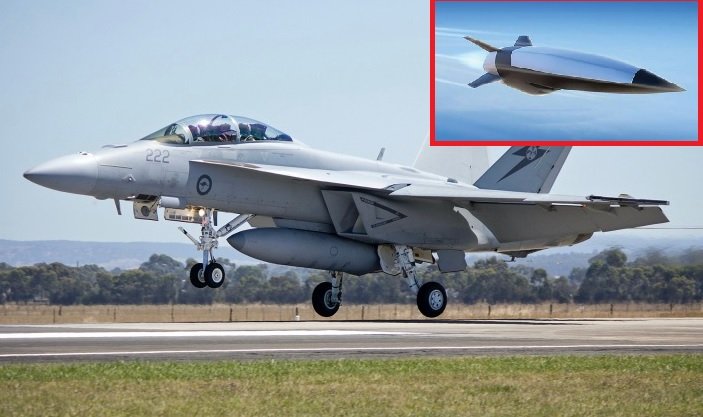
Australia — The U.S. Air Force, in cooperation with the Royal Australian Air Force (RAAF), has conducted the first flight test release of the Hypersonic Attack Cruise Missile (HACM) over a designated test range in Australia.
An Air Force spokesperson confirmed that a HACM flight-test unit was released by the RAAF to collect data under realistic flight conditions. The test is part of the Southern Cross Integrated Flight Research Experiment (SCIFiRE), a U.S.-Australia cooperative effort focused on developing high-precision hypersonic weapons using air-breathing propulsion.
The test was first reported by The War Zone on October 5, 2026.
Details of First Flight Test Remain Classified
The Air Force has not disclosed the exact date of the test or several important details about the flight.
Information that has not been released includes the aircraft used to release the test missile, whether the missile's scramjet engine successfully ignited after release, flight duration, speed, range and the total distance covered.
Some reports have identified the Woomera Test Range in South Australia as a likely location for the test, although the specific location of the release has not been officially confirmed in the information provided.
The Air Force also has not released performance results from the flight.
HACM Uses Rocket Booster and Scramjet Propulsion
HACM is an air-launched, air-breathing hypersonic cruise missile being developed with RTX, formerly Raytheon, as the prime contractor and Northrop Grumman responsible for the scramjet engine.
The weapon is designed to operate at speeds above Mach 5. Its propulsion system uses a solid rocket booster to accelerate the missile to the speed required for the scramjet engine to operate. After the booster phase, the scramjet is intended to sustain hypersonic flight.
The program builds on earlier U.S. hypersonic research, including the Defense Advanced Research Projects Agency's (DARPA) Hypersonic Air-breathing Weapon Concept (HAWC).
HACM is smaller than the Air Force's AGM-183 Air-Launched Rapid Response Weapon (ARRW) and is intended to be compatible with tactical aircraft rather than requiring a heavy bomber for launch.
The F-15E Strike Eagle has been identified as a U.S. launch platform for HACM, while the Australian side is using F/A-18F Super Hornets for testing.
U.S.-Australia SCIFiRE Cooperation
The flight test was conducted under the SCIFiRE program, which reflects more than 15 years of cooperation between the United States and Australia in advanced defense technology.
The two countries are working together on the development and testing of high-precision hypersonic weapons powered by ramjet or scramjet propulsion.
The recent release represents an important transition for HACM from earlier development activities to actual flight testing. However, the available information does not establish whether all planned flight objectives were achieved during the test.
Program Schedule Moves Toward 2027
HACM flight testing was originally expected to begin in 2024, but the schedule was delayed and subsequently moved into 2026 following design reviews and other program changes.
To support a rapid-fielding decision in fiscal year 2027, the Air Force reduced the planned rapid-prototyping flight-test program from seven flights to five.
A July 2026 assessment by the Government Accountability Office (GAO) reported that the program had essentially no remaining schedule margin.
The Air Force has requested about $1.2 billion in its fiscal year 2027 budget for HACM maturation and initial procurement. This includes approximately $404 million for the first operational production lot. Full-rate production is planned for fiscal year 2029.
Around 13 missiles are being produced in the current phase for testing, spares and potential early capability.
The latest flight test is therefore a key step in the remaining HACM test program. Further flight tests are expected as the United States and Australia continue evaluating the missile ahead of the planned rapid-fielding decision.
——— End of Article ———