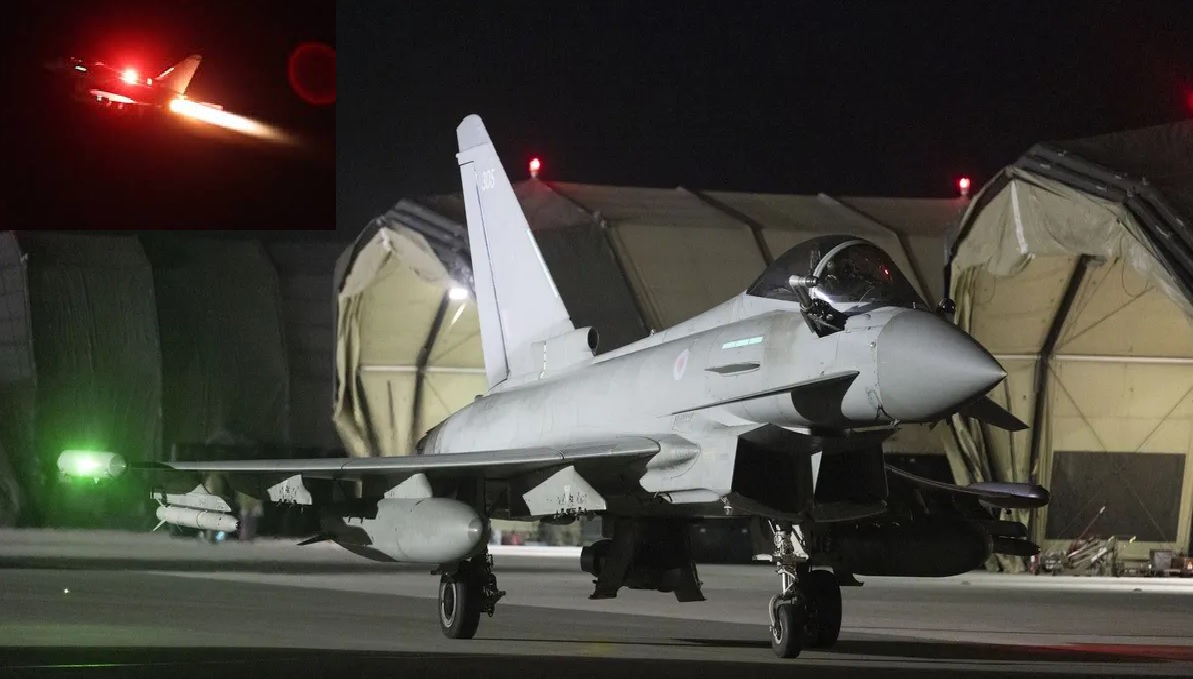
London / Damascus: Royal Air Force combat aircraft have carried out successful precision strikes against Daesh targets in Syria, reinforcing international efforts to prevent any resurgence of the terrorist organisation more than five years after its battlefield defeat. The operation, confirmed by the UK Ministry of Defence on 3 January, was conducted jointly with France and focused on dismantling a clandestine Daesh infrastructure site in central Syria.
According to the Ministry of Defence, the strikes followed intelligence-led surveillance patrols designed to monitor residual Daesh activity after the group’s territorial collapse at Baghuz Fawqani in March 2019, the last major stronghold held by the so-called Islamic State. UK and allied intelligence services assessed that Daesh cells continue to attempt to regroup, store weapons, and plan attacks in remote areas, particularly in desert and mountainous terrain.
Underground Daesh Site Identified Near Palmyra
Military analysis identified an underground facility in mountainous terrain north of Palmyra, an area historically exploited by extremist groups due to its isolation and rugged geography. The site was assessed to have been occupied by Daesh and likely used for storing weapons, explosives, and logistical supplies intended to support future attacks.
The Ministry of Defence stated that no civilian habitation was present in the surrounding area, significantly reducing the risk to non-combatants and enabling the operation to proceed in line with strict UK rules of engagement and international humanitarian law.
RAF Typhoons Conduct Precision Strike
On the evening of Saturday, 3 January, RAF Typhoon FGR4 multirole fighter aircraft, operating alongside French Air and Space Force assets, conducted the strike mission. The Typhoons were supported by an RAF Voyager aerial refuelling tanker, allowing extended time on station over Syria.
The aircraft engaged the target using Paveway IV precision-guided bombs, a weapon designed for high accuracy and reduced collateral damage. Initial post-strike assessments indicated that access tunnels leading into the underground facility were successfully struck, degrading the site’s operational utility.
“All aircraft returned safely to base,” the Ministry of Defence said, adding that there was no indication of civilian casualties or unintended damage.
UK Reaffirms Commitment to Counter-Terror Operations
UK Defence Secretary John Healey MP said the operation demonstrated Britain’s continued leadership in international counter-terrorism efforts.
“This action shows our UK leadership, and determination to stand shoulder to shoulder with our allies, to stamp out any resurgence of Daesh and their dangerous and violent ideologies in the Middle East,” Healey said.
“I want to thank all the members of our Armed Forces involved in this operation – for their professionalism and their courage.”
Operations Continue Over Holiday Period
Healey noted that those involved in the Syria mission were among thousands of British service personnel deployed worldwide over the Christmas and New Year period, underscoring the Armed Forces’ year-round operational readiness. He said the strike illustrated how UK forces remain prepared at short notice to counter threats that could ultimately impact British and allied security.
The operation forms part of the UK’s ongoing contribution to international efforts to prevent Daesh from rebuilding operational networks, particularly in regions where instability and geography provide opportunities for extremist groups to hide and reorganise.
Preventing a Daesh Resurgence
Although Daesh lost its territorial “caliphate” in 2019, Western defence officials have repeatedly warned that the group retains the intent and capability to conduct insurgent and terrorist activities. Coalition air operations, intelligence surveillance, and partner-nation cooperation remain central to ensuring the group cannot re-establish safe havens.
The Ministry of Defence emphasised that the 3 January strike was a measured, intelligence-driven action, aimed at disrupting Daesh’s ability to threaten regional stability and international security, while maintaining the highest standards of civilian protection.
——— End of Article ———