LONDON — The British Army has deployed its first passive counter-uncrewed aerial system (C-UAS) detection capability at Warminster Garrison under Project Halo Shield, a programme that moved from concept to operational deployment in less than six months.
The project was funded by UK Defence Innovation (UKDI) on behalf of Army Innovation and was initiated and led by the British Army’s Experimentation and Trials Group (ETG). The deployment combines radio-frequency (RF) and optical detection technologies supplied by Dedrone, now part of US-based Axon, and Edinburgh-based Quell.
Layered Passive Detection
Dedrone supplied the command-and-control software, which combines information from multiple sensors into a single operational picture. Three RF sensors are used to triangulate the position of drones across the garrison, while a fourth RF sensor identifies the aircraft and its controller by detecting the signals exchanged between them.
The system is passive, meaning its sensors do not transmit signals that could reveal their presence. This allows the Army to detect and track drones without using an active radar-like transmission.
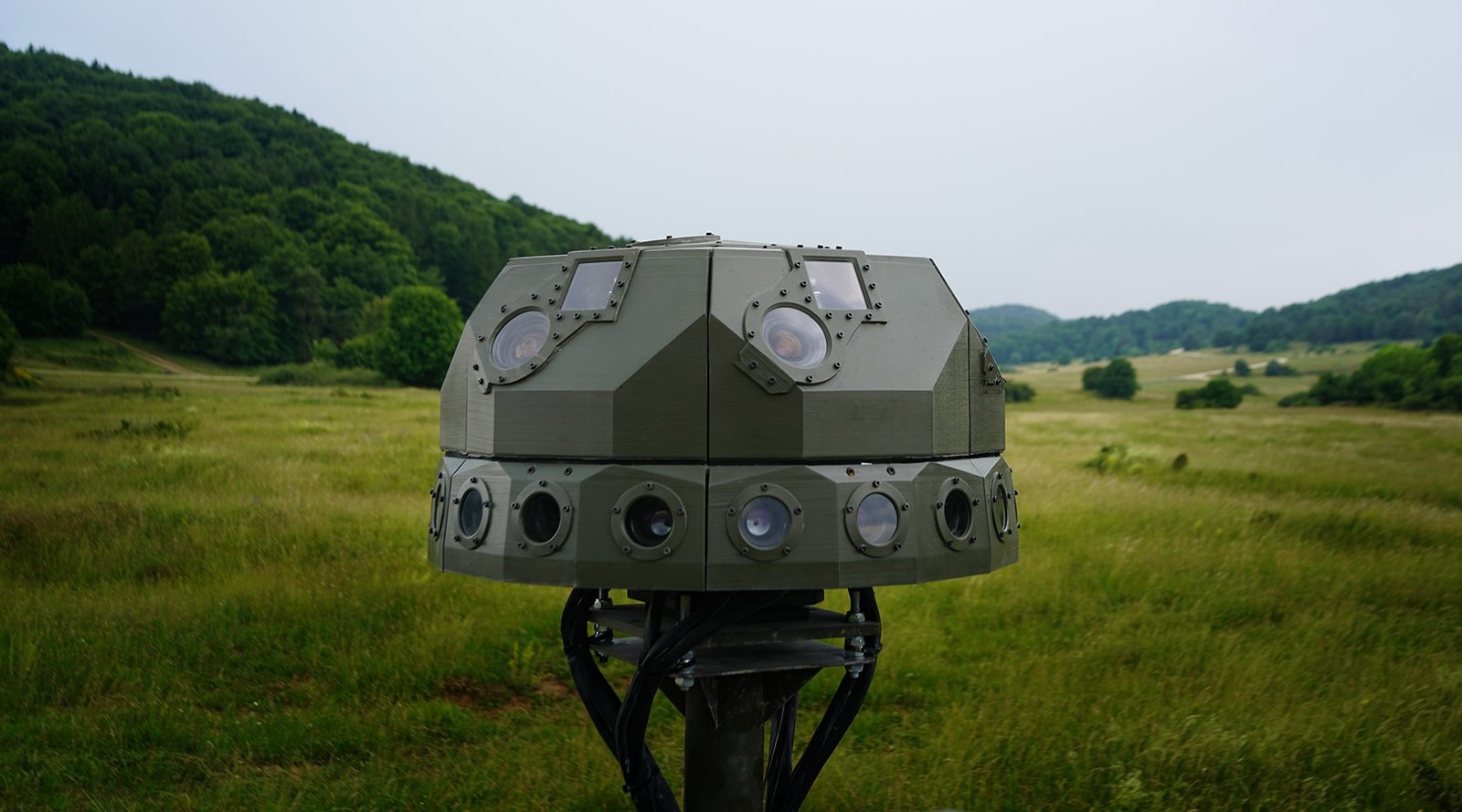
Quell provides the second layer through its SkySpyke optical detection system. The autonomous system provides hemispheric sky coverage and can detect, track and identify airborne objects. Its artificial-intelligence software filters detections and provides alerts and visual confirmation of objects of interest, reducing the workload for operators.
29 Drone Alerts During Initial Monitoring
During its first 17 days of live monitoring, the system recorded 29 drone position alerts, with detections reaching distances of up to 5 kilometres (3.1 miles). The British Army said none of the detected drones presented a threat to the base.
The Army also flew its own drones around the installation to test the system and identify potential gaps or weaknesses in coverage.
The rapid deployment was supported by earlier work between the ETG and both suppliers during field demonstrations and counter-drone exercises, including Project Vanaheim and Project Flytrap. According to UKDI, this earlier testing helped establish the basis for the Warminster deployment.
Detection-Only Capability for Now
Project Halo Shield is currently focused on detection rather than defeating drones. The system does not currently include effectors capable of neutralising an aircraft. According to the Army, effectors are prepared for possible future integration if policy and permissions allow.
The current architecture is therefore designed to give commanders a clearer picture of nearby airspace using passive RF and optical sensors.
Colonel James Howard of the Experimentation and Trials Group said the project is helping improve protection at Army barracks while also supporting training. The system can be used to provide an “enemy forces” environment for Army drone pilots, allowing them to train against a detection capability.
Possible Expansion to Other Army Sites
The results from Warminster are being used to inform the Army's approach to wider passive drone detection. Future phases could add radar and acoustic sensors alongside the existing RF and optical systems at other garrisons.
The planned combination would create a more layered detection architecture, with different sensor types providing complementary information about activity in the airspace.
UKDI said Project Halo Shield has provided a foundation for considering wider deployment of passive C-UAS capabilities across UK military sites.
——— End of Article ———