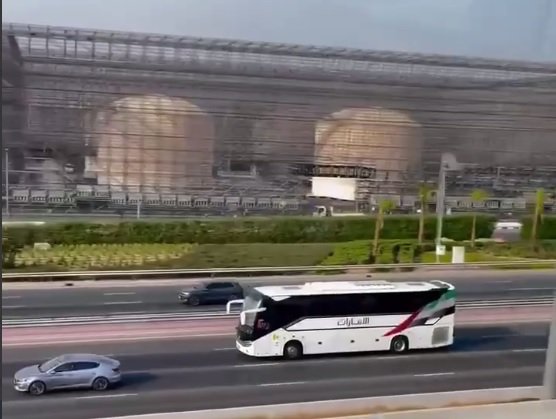
DUBAI, UAE — The United Arab Emirates has completed the installation of large steel-and-mesh protective structures over critical fuel storage tanks near Dubai International Airport (DXB), adding a passive defense layer against one-way attack drones.
According to satellite imagery and footage published by OSINT researcher Egypt’s Intel Observer, construction at the Dubai fuel farm at 25°14'05.70"N, 55°23'10.49"E began in May 2026 and was largely completed by August 20. Similar structures have also been installed around strategic infrastructure in Abu Dhabi.
The work follows a March 16, 2026 drone strike in which an Iranian one-way attack drone hit one of the approximately 10 fuel tanks at the Dubai airport fuel farm, located between Terminal A and the VIP Royal Air Wing terminal. The strike caused a major fire and a large smoke plume, temporarily disrupted airport operations and led to some flights being diverted to Al Maktoum International Airport. Civil Defence teams contained the fire, and no injuries were reported.
Massive anti-drone frameworks have been erected over oil storage tanks in Abu Dhabi, UAE, after strikes by Iranian Shahed-136 kamikaze drones. pic.twitter.com/q0umDUcTZv
— The Defense News (@TheDefenseNews) August 23, 2026
Large-Scale Protective Framework
Unlike protective metal structures commonly placed around individual tanks, the UAE has constructed a large steel framework over the entire tank farm at the Dubai site. The framework uses heavy steel structures and mesh positioned above and around the tanks.
The design creates greater distance between an incoming drone and the fuel tanks. If a one-way attack drone detonates against the mesh or before reaching the tank, the additional separation can reduce the effect of its explosive payload. The arrangement is particularly intended to provide protection against drones such as the Iranian Shahed-136.
The structures are a passive layer and are not designed to stop ballistic or cruise missiles. They provide an additional barrier when active air-defense systems are dealing with repeated or large numbers of incoming drones.
Wider UAE Air-Defense Measures
The new structures come amid continued attacks on UAE infrastructure during the conflict that began in February 2026. According to UAE Ministry of Defence figures, its air-defense forces have engaged 2,265 drones, 551 ballistic missiles and 29 cruise missiles launched by Iran.
Energy infrastructure, including facilities at the Port of Fujairah and the Habshan natural gas facility, has also faced attacks. The March 16 strike near Dubai International Airport highlighted the vulnerability of fixed fuel storage to one-way attack drones.
The completed steel-and-mesh structures at Dubai and Abu Dhabi therefore provide a physical, passive layer of protection for critical fuel infrastructure alongside the UAE's existing active air-defense systems.
——— End of Article ———