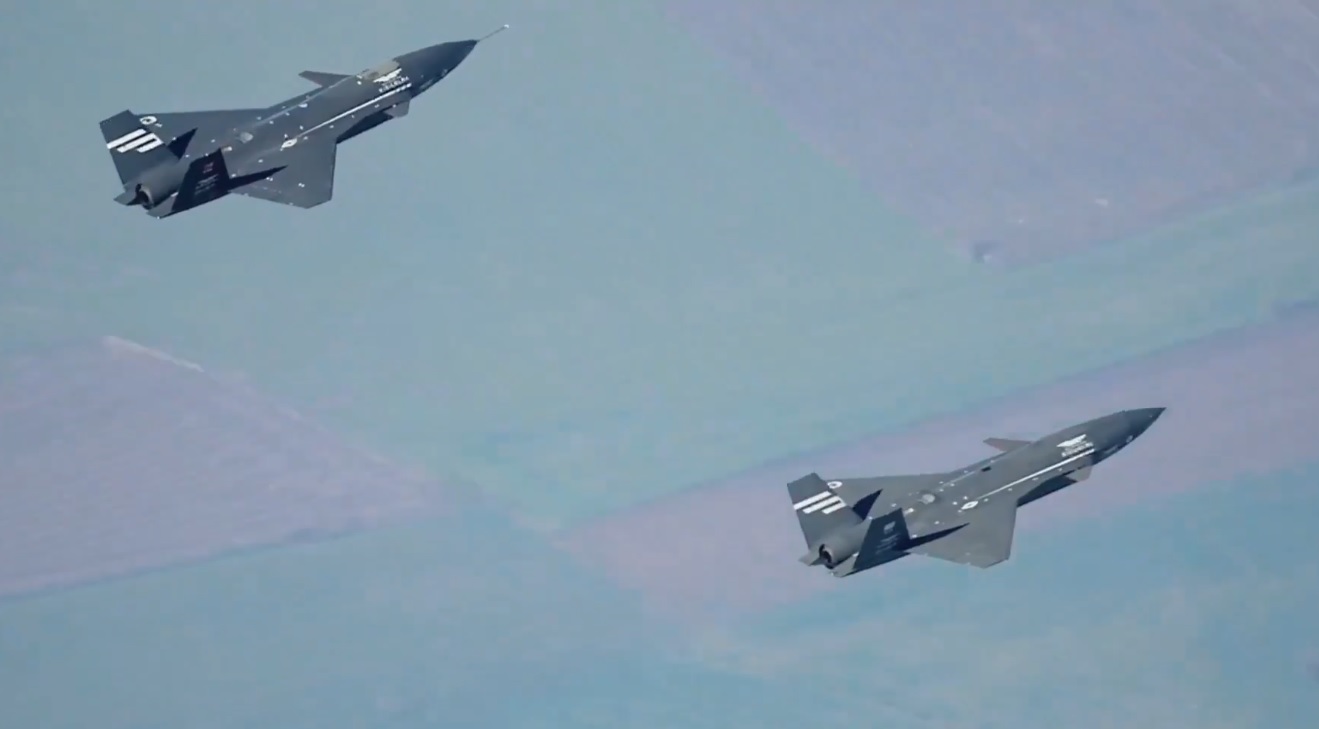
Turkey has reached a historic milestone in military aviation after two KIZILELMA unmanned fighter jets successfully carried out the world’s first fully autonomous close formation flight using artificial intelligence alone, without pilots or remote human control. The breakthrough was announced by Baykar on December 28, 2025, marking a decisive step toward a future of AI-driven air combat.
According to Baykar, the two jet-powered aircraft flew in tight, coordinated formation, continuously adjusting position, speed, and altitude in real time through onboard AI algorithms, advanced sensors, and encrypted data sharing. At no point was human input required, distinguishing the flight from existing remotely piloted or semi-autonomous drone operations. Defense experts describe the achievement as a turning point that elevates Turkey into a select group of nations shaping the next era of aerial warfare.
A Global First in Autonomous Combat Aviation
The aircraft involved were Bayraktar KIZILELMA platforms—armed, combat-capable unmanned fighter jets, not experimental drones. Close formation flying is among the most demanding tasks in military aviation, traditionally requiring years of pilot training and constant human judgment. Successfully executing such maneuvers using AI alone demonstrates a level of autonomy not yet publicly shown by any other defense manufacturer worldwide.
Analysts note that no Western or Eastern aerospace firm has confirmed or released evidence of two fully autonomous, jet-powered unmanned fighters performing close formation flight without pilot oversight. The demonstration therefore sets a new global benchmark for autonomous decision-making in high-risk aerial environments.
What Makes KIZILELMA a Game-Changer
KIZILELMA is designed as a low-observable, high-performance unmanned fighter aircraft, capable of operating from short-runway aircraft carriers as well as land bases. The platform integrates advanced radar, sensor fusion, and AI-enabled mission systems, allowing it to conduct air-to-air and strike missions in contested environments. Baykar has indicated that future variants are expected to achieve supersonic performance, further expanding its combat role.
The ability of two KIZILELMA jets to fly autonomously in formation is a critical step toward swarm warfare, cooperative dogfighting, and manned–unmanned teaming, where multiple aircraft operate as a single, adaptive combat network.
Ahead of Major Powers
The announcement places Turkey visibly ahead in public demonstrations of autonomous fighter capabilities. While the United States continues to develop programs such as Skyborg and the Navy’s Collaborative Combat Aircraft, and China’s loyal wingman projects remain largely classified, none have yet confirmed an AI-only formation flight between armed unmanned fighter jets.
Baykar’s demonstration suggests that Turkey’s indigenous AI and autonomy technologies have moved beyond theory and controlled testing into operationally relevant performance.
Path to Service and Future Tests
As of late 2025, the KIZILELMA program is in its advanced flight-test phase, with serial production expected to begin in 2026. The aircraft is projected to enter service with the Turkish Air Force and Turkish Navy within the next 12 to 18 months. Baykar has also confirmed plans for further demonstrations in 2026, including beyond-visual-range combat simulations, swarm coordination, and joint operations with manned fighter aircraft.
Redefining the Future of Dogfighting
Military strategists say the successful AI-only formation flight challenges long-standing assumptions about the role of human pilots in air combat. With artificial intelligence now capable of executing precision maneuvers once reserved for elite aviators, the balance of air power is increasingly shifting toward algorithms, autonomy, and data dominance.
The KIZILELMA formation flight signals more than a technological success—it marks the arrival of a new chapter in warfare, where the future of dogfighting is not just unmanned, but autonomous.
——— End of Article ———