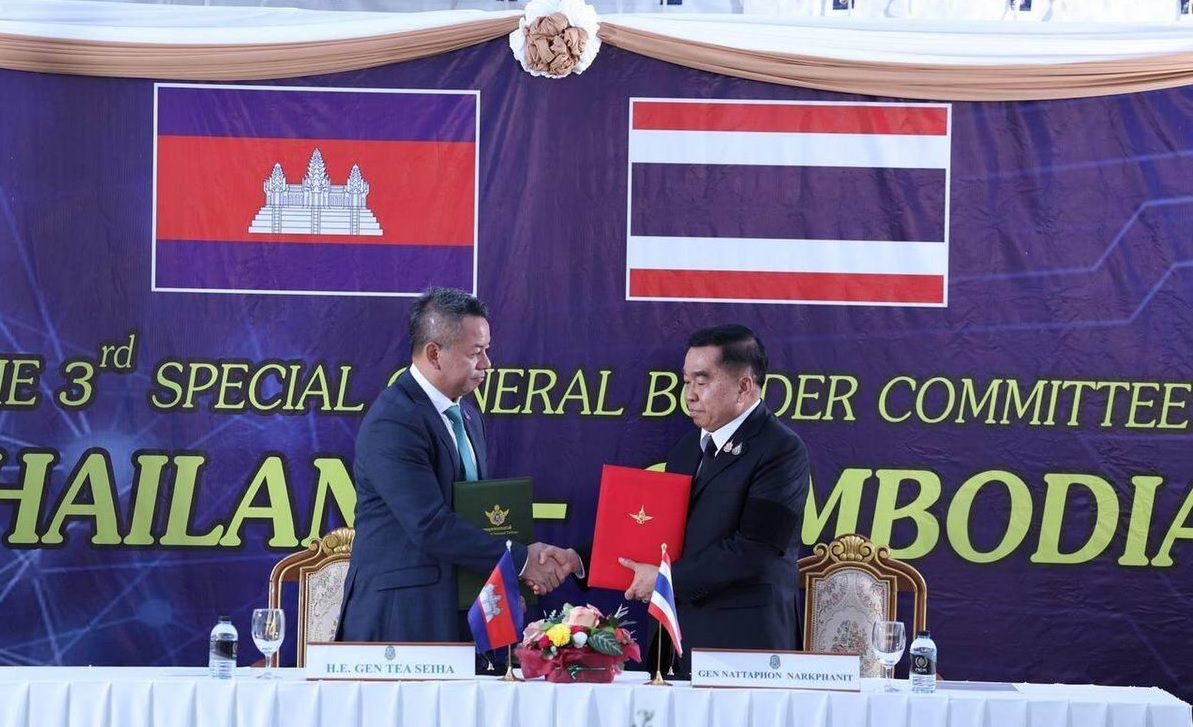
Thailand and Cambodia have signed a ceasefire agreement aimed at halting intense fighting along their disputed border, committing both sides to freeze troop positions, enable the return of displaced civilians, and undertake confidence-building measures to stabilise the situation, according to official statements released on Saturday.
Cambodia’s defence ministry confirmed the ceasefire, while a joint statement said both governments agreed to “maintain current troop deployments without further movement” in sensitive border areas. The agreement also provides for the safe return of civilians forced to flee their homes during recent clashes.
A key provision of the deal states that Thailand will return 18 Cambodian soldiers currently in its custody if the ceasefire holds for 72 hours, a step described by officials as an initial confidence test of the truce.
Ceasefire After Weeks of Deadly Clashes
The agreement comes after weeks of renewed fighting that has raised regional alarm and triggered international diplomatic engagement. The latest round of violence is part of a decades-old border dispute, rooted in colonial-era demarcation and competing territorial claims near ancient temple complexes.
According to official counts cited by AFP, the renewed clashes this month killed more than 40 people and displaced close to one million civilians, creating one of the most serious humanitarian crises between the two neighbours in years.
Fighting intensified on December 8–9, after a July ceasefire collapsed. During this phase, Thailand carried out air and artillery strikes, while Cambodia responded with rocket fire. The exchanges continued even as peace talks were under way, with Phnom Penh accusing Bangkok of launching fresh air strikes during negotiations, an allegation Thailand rejected, saying its actions were defensive and necessary for security.
What The Ceasefire Covers — And What It Does Not
Under the terms reported by Reuters, the immediate focus of the ceasefire is on preventing further escalation by locking military units into their current positions and reducing the humanitarian fallout of the fighting.
The return of displaced civilians is intended to reverse mass movements triggered by shelling, air operations and artillery duels, while the conditional release of detained soldiers is designed to signal restraint on both sides.
However, neither government has publicly detailed monitoring mechanisms, third-party verification arrangements, or timelines beyond the initial 72-hour confidence period, leaving questions about how violations would be addressed if fighting resumes.
Where The Clashes Are Concentrated
The violence has been concentrated along disputed stretches of the Thailand–Cambodia border, particularly near the Dangrek mountain range, which runs along northeast Thailand and northern Cambodia. The region contains several ancient Khmer temples, and its strategic high ground has long been contested.
These areas have seen heavy troop deployments, artillery exchanges, and air operations during the latest escalation, raising fears of a wider conflict if restraint fails.
A Dispute Shaped By History And International Rulings
The border dispute dates back to the early 20th century, when boundaries were drawn during French colonial rule in Cambodia. Thailand has long argued that some colonial-era maps inaccurately defined the frontier.
A central flashpoint remains the Preah Vihear Temple. In 1962, the International Court of Justice ruled that the temple itself belongs to Cambodia. A 2013 clarification reaffirmed Cambodian sovereignty over areas immediately surrounding the site but did not fully resolve broader border claims, leaving room for recurring disputes.
Symbolism, Statues And Rising Political Tension
Tensions have also been inflamed by symbolic actions. Thailand recently defended the demolition of a Lord Vishnu statue in the disputed An Ses area of Cambodia’s Preah Vihear province, calling it a security measure. Cambodia countered that the site lies within its territory.
Videos verified by AFP showed the statue—built in 2014 and located roughly 100 metres from the frontier—being removed using heavy machinery. The incident drew regional criticism and added to diplomatic friction amid ongoing clashes.
International Pressure And Fragile Calm
The violence has drawn attention from global and regional actors. The United States has backed diplomatic efforts to restore calm, while members of ASEAN have urged both sides to return to dialogue.
During the December escalation, US President Donald Trump said he had spoken to leaders in Bangkok and Phnom Penh, claiming they had agreed to halt fighting—though clashes were later reported, underscoring the fragility of earlier commitments.
Thailand’s caretaker Prime Minister Anutin Charnvirakul said military operations would continue until threats to Thai territory and civilians cease, accusing Cambodian forces of violating previous understandings. Cambodian Prime Minister Hun Manet has reiterated Phnom Penh’s support for a ceasefire and dialogue, while accusing Thailand of escalating military action.
A Cautious Pause, Not a Settlement
While the ceasefire offers a temporary pause in hostilities, analysts say it falls short of a political settlement of the underlying dispute. With no detailed monitoring framework and deep-rooted historical grievances unresolved, the coming 72-hour period is seen as a critical test of whether the truce can hold—or whether the border could once again slide back into violence.
——— End of Article ———