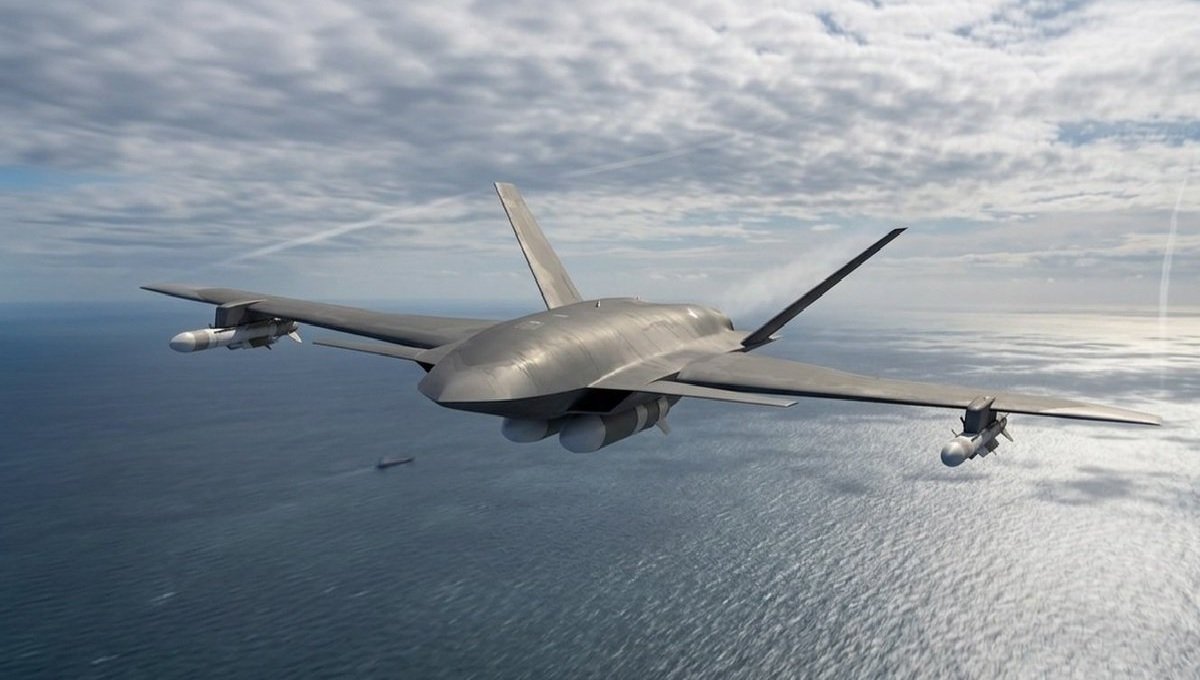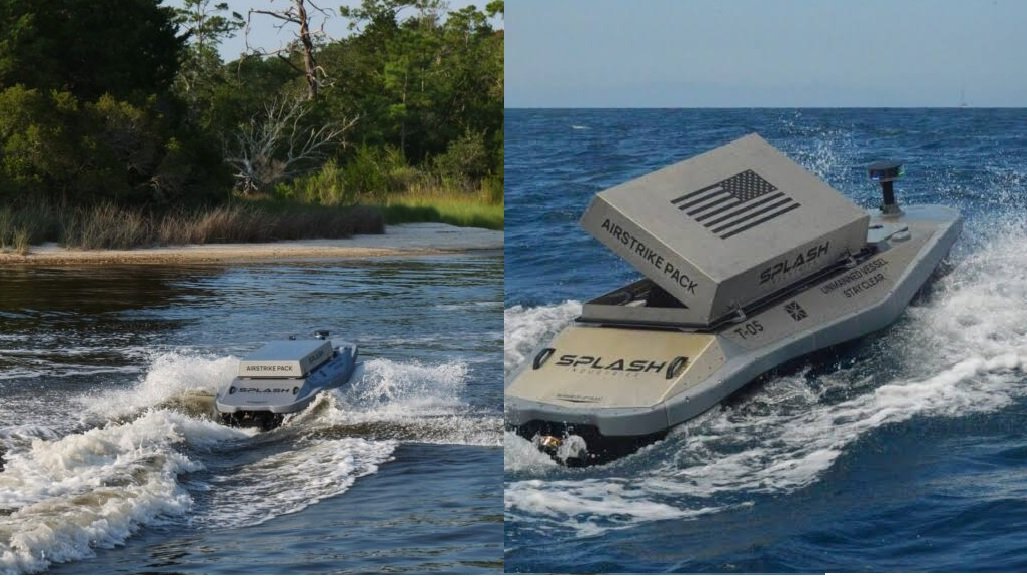
INGLEWOOD, Calif., — Splash Industries has introduced a new mission module for its Typhoon uncrewed surface vessel (USV) that allows operators to launch one-way aerial drones directly from the water.
Called the Airstrike Pack, the module is designed to let operators deploy aerial assets with a single button press through the company’s proprietary command-and-control software, Splash C2. Splash Industries said the system has already been tested during a recent force-on-force exercise.
The company said its vertically integrated approach, including in-house development of software and electronics, has helped keep the system rugged, easy to use and relatively low cost. Splash said the UAV deployment capability is available at about one-tenth the price of its nearest competitor.
Typhoon USV capabilities
The Typhoon is an 11-foot uncrewed surface vessel developed by Splash Industries for national security missions, including maritime surveillance and cargo delivery.
According to the company, the vessel has a sustained speed of more than 50 knots and has exceeded 70 knots during testing. It has an operational range of more than 600 nautical miles (1,111 km) and uses a modular deck that can be configured for different payloads, including cargo and sensors.
Splash Industries says the Typhoon can be assembled in about eight hours and is priced at approximately one-tenth the cost of comparable platforms. The company develops its software, electronics and sensors in-house.
The Airstrike Pack adds another mission option to the Typhoon by allowing the USV to deploy one-way aerial drones from the surface.
Autonomous Navy resupply demonstration
The announcement follows a major milestone for Splash Industries during the Rim of the Pacific (RIMPAC) exercise near Hawaii in July 2026.
During the exercise, a Typhoon USV completed what Splash Industries described as the world’s first fully autonomous underway resupply of a U.S. Navy warship. The vessel autonomously navigated open water, approached the amphibious assault ship USS Essex (LHD 2) and guided itself into the ship’s flooded well deck.
Splash said the operation was completed without satellite or radio commands. The demonstration was overseen by the Naval Postgraduate School’s Consortium for Advanced Manufacturing Research and Education (CAMRE).
During the same 24-hour period, the Typhoon also delivered uncrewed aerial system components manufactured aboard the USS Essex by U.S. Marine Corps personnel back to shore, according to information provided by the consortium.
Funding and larger USV development
Splash Industries officially emerged from stealth in July 2026 after announcing a $4.2 million seed funding round led by Ubiquity Ventures.
The company said its autonomous vessels had already completed more than 10,000 nautical miles (18,520 km) of deployments across three continents.
Splash co-founder and CEO Ivan Avanesov has also said the company is developing a larger uncrewed vessel called Tempest, which is being prepared for U.S. Navy testing.
The Tempest is expected to have a payload capacity of 1,500 pounds (680 kg) and an operational range of 300 nautical miles (556 km).
With the introduction of the Airstrike Pack, Splash Industries is expanding the Typhoon’s mission configuration beyond surveillance and cargo delivery to include the deployment of one-way aerial drones from an uncrewed surface vessel.
——— End of Article ———