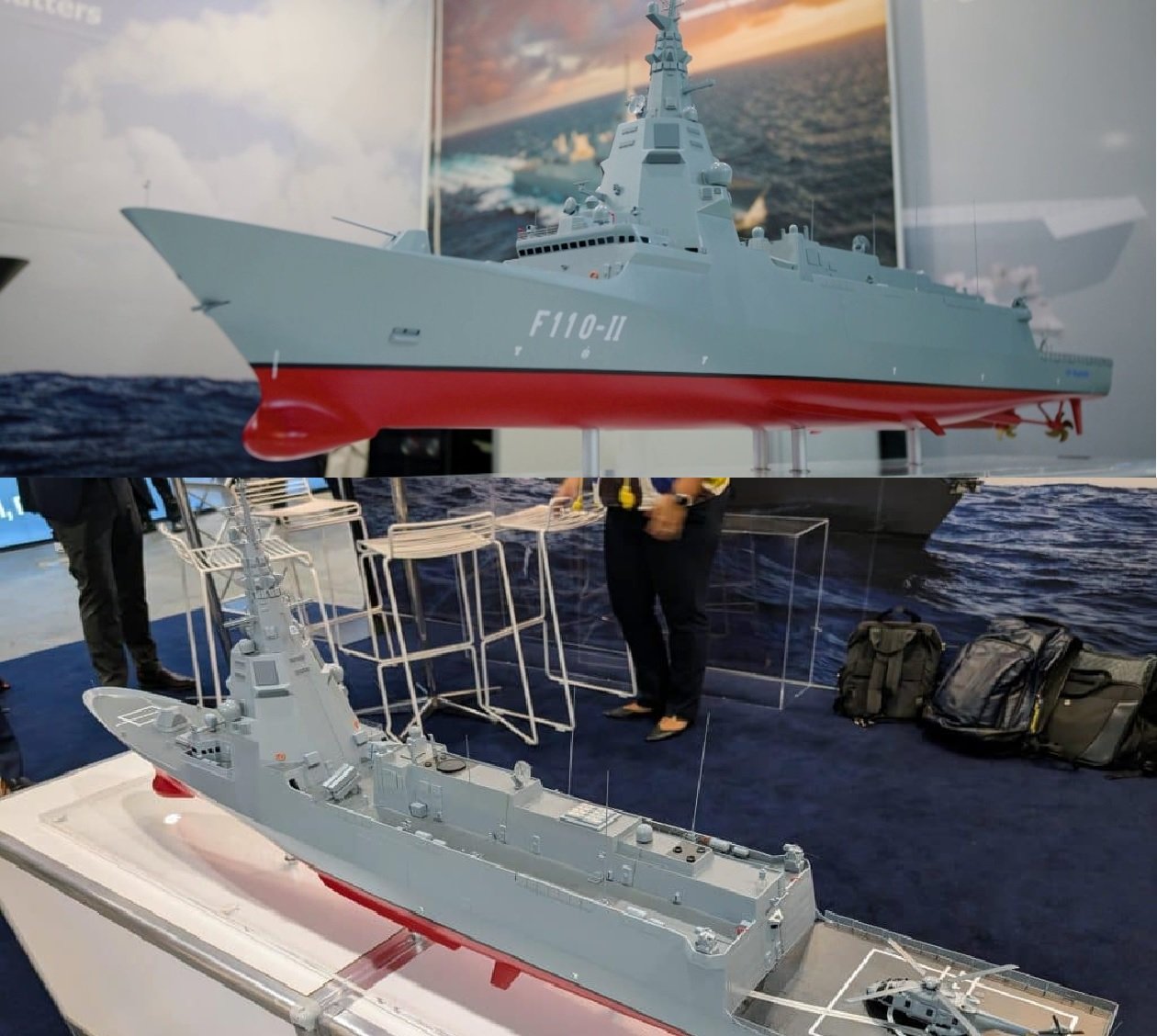
MADRID, SPAIN — The Spanish Navy and state-owned shipbuilder Navantia are developing an enhanced version of the F110 Bonifaz-class frigate, known as the F110 Integrated Air and Missile Defence (IAMD) variant, to strengthen Spain’s naval air and missile defence capabilities.
The project follows the Spanish Navy’s Armada 2050 strategic requirements and builds on the five baseline F110 frigates currently under construction. Navantia displayed a scale model of the proposed F110 Flight II/IAMD configuration at DALO Industry Days 2026 in Denmark.
Larger Design and Increased Missile Capacity
The proposed frigate will measure approximately 150 metres long, with a beam of around 18.6 metres and a displacement of approximately 6,700 tonnes, compared with 145 metres and 6,100 tonnes for the baseline F110. Earlier design information indicates a crew of around 170, a maximum speed exceeding 29 knots and a cruising speed above 18 knots, supported by more powerful gas turbines.
Its 64 Mk 41 Vertical Launch System (VLS) cells, compared with 16 on the baseline F110, will be arranged in forward and aft groups to accommodate different missile types, including longer-range surface-to-air missiles. An enhanced Lockheed Martin SPY-7 solid-state radar will support the detection, tracking and engagement of multiple threats, including ballistic missiles, cruise missiles and uncrewed aerial systems.
The frigate is designed for area air defence, escorting high-value assets and coordinating air defence within naval task groups.
Advanced Combat Systems and Multi-Mission Capabilities
The F110 IAMD will use SCOMBA New Generation (NG), Navantia’s next-generation combat management system. Its cloud-based architecture will integrate sensors, weapons, onboard systems, data links and uncrewed vehicles (UxVs), providing a shared tactical picture and supporting interoperability with NATO and European Union task groups. Its open, scalable and cyber-secure design will allow the integration of future sensors, weapons and countermeasures.
The frigate will retain the F110 family’s anti-submarine warfare (ASW), anti-surface warfare (ASuW) and electronic warfare capabilities, alongside asymmetric-threat protection. Its mission space will accommodate mission modules, uncrewed vehicles and a second helicopter.
Navantia’s Smart Ship technologies will include a Digital Twin, condition-based maintenance and an integrated platform management system to monitor ship condition, anticipate maintenance needs, improve operational availability and support crew training. Earlier design information also identified onboard 3D printing for producing spare parts during deployments.
Industrial Impact and Programme Status
The programme is expected to involve more than 500 Spanish companies, technology centres and academic institutions, supporting domestic shipbuilding capabilities and Spain’s strategic autonomy.
Earlier public presentations indicated plans for two F110 Flight II/IAMD frigates in addition to the five baseline ships. Their final configuration is being refined by Navantia, the Spanish Navy and the Ministry of Defence according to operational requirements and the procurement process.
Construction of the first five F110 frigates continues at Navantia’s Ferrol shipyard. The lead ship, Bonifaz (F111), was launched in September 2025 and is undergoing fitting out, with delivery planned for 2028. The remaining ships are at different stages of construction.
The F110 IAMD programme will extend the existing frigate family with stronger air and missile defence capabilities while retaining its multi-mission role.
——— End of Article ———