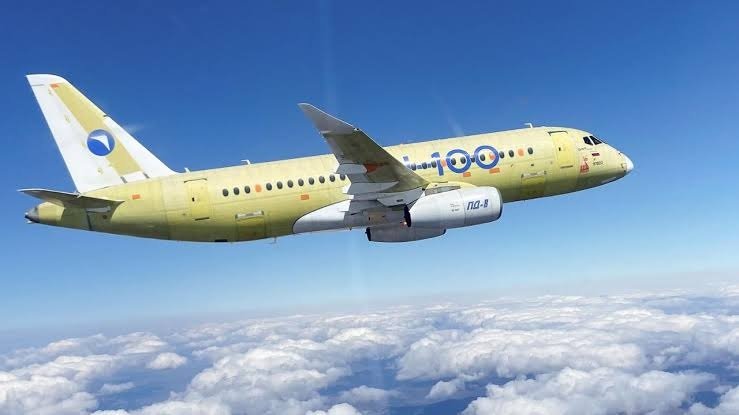
MOSCOW, — Russia’s state-owned Rostec corporation has announced that the integrated flight control system developed for the SJ-100 Superjet has completed a three-year qualification programme involving approximately 1,500 tests, bringing the system closer to certification.
Developed by enterprises of the Radio-Electronic Technologies Concern (KRET), the system transmits pilot commands to the aircraft’s flight control surfaces and actuators. Development is led by the Moscow Institute of Electromechanics and Automation (MIEA), which coordinates work across multiple factories and research institutes.
Extensive Testing and Safety Features
The qualification programme covered approximately 500 components and systems across more than 30 categories of external impacts. Testing assessed resistance to vibration, humidity, icing, electromagnetic interference, voltage surges, salt fog, sand, dust, fire, water, magnetic fields, radio-frequency interference and contaminating fluids. Engineers also verified strength, service-life characteristics, and hardware and software compliance.
Lightning-protection tests subjected the equipment to voltage pulses of up to 1,500 volts, approximately 55 times the normal onboard electrical system voltage, to assess its ability to withstand short-duration electrical disturbances.
Thermal testing exposed the hardware to temperatures ranging from −55°C to +85°C, beyond its specified operating range of −40°C to +70°C. The programme also included assessments under simulated fire conditions.
The system features four-channel redundancy, including four distinct rudder-control channels with dissimilar designs. This architecture is intended to maintain aircraft controllability if individual components or channels fail. Rostec states that the system is designed to meet a maximum failure probability of one in a billion (10⁻⁹).
KRET Chief Executive Alexander Pan said Russian enterprises had produced the system entirely, from design drawings to serial production samples, and that its performance was comparable to foreign equivalents.
SJ-100 chief designer Kirill Kuznetsov described the integrated control system as one of the aircraft’s key systems, with particularly high reliability requirements. According to Rostec, the test results confirm that the system meets safety requirements and is ready for use on the aircraft.
Part of Russia’s Import-Substitution Programme
The development is part of Russia’s broader effort to replace foreign aerospace components with domestically produced alternatives following Western sanctions. KRET is manufacturing approximately 650 components across 11 enterprises for the Superjet programme, including avionics, control panels, lighting systems, hydraulic and fuel-system sensors, warning devices and flight-data recording equipment.
More than 40 categories of foreign components have been replaced with Russian-made alternatives for the SJ-100. The aircraft is also transitioning to domestically produced PD-8 turbofan engines, developed by the United Engine Corporation (UEC), which completed their own certification test campaigns earlier in 2026, according to the provided information.
The SJ-100 is a regional passenger jet designed to carry up to 103 passengers. Prototype flight testing continued in September and October 2026, including activities in Minsk, Belarus, and Novosibirsk, with work focused on systems such as the autopilot and automatic landing capabilities.
Final Certification Still Pending
Rostec confirmed that the integrated flight control system has entered the final stage of certification. However, completion of the qualification programme does not constitute final approval.
Certification by Russian aviation authorities and subsequent operational performance will determine whether the system meets the requirements for commercial airline use.
——— End of Article ———