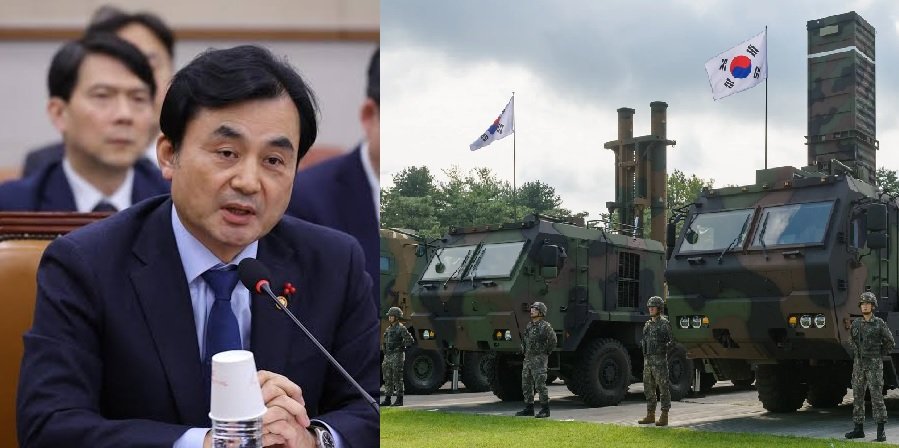
SEOUL, — South Korea’s government has submitted a 73.2777 trillion won ($51.4 billion) defense budget proposal for 2027 to the National Assembly. The proposal is 8.2 percent higher than the 2026 budget, marking the largest annual increase in about two decades and taking defense spending above 70 trillion won for the first time.
The budget focuses on strengthening self-reliant defense capabilities, preparations for the transfer of wartime operational control (OPCON), military restructuring amid declining manpower, and the expansion of AI, unmanned systems, drones and counter-drone capabilities.
Budget Breakdown
Of the total, 50.0416 trillion won ($35.1 billion) is allocated to force operations, up 5.9 percent. Defense capability improvement receives 22.7112 trillion won ($15.9 billion), an increase of 13.8 percent, while military service administration receives 524.9 billion won ($368.2 million), up 1.4 percent.
The defense capability improvement budget has increased by about 2.8 trillion won, the largest increase on record. Funding for OPCON preparations and self-reliant defense capabilities will rise 34.9 percent, from 9.0222 trillion won to 12.1744 trillion won.
KF-21, L-SAM and Nuclear-Powered Submarine
South Korea plans to accelerate key capabilities for responding to North Korea’s nuclear and missile threats, including medium-altitude reconnaissance UAVs (MUAVs) and long-range surface-to-air missiles (L-SAMs). Their deployment is planned to be brought forward by roughly one year, targeting late 2027 to 2028.
The government will also expand KF-21 fighter mass production. Funding for the program will rise from about 1.4 trillion won to 3.3 trillion won, including around 150 billion won for follow-on production.
For the first time, the budget also includes nearly 100 billion won for the initial phase of the Jang Bogo N nuclear-powered submarine project, covering initial design, facilities and related reviews.
Military Restructuring and AI
To address declining military-age population, the standing reserve force will expand from 3,700 to 7,000 personnel in 2027. Reserve-training compensation will increase from 68.8 billion won to 90.3 billion won.
The government also plans to increase the monthly pay of entry-level staff sergeants to about 3 million won and use civilian personnel for selected non-combat duties, including facility management, snow removal and some garrison security functions.
Funding for AI and manned-unmanned hybrid systems will increase 55.5 percent, from 496.8 billion won to 772.7 billion won. This includes 43 billion won for physical-AI demonstration projects involving transportation, garrison security and hazardous-material handling.
Planned systems include AI-enabled border surveillance, unmanned ground sensors, explosive-detection and disposal robots, autonomous underwater mine detectors, unmanned surface vessels and multi-legged robots.
Drone and Counter-Drone Capabilities
Spending on drone and counter-drone systems will rise 18.8 percent, from 678.8 billion won to 806.1 billion won. The budget supports swarm-drone research, medium-range loitering munitions, tactical drones and reconnaissance systems.
Funding to train 500,000 “drone warriors” will increase from 29.6 billion won to 77.1 billion won. South Korea will also expand border counter-drone capabilities, invest in Block-I laser anti-aircraft weapons and begin development of mobile Block-II laser systems.
A new K-Blue UAS certification system will also be introduced to support rapid acquisition of quality-assured drones.
Defense Technology and Industry
The proposal includes 56.5 billion won for defense semiconductors, 9 billion won for advanced aviation propulsion and 12.1 billion won for high-power laser-based hard-kill technology.
Funding for the K-Defense Startup Incubation program will increase from 5.4 billion won to 12.4 billion won. Support for defense innovation companies will rise from 65.9 billion won to 75.8 billion won.
Military-technology demonstrations by small and medium-sized enterprises will receive 17 billion won, up from 7 billion won, while defense export support will rise from 51.2 billion won to 62.7 billion won.
If approved by the National Assembly, the 2027 defense budget will represent approximately 2.33 percent of South Korea’s projected GDP, compared with 2.28 percent in 2026. The proposal will now undergo National Assembly deliberation.
——— End of Article ———