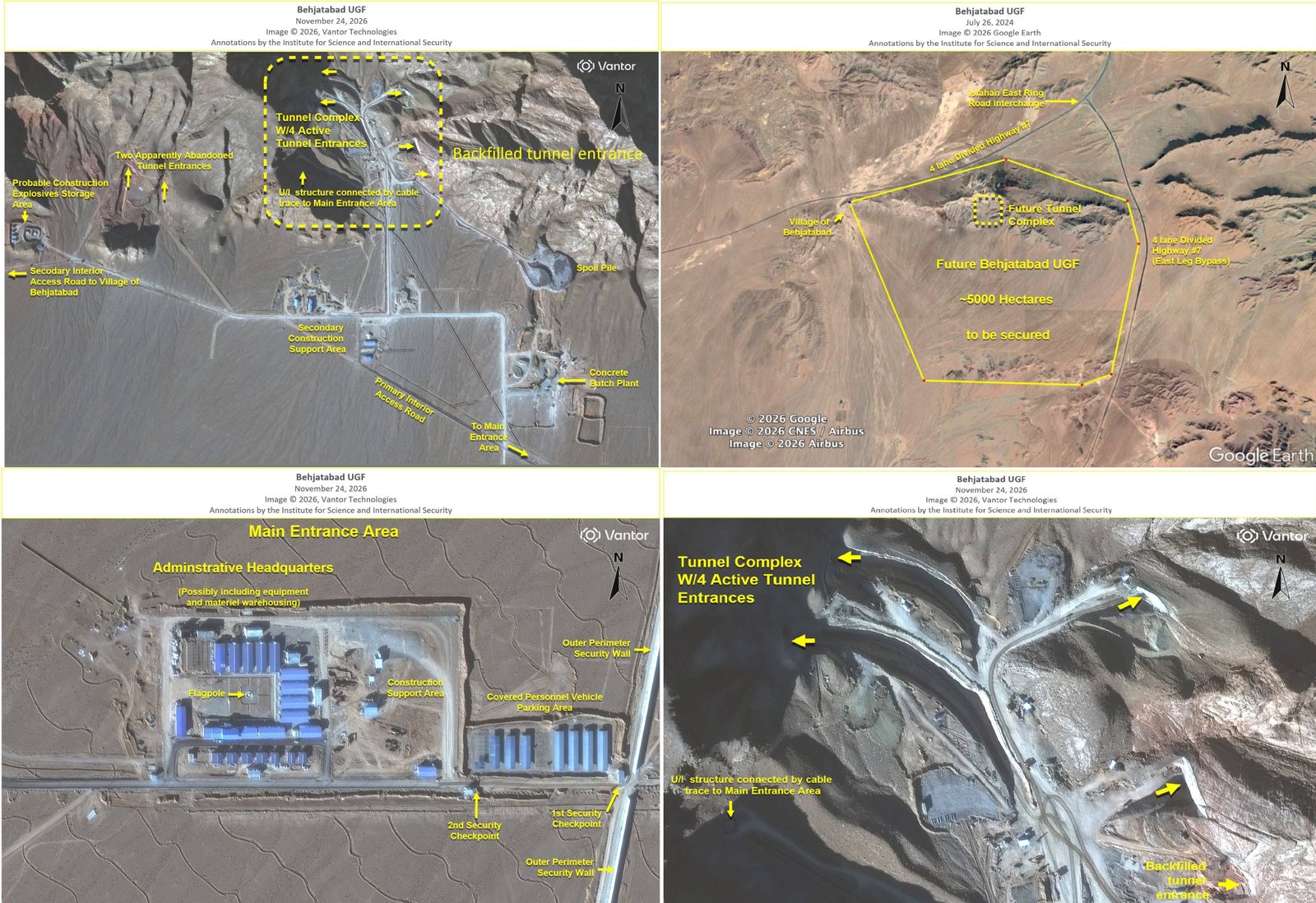
CENTRAL IRAN — Satellite imagery shows rapid construction of a large fortified underground facility at Behjatabad in central Iran, located approximately 62 kilometres from both the Isfahan nuclear site and Pickaxe Mountain near Natanz.
The Washington-based Institute for Science and International Security (ISIS) published its assessment on November 25, based on commercial satellite imagery from Vantor Technologies. The facility's planned outer security perimeter could cover approximately 5,000 hectares (12,000 acres). Construction of the perimeter security barrier has recently begun.
Satellite imagery analyst Ben Tzion Macales first highlighted the project publicly on November 17. The construction timeline shows initial land clearing between December 7 and 12, 2025, followed by a new access road in January 2026. Activity at the eastern tunnel section became visible in April, while a second tunnel section appeared in June. Images from November 24 identify four active tunnel entrances and one backfilled entrance.
Possible Military and Nuclear Purpose
ISIS said the facility's exact purpose remains unknown. However, its security arrangements, construction speed and location suggest possible military applications, including housing ballistic missiles or other major weapons systems.
The institute has not ruled out a nuclear-related purpose but stressed that available imagery does not establish any connection to Iran's nuclear programme. A fuller assessment with additional satellite imagery is expected.
Claims circulating on social media suggest that Behjatabad could extend 150–200 metres underground and become operational by mid-2027. However, these figures are not confirmed by the published ISIS assessment.
Comparison with Pickaxe Mountain
Behjatabad is located approximately 62 kilometres from Pickaxe Mountain (Kuh-e Kolang Gaz La) near Natanz, where underground construction began in 2020.
Pickaxe Mountain's underground facilities are estimated to extend approximately 80–145 metres beneath the mountain ridge, although their internal layout remains uncertain.
The claimed additional depth of Behjatabad could make its underground infrastructure more difficult to reach through conventional airstrikes, but its actual depth has not been independently established.
US-Israel Discussions Over Iran
The satellite findings come amid renewed discussions between Israeli Prime Minister Benjamin Netanyahu and US President Donald Trump over Iran's nuclear and missile programmes.
Netanyahu has reportedly urged Washington to consider renewed military action, citing concerns about Iran rebuilding its missile capabilities and strengthening underground facilities. Mossad chief Roman Gofman has also visited Washington to brief US officials on Israeli intelligence.
Trump has maintained that preventing Iran from obtaining nuclear weapons remains a US priority and has discussed targeting Pickaxe Mountain if military operations resume. However, Israeli military leaders and opposition figures have expressed caution about immediate escalation, arguing that Iran does not currently pose an imminent threat requiring an urgent strike.
Unaccounted Uranium Stockpile
Another concern involves approximately 440 kilograms of uranium enriched to 60%, which the International Atomic Energy Agency (IAEA) has been unable to fully verify because of restricted access.
The latest satellite assessment does not establish where this material is stored or whether it has any connection to Behjatabad. There is no confirmed evidence linking the uranium stockpile to the new underground complex.
For now, satellite imagery confirms significant construction activity and expanding security infrastructure at Behjatabad. However, its intended purpose, actual underground depth and expected operational date remain unconfirmed.
——— End of Article ———