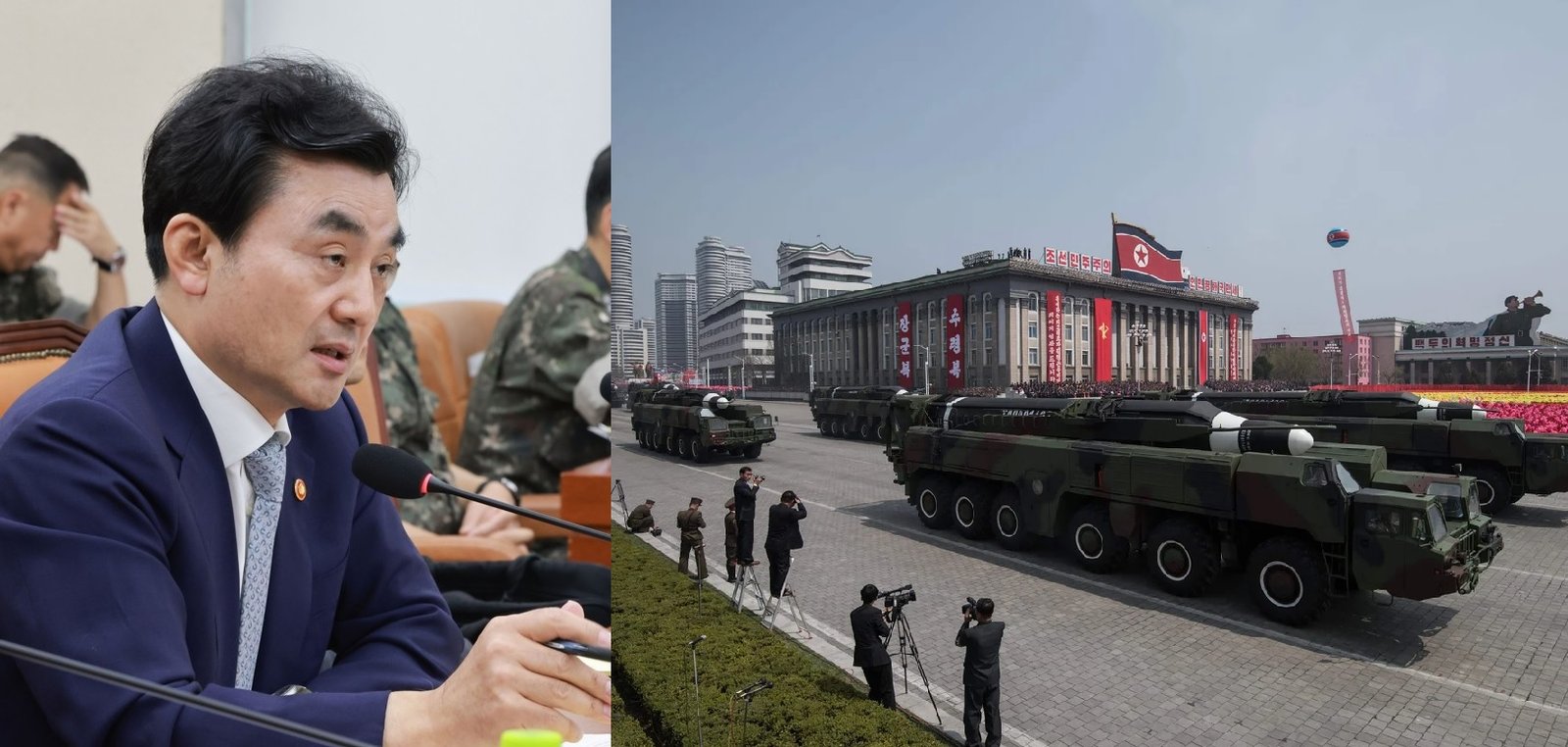
SEOUL, — South Korean Defense Minister Ahn Gyu-back told lawmakers Thursday that North Korea is generally estimated to possess 80 to 120 nuclear weapons, while saying that Seoul cannot provide an exact figure.
“We typically see that (North Korea has) around 80 to 120 (nuclear weapons), but I am very limited in providing a specific figure,” Ahn said during a meeting of the National Assembly’s National Defense Committee. He was responding to opposition People Power Party lawmaker Sung Il-jong.
Ahn later clarified that the 80–120 figure comes from estimates by private research organizations and is not an official confirmation by South Korea’s military. The assessment partly reflects estimates of the plutonium North Korea is believed to have produced and possessed.
The estimate differs sharply from a figure cited by U.S. President Donald Trump on Wednesday. Speaking to reporters at the White House, Trump said North Korea has “57 very powerful nuclear weapons.” It was the first time Trump had publicly cited a specific number for Pyongyang’s nuclear arsenal. Trump made the comment while discussing his relationship with North Korean leader Kim Jong Un and saying he expects to meet Kim later this year.
Ahn acknowledged that the South Korean and U.S. figures “appear to be slightly different.”
Independent assessments also vary. The Stockholm International Peace Research Institute (SIPRI) estimated in its 2026 Yearbook that North Korea had about 60 nuclear warheads at the beginning of 2026 and enough fissile material to produce at least 30 more. Earlier SIPRI-related estimates placed the number closer to 50. SIPRI also estimated that India possessed approximately 190 nuclear warheads at the start of 2026.
The differences partly reflect how nuclear arsenals are measured. Some estimates count assembled nuclear warheads, while others also consider the amount of plutonium and highly enriched uranium available to potentially produce additional weapons.
North Korea’s exact nuclear inventory remains difficult to establish because its nuclear program is highly secretive and much of its related infrastructure is underground.
South Korea and the United States do not officially recognize North Korea as a legitimate nuclear-armed state. Ahn reiterated that Seoul “cannot officially acknowledge” North Korea’s possession of nuclear weapons and that denuclearization of the Korean Peninsula remains the government’s policy.
The differing estimates come as discussions continue over possible U.S.-North Korean diplomacy, including reports of potential high-level contacts later this year.
——— End of Article ———