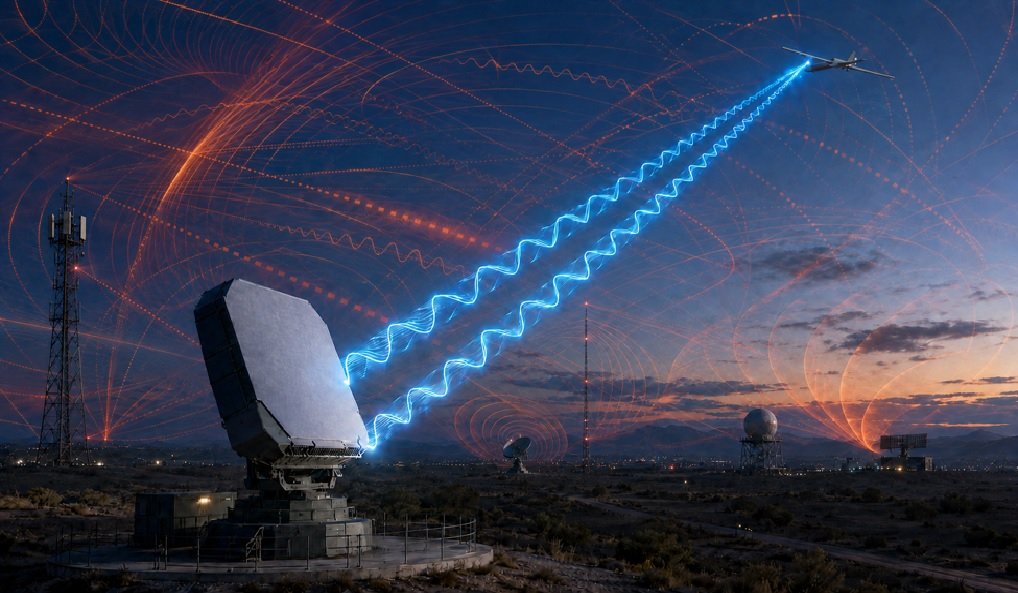
SYRACUSE, N.Y. — SRC, Inc., a not-for-profit defense research and development company based in North Syracuse, New York, has received a U.S. patent for a software-based method designed to help radar systems distinguish real reflective targets from electronic interference.
The U.S. Patent and Trademark Office issued the patent on June 23, 2026, as U.S. Patent No. 12,663,529. The patent is titled “Radar Apparatus and Methods for Determining the Presence of a Reflective Target Using a Multiple Response Comparison.” SRC engineers John C. Dougherty and David L. Weldum are listed as the inventors.
Addressing interference in crowded radio-frequency environments
Modern radar systems can operate in environments containing signals from other radars, radio transmitters, cell phone towers and similar sources. These signals can sometimes be stronger than the relatively weak echoes returned by physical objects.
Such interference can cause radar systems to register or track signals that do not correspond to actual objects. SRC's patented method is designed to identify these false detections before they are presented to radar operators or entered into tracking.
How the patented method works
The technique is designed for scanning radars that use multiple overlapping beam patterns.
When a radar detects a signal at a particular angle in one beam pattern, the software checks the corresponding location in an overlapping beam. It then compares the measured response with the response expected from a genuine reflective target.
If the signal matches the expected pattern within a predetermined error threshold, the system can identify it as a valid target. If the response falls outside the expected range, the system identifies it as interference and filters it out before the detection is displayed to an operator or used for tracking.
According to SRC, this approach can reduce false detections while also conserving radar processing resources.
The method is software-based and was developed for integration with a range of scanning radar systems rather than a single specific platform. SRC engineers developed and tested the technique using recorded radar data to evaluate its performance in complex radio-frequency environments.
Inventors
John C. Dougherty, SRC's chief systems engineer, has about 25 years of experience with the company and five years of previous industry experience. He earned a bachelor's degree in electrical engineering from the State University of New York at Buffalo, followed by a master's degree in electrical engineering and an MBA from Syracuse University. The patent is his seventh.
David L. Weldum, a senior principal systems engineer at SRC, has 23 years of experience with the company and 14 years of previous industry experience. He holds a bachelor's degree from Michigan Technological University and a master's degree from Syracuse University. The patent is his second with SRC and third overall.
SRC's radar technology work
SRC President and CEO Kevin Hair said innovation has been central to the company for nearly 70 years and that the patent reflects its work on challenges faced by radar operators.
The new patent adds to SRC's existing portfolio of radar-related technologies. The company said the technology is intended to help operators reduce false reports caused by interference and focus on relevant radar information.
Founded in 1957, SRC is headquartered in North Syracuse, New York, and focuses on research and development in defense, environment and intelligence. The company is chartered as an independent not-for-profit organization by the state of New York and employs more than 1,400 people.
——— End of Article ———