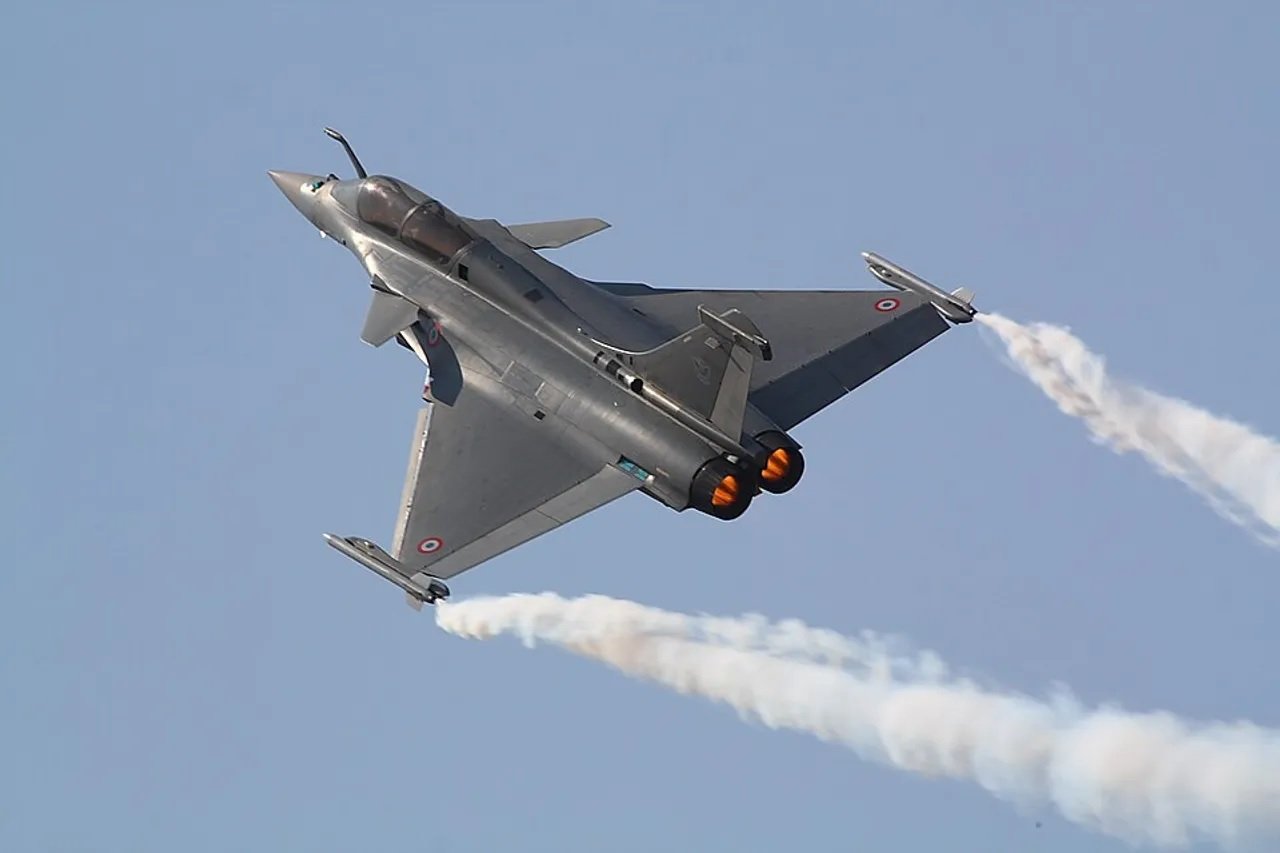
NEW DELHI — Russian defense analysts from the Center for Analysis of World Arms Trade (CAWAT) have claimed that export versions of French-made Rafale fighter jets and SCALP-EG cruise missiles supplied to India could contain software and hardware “bookmarks” that might allow their use to be restricted remotely.
The claim, reported by RIA Novosti on September 7, comes from an expert study being prepared for publication. CAWAT says the alleged Rafale “bookmarks” could be activated by an external radio-electronic signal and makes a similar claim about SCALP-EG missiles.
However, the publicly reported assessment does not provide technical evidence demonstrating that such a remote-disable mechanism exists in India's Rafales or SCALP-EG missiles.
What is the basis of the Russian claim?
CAWAT's publicly reported argument appears to have two main parts. First, it asserts that export Rafales contain software and hardware “bookmarks” that could be activated by an external signal and that France has a remote capability related to SCALP-EG missiles. Second, it connects this allegation with the May 2025 India-Pakistan fighting, asking whether India's independent use of SCALP-EG could have caused or contributed to the alleged losses of several Rafales.
Importantly, CAWAT does not publicly disclose the technical evidence behind the alleged “bookmarks.” The published account does not identify source-code analysis, a tested aircraft system, intercepted activation signals or technical documentation demonstrating the claimed remote-disable function. CAWAT itself says that only competent Indian authorities could determine whether such a connection existed through a detailed investigation.
Rafale losses do not establish a “kill switch”
CAWAT's reference to alleged Rafale losses therefore cannot by itself establish the existence of a remote “kill switch.”
India acknowledged aircraft losses during the May 2025 conflict but did not publicly confirm a Rafale combat loss. A later Indian Air Force support document provides an important piece of indirect evidence: in June 2026, the IAF sought bridge support for its full fleet of 36 Rafales, with the support requirement calculated on the basis of 36 aircraft.
Because this document was issued more than a year after the fighting, it is relevant when assessing earlier claims of Rafale losses. it is valid official documentary evidence that the IAF continued to account for and support the fleet as 36 aircraft.
India continues to pursue more Rafales
India has also continued moving toward the acquisition of 114 additional Rafales under the Multi Role Fighter Aircraft programme.
The CAWAT report gives the proposed breakdown as 88 single-seat and 26 twin-seat aircraft, while India's Defence Acquisition Council approved the MRFA procurement process in February 2026. The subsequent procurement process has continued, including India's request to France for the 114-aircraft deal.
The decision to continue with a major Rafale acquisition is relevant because India has not publicly indicated that it found a fundamental operational problem with the aircraft following the 2025 fighting.
No technical proof of remote deactivation
The central issue remains the technical claim itself.
CAWAT has not publicly presented source-code analysis, technical documentation, examination of an Indian Rafale, evidence of an external activation signal, or a demonstrated test showing that France can remotely disable India's Rafales or SCALP-EG missiles.
Dependence on a foreign manufacturer for proprietary software, updates, maintenance and technical support is not the same as having a remotely activated “kill switch.”
Russian defense-market context
The assessment also comes as Russia and France remain competitors in India's defense market. This does not prove that CAWAT's claim is politically or commercially motivated, but it makes independent verification important before accepting a serious allegation about French defense equipment.
Conclusion
The CAWAT assessment remains a hypothesis rather than a demonstrated technical finding.
The Russian analysts have not publicly demonstrated that India's Rafales or SCALP-EG missiles contain a remotely activated disabling mechanism. Their reference to alleged Rafale losses during the 2025 fighting also does not establish that any aircraft was disabled by such a system.
The later IAF documentation covering all 36 Rafales provides strong indirect official evidence that India continued to account for the complete fleet, while the continued move toward 114 additional Rafales shows that New Delhi remains committed to the aircraft.
Without direct technical evidence establishing the alleged mechanism, the Russian “kill switch” claim remains unverified and requires independent examination before it can be treated as an established capability.
——— End of Article ———