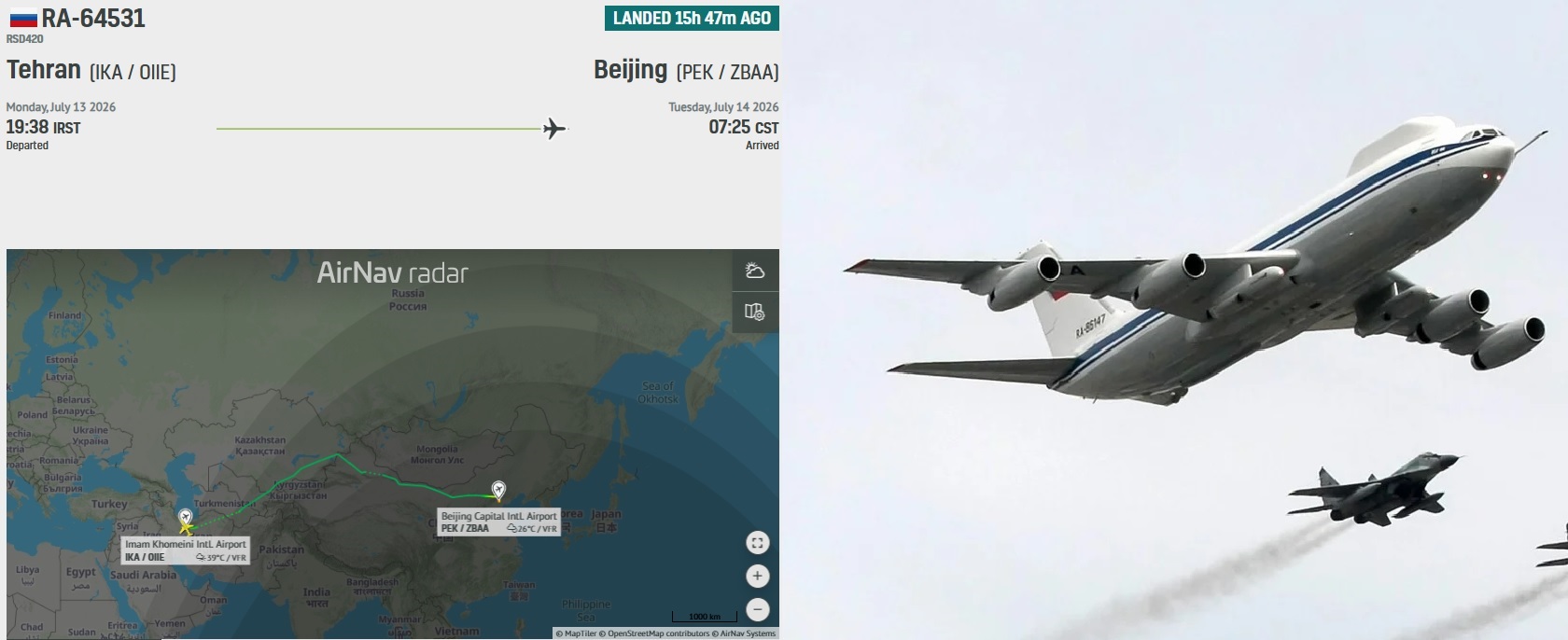
MOSCOW/TEHRAN — A Russian Tu-214PU airborne command post aircraft made a brief visit to Tehran on July 13, just hours before the United States launched a large-scale military operation against Iranian targets, according to publicly available flight-tracking data. The purpose of the Russian aircraft's visit has not been officially disclosed by either Moscow or Tehran.
Russian Tu-214PU Arrives in Tehran
Flight tracking data from AirNav Radar and Flightradar24 showed that the Tu-214PU, bearing registration RA-64531 and operating under the callsign RSD420, departed Moscow's Vnukovo Airport and arrived at Imam Khomeini International Airport in Tehran at approximately 07:35 a.m. Kyiv time on July 13.
The aircraft remained in the Iranian capital for around 12 hours before departing at 07:08 p.m. Kyiv time. It then continued east and landed at Beijing Capital International Airport at 02:25 a.m. Kyiv time on July 14.
The flight was visible through publicly available ADS-B flight tracking systems, with the aircraft traveling over the Caspian Sea before reaching Tehran.
Neither Russian nor Iranian authorities have announced the purpose of the visit.
Specialized Airborne Command Post
The Tu-214PU is a specialized version of the Tu-214 aircraft designed to serve as an airborne command-and-control platform for the Russian government. It is operated by the Rossiya Special Flight Squadron, which transports senior Russian government officials and operates aircraft configured for state missions.
Built at the S. P. Gorbunov Kazan Aviation Plant, the aircraft completed its first flight on December 28, 2018, and entered service with the Rossiya fleet during the summer of 2019.
The aircraft is equipped with secure communication systems, satellite communication antennas, relay equipment, encryption units, electromagnetic pulse (EMP) protection, and anti-jamming capabilities. These systems allow government and military leaders to maintain secure communications even if ground-based infrastructure becomes unavailable during emergencies.
Although it is often informally referred to as a "doomsday plane", the Tu-214PU is primarily intended to provide secure command and communication capabilities. Unlike Russia's Il-80 airborne command aircraft, it is not considered the country's primary airborne nuclear command platform.
U.S. Launches Retaliatory Strikes Across Iran
The Russian aircraft's departure from Tehran came only hours before the U.S. Central Command (CENTCOM) began military strikes against Iranian targets.
According to CENTCOM, the operation started at approximately 11:45 p.m. Kyiv time on July 13 (about 10:15 p.m. Eastern Time) and continued for more than five hours, ending around 05:15 a.m. Kyiv time on July 14.
The United States said it used precision-guided munitions to strike military facilities in Bushehr, Chabahar, Jask, Konarak, Abu Musa, and Bandar Abbas.
CENTCOM stated that the operation targeted coastal defense systems, missile launchers, unmanned aerial vehicle (UAV) facilities, and maritime assets. According to the U.S. military, the objective was to reduce Iran's ability to carry out further attacks against commercial shipping operating through the region's strategic sea lanes.
The command also said that more than 50,000 U.S. service members remain on combat readiness across the Middle East.
Strait of Hormuz Attack Triggered Escalation
The latest military escalation followed an attack on commercial shipping in the Strait of Hormuz.
On July 13, the United Arab Emirates Ministry of Defence reported that Iranian cruise missiles struck two Emirati oil tankers, Mombasa and Al Bahiyah, while they were transiting the southern shipping lane through Omani territorial waters.
The missile strikes caused fires aboard both vessels. One Indian crew member aboard the Mombasa was killed, while eight crew members were injured, including six Indian nationals and two Ukrainian nationals. Officials said four of the injured suffered serious wounds.
The Islamic Revolutionary Guard Corps (IRGC) claimed responsibility for the attack. Iranian military officials said the tankers had allegedly disabled their navigation systems, ignored repeated warnings, and entered what Iran described as a prohibited area.
Russia-Iran Defense Cooperation
The Tehran visit also comes amid expanding Russia-Iran defense cooperation. The two countries signed a 20-year Comprehensive Strategic Partnership Treaty in January 2025, strengthening cooperation across defense, security, and other strategic sectors.
Open-source flight records indicate that the same Tu-214PU aircraft also made a visit to Iran earlier in 2026 during another period of heightened regional tensions.
Neither Moscow nor Tehran has confirmed whether the July 13 flight was connected to the subsequent U.S. military operation.
——— End of Article ———