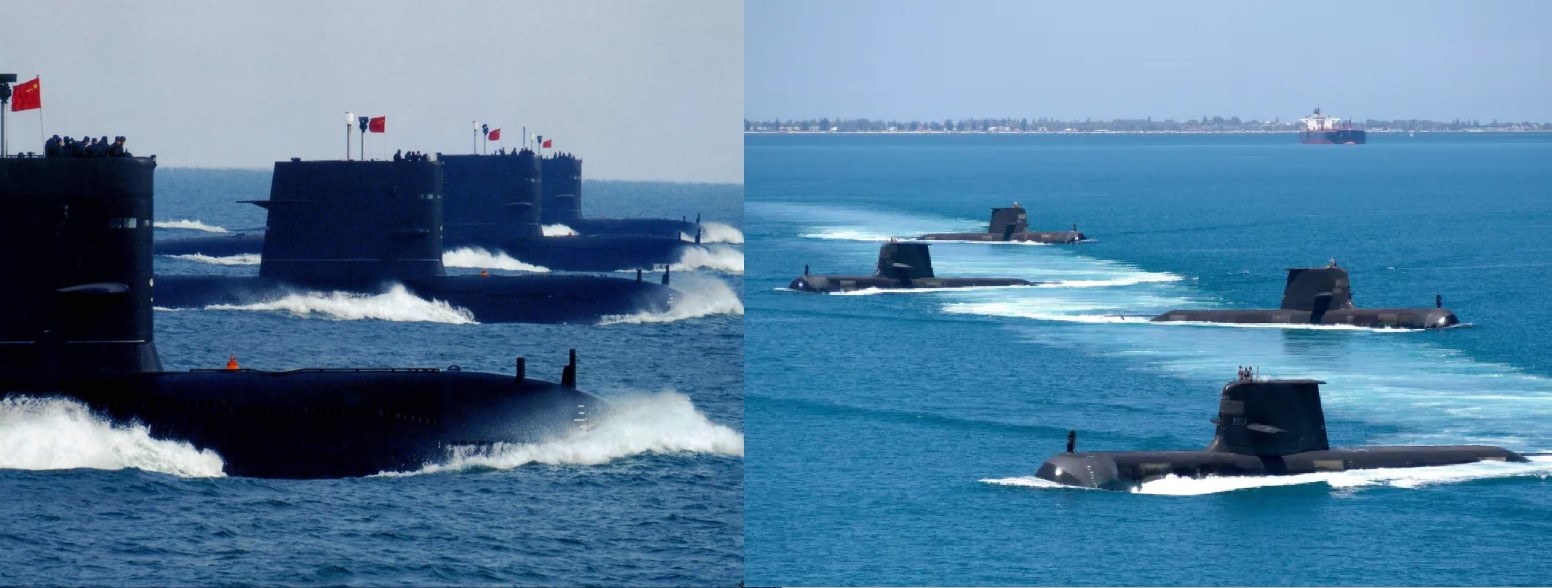
A recent Pentagon assessment has raised fresh alarm in Washington, warning that the People’s Liberation Army Navy (PLAN) is on course to surpass the United States Navy in submarine numbers by 2035 and could also match U.S. aircraft carrier strength within the same timeframe. While the United States continues to enjoy a qualitative advantage, driven largely by its nuclear-powered carrier fleet, the report underscores that China’s rapid shipbuilding pace is steadily narrowing the gap.
U.S. Submarine Numbers Expected To Dip Before Recovery
In contrast, the Pentagon warns that the U.S. Navy’s submarine force is heading into a temporary but strategically significant decline, even as it remains one of the most capable undersea fleets in the world. According to the Nuclear Threat Initiative (NTI), the United States currently operates 71 submarines, all of them nuclear-powered, underscoring Washington’s enduring qualitative edge in undersea warfare.
The current U.S. submarine inventory consists of 14 Ballistic Missile Submarines (SSBNs), which form the sea-based leg of America’s nuclear deterrent; 53 Nuclear-Powered Attack Submarines (SSNs) tasked with intelligence, sea control, and strike missions; and four Guided Missile Submarines (SSGNs) capable of launching large salvos of cruise missiles and supporting special operations forces.
Despite this formidable force structure, Pentagon projections indicate that U.S. attack submarine numbers are set to decline sharply due to procurement gaps following the Cold War and the retirement of older platforms. The number of American SSNs is expected to fall to around 47 boats by 2030, marking the lowest point of what U.S. naval planners describe as a submarine “valley.”
Although U.S. submarine numbers are projected to stabilize and gradually recover later in the decade, this interim shortfall is a central concern for Pentagon strategists. The timing coincides with China’s continued submarine fleet expansion, raising the risk that undersea balance calculations in the Indo-Pacific could temporarily tilt during a critical window—particularly in scenarios involving Taiwan or contested waters in the Western Pacific.
Aircraft Carriers: Numbers Versus Capability
The Pentagon report also highlights China’s ambitions in aircraft carrier development. Beijing currently operates three carriers, including its newest and most advanced platform, Fujian, which is equipped with electromagnetic catapults and designed to support more capable fixed-wing aircraft.
Looking ahead, the Pentagon assesses that China aims to field up to six operational carriers by 2035, bringing the total fleet to nine aircraft carriers if construction timelines hold. This would place China close to parity with U.S. carrier numbers, at least on paper.
However, the report emphasizes a key distinction: All 11 U.S. aircraft carriers are nuclear-powered, enabling longer deployments, higher sortie rates, and sustained global operations, whereas China’s carriers remain conventionally powered.
Why 2035 Matters To Washington
Pentagon officials stress that the warning is not about an immediate loss of U.S. naval superiority, but about converging trendlines. By 2035, China could field more submarines, nearly equivalent carrier numbers, and a fleet increasingly optimized for regional dominance.
In a potential crisis involving Taiwan, the South China Sea, or the Western Pacific, such shifts could compress U.S. response timelines, complicate deterrence, and raise operational risk—particularly during the years when U.S. submarine numbers are at their lowest.
Industrial Power At The Core Of Naval Competition
Ultimately, the Pentagon assessment frames the rivalry as a contest of industrial capacity as much as combat capability. China’s ability to build ships faster, replace losses quickly, and scale production is emerging as a decisive factor in naval planning.
As the United States works to stabilize its submarine force and maintain its qualitative edge through advanced platforms, nuclear propulsion, and operational experience, the Pentagon’s message is clear: the balance of power in the Indo-Pacific is tightening, and the window between now and 2035 will be critical in shaping the future maritime order.
——— End of Article ———