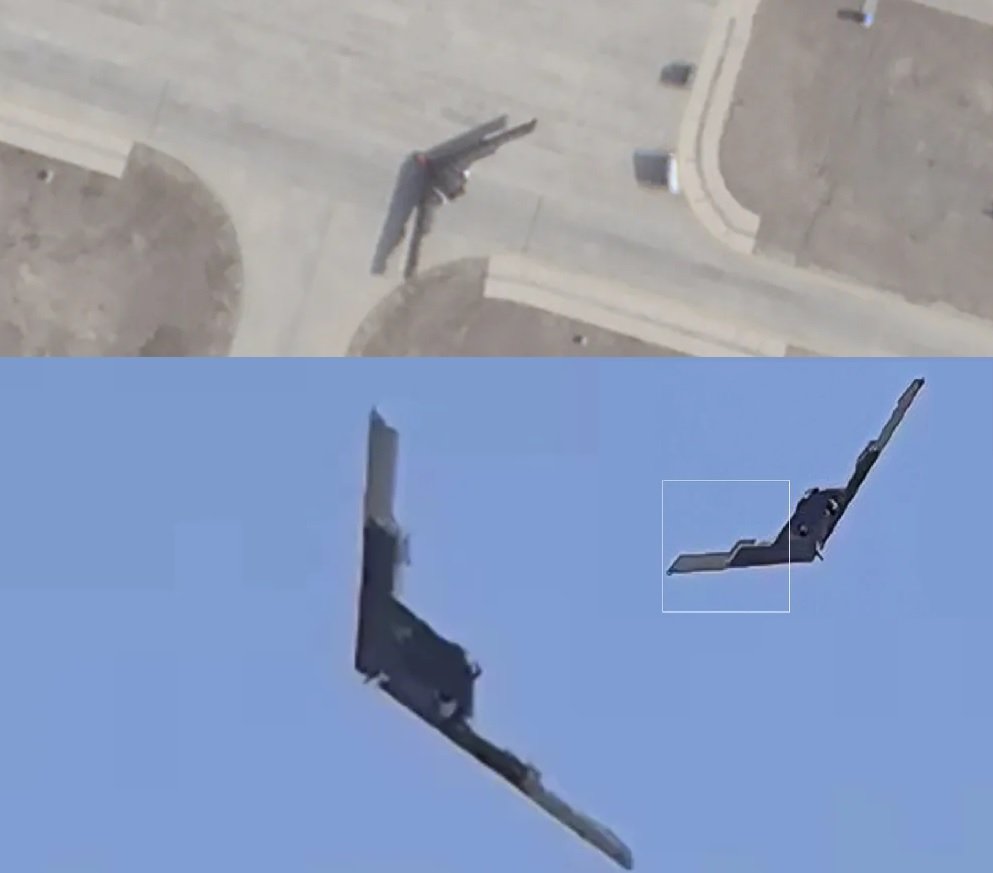
Malan, Xinjiang, China — New photographs and satellite imagery have provided the clearest public view yet of a large Chinese flying-wing drone unofficially known as the WZ-X. The latest images confirm that the aircraft has an unusual stepped-wing configuration that was difficult to identify in earlier satellite imagery.
The aircraft was first identified in commercial satellite imagery taken on May 14, 2025, at the People’s Liberation Army Air Force (PLAAF) test facility near Malan in China’s Xinjiang region. At the time, it was unclear whether the apparent breaks in the wing outline were actual design features or artifacts caused by the imagery. New ground-level photographs and a recent satellite image now show that the changes in wing shape are part of the aircraft’s design.
Unusual stepped-wing configuration
The WZ-X has a broad-chord inner wing that transitions abruptly into a much narrower outer section. Instead of continuously tapering from the center fuselage toward the wingtips, the outer sections become significantly longer and thinner.
This creates a distinctive stepped-wing appearance and produces a shallow, semi-sawtooth trailing edge. The aircraft also has a diamond-like central fuselage with long outer wing sections.
The configuration is different from the continuous flying-wing layouts seen on aircraft such as the U.S. B-2 Spirit. The reason for the unusual wing arrangement has not been officially explained.
The long outer wings give the aircraft a high aspect ratio, a configuration generally associated with efficient flight and reduced induced drag. However, the effect of the specific stepped geometry on the aircraft's radar signature remains uncertain.
Large aircraft with a roughly 173-foot wingspan
The WZ-X is the largest Chinese flying-wing aircraft identified to date. Recent imagery supports an estimated wingspan of approximately 170 to 173 feet (52 to 53 meters), making it roughly comparable in span to the 172-foot B-2 Spirit.
Aviation specialist Andreas Rupprecht estimates the aircraft's length at approximately 46 feet (14 meters). The central fuselage appears relatively spacious compared with the aircraft's overall thickness and could provide room for fuel, sensors and communications equipment, although the exact internal configuration has not been confirmed.
Images from the rear also show large landing-gear doors and split rudders positioned toward the outer wing areas. Slot-like openings at the rear of the center section have led analysts to assess that the aircraft is likely powered by two engines.
A dorsal antenna visible on the aircraft has also been assessed as being associated with satellite communications.
Possible high-altitude, long-endurance role
The WZ-X's size and aerodynamic configuration have led analysts to associate it with high-altitude, long-endurance (HALE) missions.
Its large central body and inner wing sections provide considerable space for fuel and mission equipment, while the unusually long outer wings could support efficient cruise flight.
The aircraft has therefore been assessed as potentially suited to long-range surveillance and communications or networking missions. However, its exact mission has not been officially confirmed.
Some analyst estimates place its normal cruising altitude between 59,000 and 66,000 feet and its range at more than 12,000 miles (about 20,000 kilometers). Reported estimates also put its cruise speed in the Mach 0.5–0.65 range. These performance figures remain unconfirmed by official Chinese sources.
A strike role has also been discussed by analysts, but there is currently no publicly confirmed information establishing the WZ-X as a strike aircraft.
Malan has become an important Chinese UAV test location
The aircraft is being tested at the Malan facility in Xinjiang, which has become an important location for China's unmanned-aircraft development.
Satellite imagery has shown extensive activity and infrastructure at the site, including multiple large aircraft and hangars. In March 2026, satellite imagery captured the WZ-X and another large flying-wing aircraft outside their hangars at the same time.
The second aircraft, unofficially referred to as the GJ-X, has a different cranked-kite wing configuration and an estimated wingspan of about 137 feet (42 meters). It was subsequently observed in flight, although its official designation and mission also remain unclear.
The presence of several large tailless and flying-wing aircraft at Malan indicates that China is testing multiple uncrewed aircraft configurations rather than relying on a single design.
Official designation remains unknown
Despite the growing amount of imagery available, the aircraft's official designation, manufacturer, propulsion details, confirmed performance and primary mission have not been publicly confirmed.
The name WZ-X is an unofficial designation used by observers to identify the aircraft. The latest imagery, however, provides considerably more information about its physical configuration, particularly the distinctive stepped outer wings and shallow serrated trailing edge.
The aircraft's approximately 170–173-foot wingspan also establishes it as one of the largest known Chinese uncrewed flying-wing platforms and places the WZ-X among the largest stealth-oriented UAV designs currently identified through publicly available imagery.
Source : TWZ
——— End of Article ———