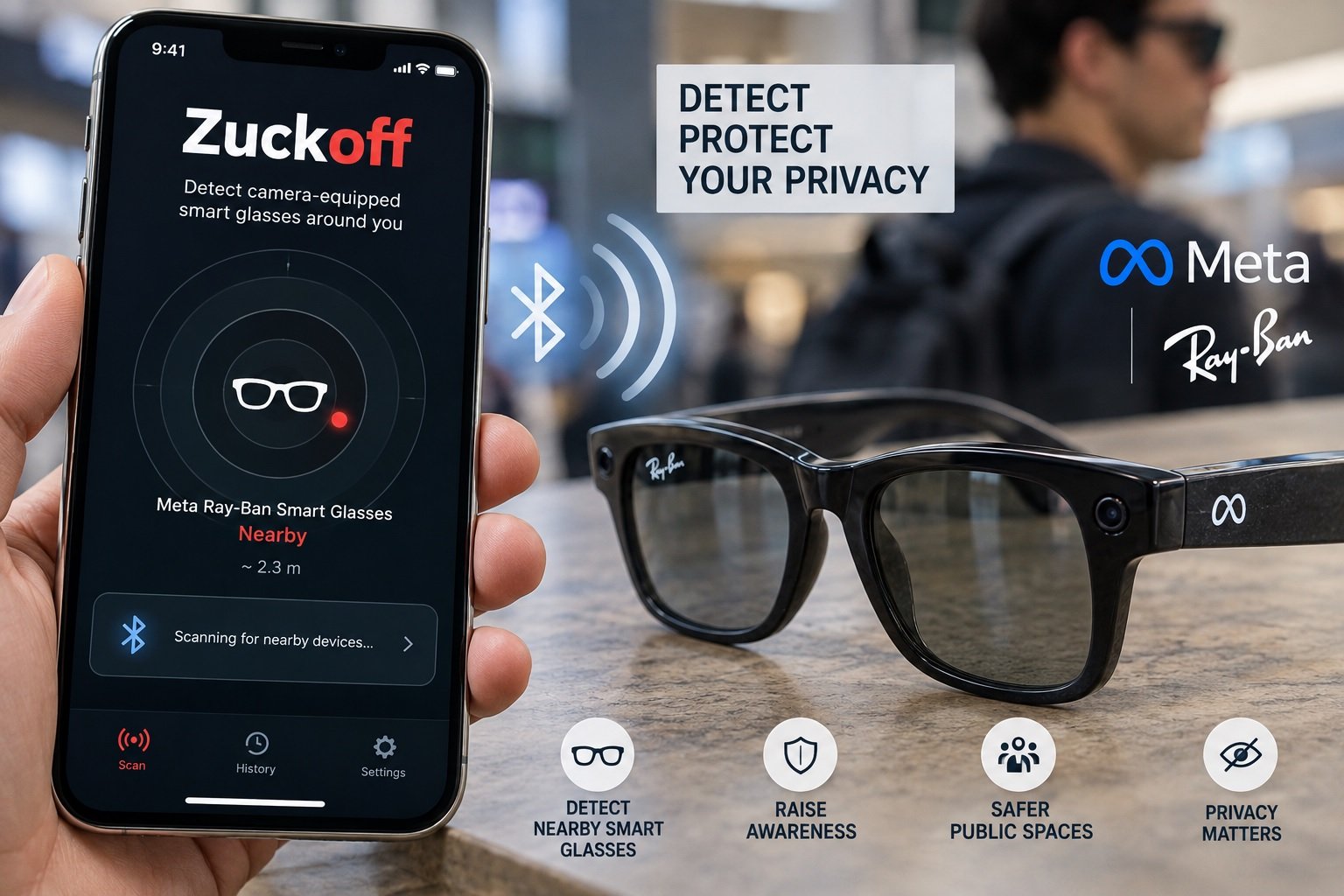
WARSAW — A Polish software developer has launched Zuckoff, an app that detects nearby camera-equipped smart glasses by scanning their Bluetooth signals. The app was developed by 30-year-old software engineer Paweł Szydłowski and has gained approximately 5,000 users in its first month on Apple's App Store.
The app was created amid growing privacy concerns over the use of smart glasses to record people without their knowledge. It primarily detects Meta's Ray-Ban smart glasses, developed in partnership with EssilorLuxottica. The glasses look similar to conventional eyewear but include a forward-facing camera, microphones and onboard artificial intelligence.
How Zuckoff Works
Zuckoff scans Bluetooth Low Energy broadcasts and compares them with a database of known smart-glasses signatures. Szydłowski built the database by purchasing several models and recording their Bluetooth fingerprints, including device identifiers, manufacturer codes and service UUIDs.
The project lists codes including 0x0D53 for Luxottica, covering Ray-Ban Meta and Oakley Meta devices, 0x058E for Meta Platforms Technologies wearables, and 0x03C2 for Snap Spectacles. The app can also flag some devices based on advertised product names, but with lower confidence.
The free version provides an estimated proximity reading while scanning. Zuckoff Pro adds background detection, push notifications, a Home Screen widget, Lock Screen Live Activity, longer sighting history and CSV export. It costs $9.99 annually, with a free trial week, or $24.99 for a lifetime license with Family Sharing.
Scanning takes place on the device. The app does not require an account or access to personal data, location, camera or microphone. Logs remain local unless users export them or voluntarily report an unidentified device.
Detection Limitations
Zuckoff can detect compatible hardware but cannot determine whether the camera is recording or identify the wearer. Bluetooth strength provides only a rough proximity estimate and does not show the device's direction.
Signals can be stronger when glasses start up, pair or are removed from their charging case, while some devices may broadcast less noticeably during normal use. Therefore, an alert indicates that compatible camera-equipped glasses may be nearby, not that recording is taking place.
The app currently supports iOS 18 or later, while an Android version is in closed testing.
Privacy Concerns
Privacy concerns around smart glasses have increased following examples of people being recorded without their knowledge. In late 2024, two Harvard students demonstrated I-XRAY, which used Meta Ray-Ban glasses to stream video while software performed facial recognition to identify people.
Meta's glasses use a small LED to indicate camera activity. After discovering that some users had covered or removed the indicator, Meta disabled the cameras on thousands of affected glasses. The company said those devices represented less than 0.1% of glasses sold and introduced software updates to improve detection of attempts to obstruct or damage the LED. It also removed online instructions showing how to bypass the indicator.
European Union regulators have reportedly contacted Szydłowski for information about Zuckoff's functionality and privacy implications, although details of the reported inquiry have not been independently confirmed.
Zuckoff is an independent project with no affiliation with Meta, Luxottica, Ray-Ban, Oakley or Snap. Szydłowski continues to expand its detection database using signals collected from physical hardware and accepts reports of additional smart-glasses models.
——— End of Article ———