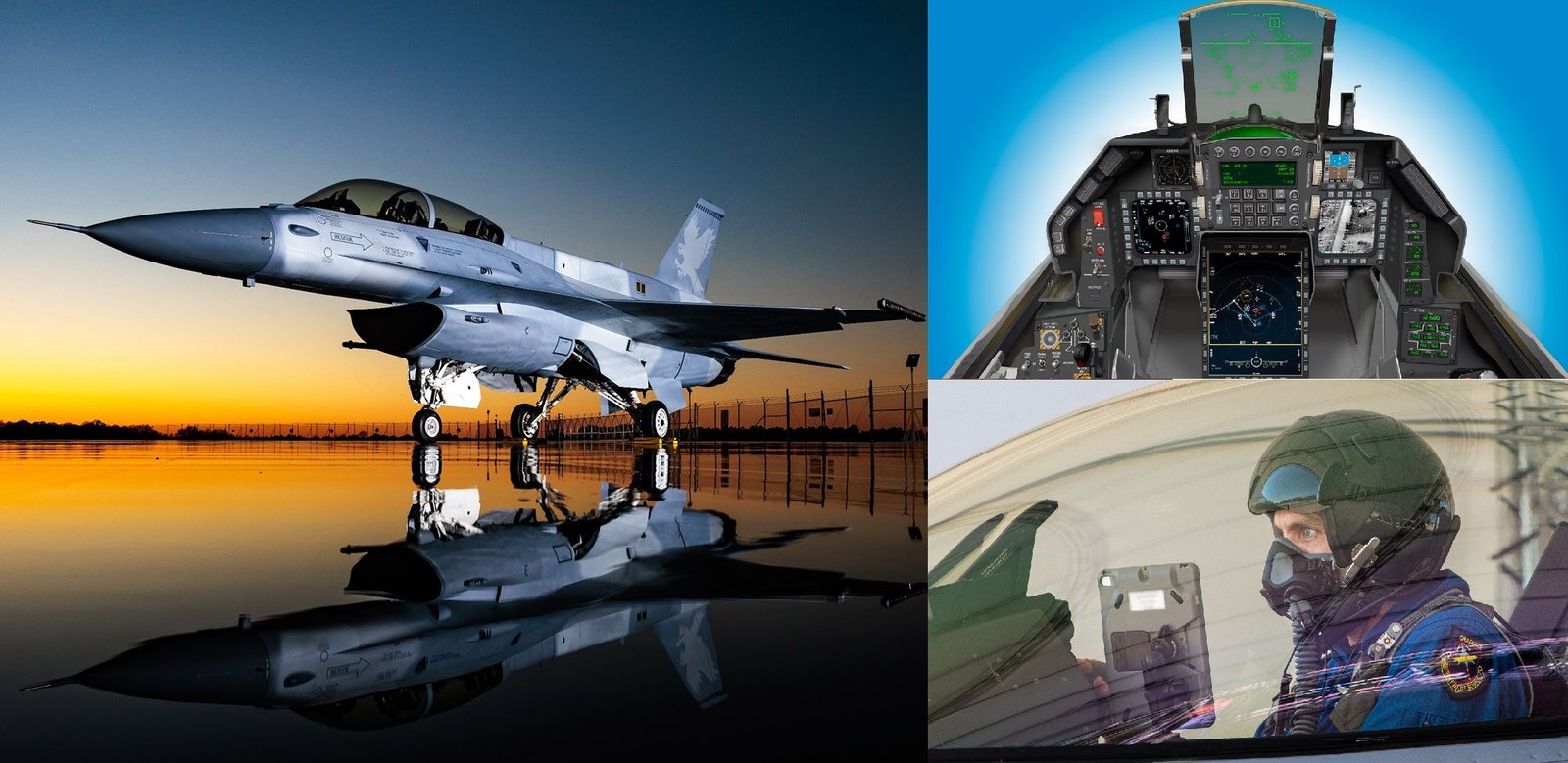
GREENVILLE, SOUTH CAROLINA — Lockheed Martin is highlighting the F-16 Block 70/72 as the most advanced production version of the F-16, combining a new-production airframe with an AESA radar, modernized cockpit, advanced targeting systems, electronic warfare capabilities and broad weapons integration.
The company describes the aircraft as an advanced fourth-generation fighter, while its Northrop Grumman APG-83 AESA radar provides what Lockheed Martin calls fifth-generation fighter radar capabilities through hardware and software commonality with the AESA radars used on the F-22 and F-35.
The Block 70/72 is currently being produced at Lockheed Martin’s facility in Greenville, South Carolina. The company says the configuration is designed to keep the F-16 operating into the 2060s and beyond.
APG-83 AESA Radar
The APG-83 is at the center of the Block 70/72 sensor package. According to Lockheed Martin, the radar provides faster all-weather targeting, greater situational awareness and more detailed digital mapping.
The radar provides the F-16 with fifth-generation fighter radar capabilities by leveraging hardware and software commonality with the AN/APG-77 AESA radar used by the F-22 and the AN/APG-81 AESA radar used by the F-35. Northrop Grumman developed the APG-83 as a multifunction active electronically scanned array (AESA) fire-control radar for the F-16.
The APG-83 supports high-resolution Synthetic Aperture Radar (SAR) mapping, allowing pilots to obtain detailed digital maps for target identification and precision strike missions. It also supports interleaved air-to-air and air-to-ground operations, allowing the radar to rapidly switch between different mission modes while maintaining situational awareness.
The radar provides multiple simultaneous air-to-air tracks, improved detection and tracking performance, and robust electronic protection for operations in dense radio-frequency environments. Northrop Grumman says the radar's electronic scanning allows faster area searches and more rapid target updates compared with mechanically scanned radars.
Lockheed Martin specifically describes the APG-83 as providing “5th Generation fighter radar capabilities” because of its hardware and software commonality with the F-22 and F-35 radar systems. This does not make the F-16 a fifth-generation fighter; the Block 70/72 remains classified by Lockheed Martin as a fourth-generation aircraft.
Northrop Grumman's published information also states that the APG-83 incorporates proven hardware and advanced operating modes from the F-22 and F-35 AESA radar programs, including electronic-protection capabilities. Its published SABR documentation says approximately 95 percent of the radar's mode suite comes directly from the F-35's APG-81 AESA radar, including electronic-protection functions.
Advanced Cockpit and Targeting Systems
The aircraft receives radar and targeting information through a new high-resolution Center Pedestal Display (CPD). The display provides color moving maps, larger air-to-air situation displays, zoom functions and digital flight information.
The Block 70/72 can also integrate Lockheed Martin’s Sniper Advanced Targeting Pod and Legion-ES infrared search-and-track (IRST) system.
These systems provide the pilot with additional sensor information beyond the aircraft's radar. The IRST system provides a passive means of searching and detecting targets, while the targeting pod provides imagery and targeting information.
The aircraft also incorporates an upgraded mission computer and avionics architecture. Lockheed Martin says the new mission computer combines computing functions for weapons and avionics into a single system and is designed to support software upgrades over time.
Electronic Warfare and Data Links
The Block 70/72 also includes an internal electronic warfare system incorporating a digital radar warning receiver and jammer technology.
Lockheed Martin says the electronic warfare system is integrated with the AESA radar, sensors, helmet-mounted display and cockpit displays. The aircraft also incorporates advanced tactical data-link capabilities for sharing tactical information and tracking data.
Broad Weapons Integration
Weapons integration is another major feature of the F-16 Block 70/72.
Lockheed Martin says more than 36 years of F-16 weapons-integration work with the U.S. Air Force and foreign military sales customers has resulted in more than 3,300 certified carriage and release configurations covering more than 180 weapons and stores.
The Block 70/72 therefore combines its modern radar and targeting systems with a large existing weapons-integration base. The aircraft is designed as a multirole platform capable of employing a broad range of air-to-air and air-to-ground weapons.
Auto GCAS and Extended Structural Life
The Block 70/72 also incorporates the Automatic Ground Collision Avoidance System (Auto GCAS). Developed by Lockheed Martin, the system is designed to prevent controlled flight into terrain by detecting the risk and initiating an automatic recovery when required.
Lockheed Martin says the system entered U.S. Air Force service in 2014 and has saved multiple pilots and F-16 aircraft.
The new-production airframe has a rated structural life of 12,000 flight hours, which Lockheed Martin says is more than 50 percent higher than previous production F-16 aircraft. The company says this provides most air forces with at least 40 years of service life without expected major structural repairs during that period.
The aircraft can also use conformal fuel tanks, which increase fuel capacity and range while maintaining the aircraft's aerodynamic characteristics.
119 Aircraft in Backlog
The technology upgrades are being introduced as Lockheed Martin continues production of new F-16s for international customers.
The company currently reports a Block 70/72 backlog of 119 aircraft, with 41 aircraft delivered to customers in seven countries. The figures represent the latest production program status reported by Lockheed Martin.
The new-production aircraft add to the existing global F-16 fleet. Lockheed Martin reports approximately 2,800 F-16s operating in 29 countries, with the worldwide fleet having accumulated more than 14 million sorties and 21 million flight hours.
Lockheed Martin also reported that F-16 deliveries resumed in 2026 following redesign and additional flight testing of a new variant. The company delivered two F-16s during the second quarter of 2026 and said it expects F-16 deliveries to increase during the year compared with 2025.
The Block 70/72 therefore represents an evolution of the F-16 design rather than a new fighter-generation designation. Its main upgrades are centered on the APG-83 AESA radar, modern mission computing, advanced targeting and IRST systems, electronic warfare, improved cockpit displays, Auto GCAS and extensive weapons integration.
——— End of Article ———