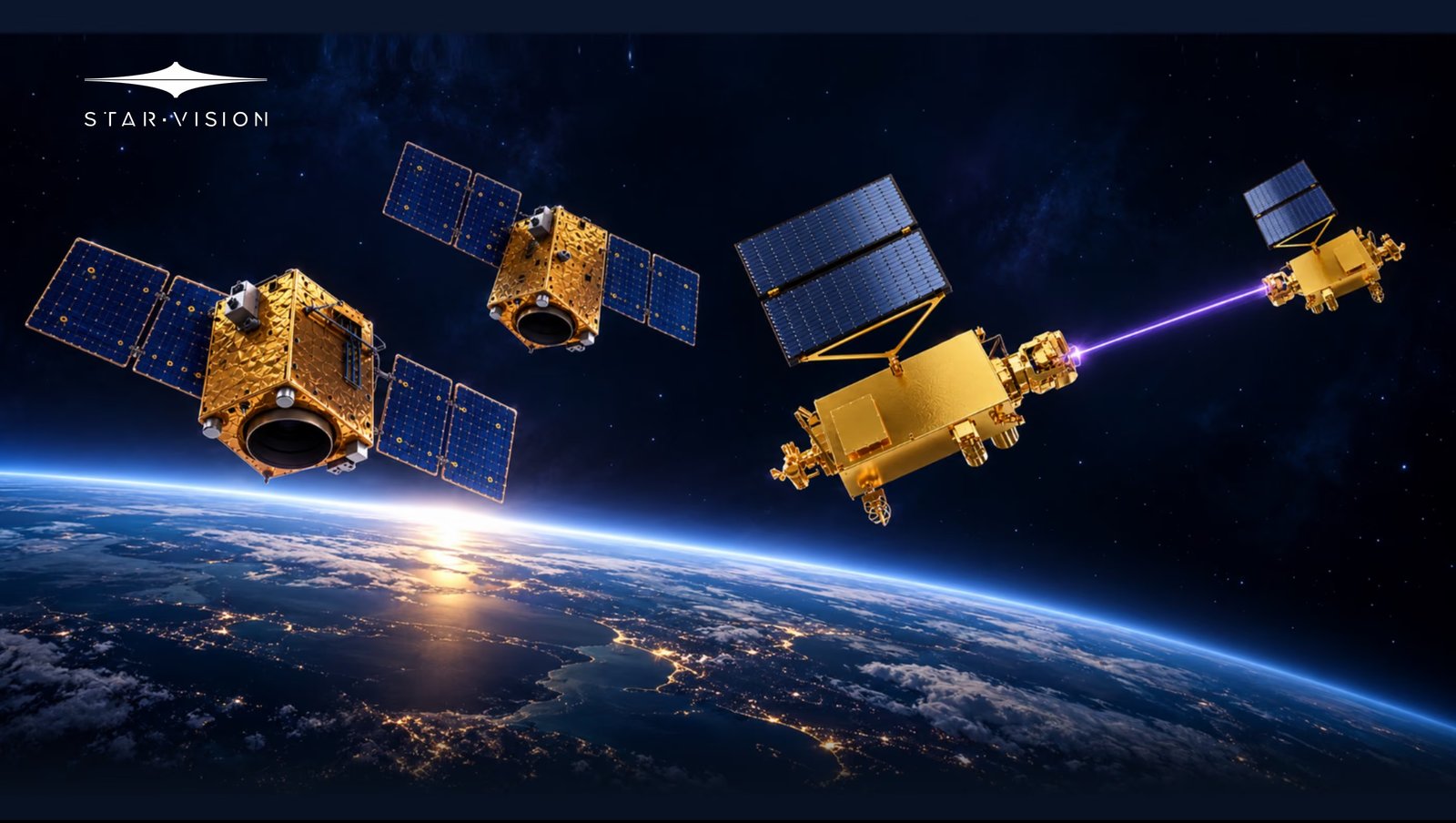
ANTALYA, TÜRKİYE — Chinese space technology company STAR.VISION unveiled four satellites at the 77th International Astronautical Congress (IAC 2026) in Antalya, Türkiye, on October 5. The satellites include an orbital computing pair designed to run a large artificial intelligence (AI) model and process satellite data directly in space.
The computing pair, Marco Polo and Ibn Battuta, is designed to operate as a distributed system capable of running Alibaba Cloud's Qwen3.5 large language model with 397 billion parameters.
Marco Polo will run the AI model using STAR.VISION's self-developed Lingshu inference payload and at least 4 terabytes of onboard storage. Its companion, Ibn Battuta, will provide computing capacity rated at 10 peta-operations per second (POPS), with planned power consumption of around 750 watts. It will process and combine optical, synthetic aperture radar (SAR) and multispectral imagery while supporting advanced AI workloads and lightweight model training in orbit.
The satellites will communicate through an optical inter-satellite laser link with a planned speed of at least 100 gigabits per second. This connection will allow them to share data and computing tasks, with Marco Polo focusing on AI inference and decision-making while Ibn Battuta handles heavier processing workloads. The pair is targeted for a sun-synchronous orbit at approximately 520 kilometres altitude, with launch planned for the fourth quarter of 2026.
Oman Twins to Support Earth Observation
STAR.VISION also introduced the Oman Twins, two Earth-observation satellites developed with Oman Lens to support international scientific cooperation and autonomous space capabilities.
The satellites will operate in a sun-synchronous orbit at approximately 530 kilometres altitude. They will carry panchromatic and multispectral imagers with a specified resolution of 0.5 metres for panchromatic imaging and 2 metres for multispectral imaging. The multispectral instruments will cover blue, green, red and near-infrared bands, with a swath width of at least 18 kilometres. The mission continues a partnership that previously produced Oman's first AI-equipped satellite.
Part of a Planned 1,080-Satellite Constellation
The Marco Polo and Ibn Battuta mission is a technology demonstration supporting STAR.VISION's proposed Space.IDC, also known as Space String, computing constellation. The company plans to deploy more than 1,080 satellites by 2035, including approximately 720 focused on AI inference and 360 providing general computing capacity.
In August 2026, STAR.VISION also launched two hyperspectral satellites, each reportedly equipped with onboard processing capabilities rated at 400 tera-operations per second.
By analysing data in orbit instead of transmitting all raw imagery to ground stations, the company aims to reduce communications bandwidth requirements and deliver useful information more quickly for applications such as Earth observation.
However, the announced performance of Marco Polo and Ibn Battuta has not yet been demonstrated in orbit. Their planned fourth-quarter 2026 launch will allow STAR.VISION to test their computing capabilities, optical communications and autonomous data processing under actual space conditions.
——— End of Article ———