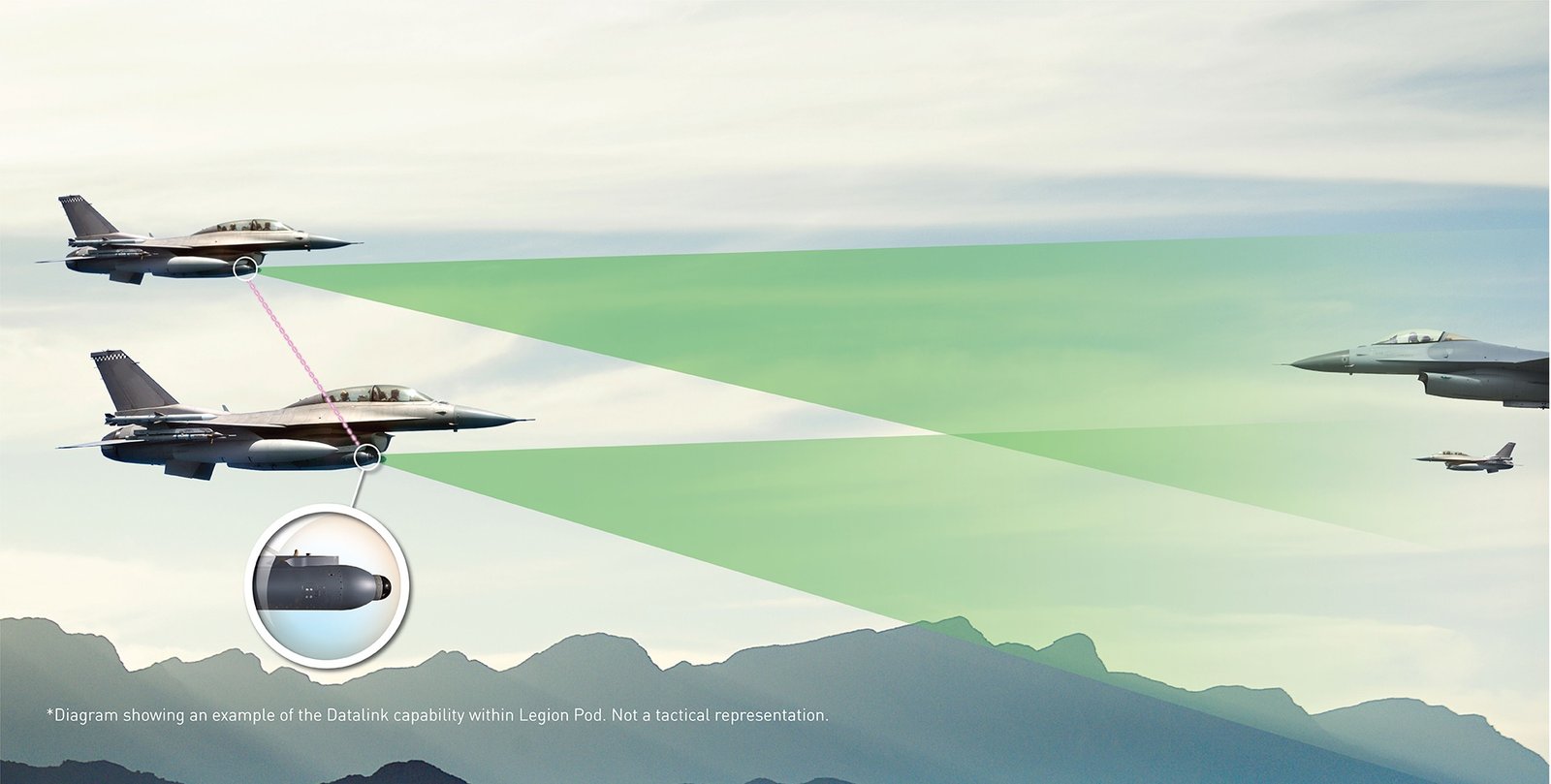
TUCSON, Ariz. — Lockheed Martin has demonstrated a direct data link between Legion infrared search-and-track (IRST) pods mounted on two F-16 fighter aircraft, allowing the aircraft to share sensor information in flight and generate targeting data without relying on their radars.
The flight test was conducted with the U.S. Air National Guard and the Air Force Reserve Test Center (AATC) from Morris Air National Guard Base in Tucson, Arizona. The two F-16s were equipped with Legion Pods connected through HiveLink, a data-link system developed by L3Harris.
According to Lockheed Martin, the demonstration showed how two passive infrared sensors can combine their observations to improve target tracking and determine range while the aircraft remain radar silent.
Combining Two Passive Sensors
The Legion Pod uses the IRST21 sensor, which detects and tracks airborne targets using infrared signatures rather than transmitting radar energy. Lockheed Martin says the system is designed to provide air-to-air detection and tracking in radar-denied environments.
A single passive IRST can provide an accurate bearing to a target, but determining range is more difficult because the sensor does not actively transmit a signal. By linking two pods on separate aircraft, their different viewing angles can be combined to establish the target's range.
Lockheed Martin previously described this approach as similar to human depth perception: two sensors observing an object from different positions provide the geometry needed to create a three-dimensional view.
During the latest demonstration, the two Legion Pods exchanged sensor information directly and combined their tracks. This allows the system to produce targeting information without requiring the infrared data to pass through the aircraft's main mission computer for processing.
Data Link Reduces Aircraft System Burden
The pod-to-pod architecture is designed to allow the Legion Pods to perform much of the data processing and communication themselves. Lockheed Martin previously stated that this approach can reduce the use of aircraft resources and shorten the time required to establish target range.
HiveLink, developed by L3Harris, is designed as a secure, software-defined data-link system supporting both line-of-sight (LOS) and beyond-line-of-sight (BLOS) communications. L3Harris says the system uses mesh networking and supports multiple waveforms for operations involving airborne, unmanned and ground platforms.
Cristin Stengel, program director for Lockheed Martin Legion, said the company is working with the Air National Guard and AATC to develop a networked passive IRST capability and provide aircrews with faster and more accurate targeting information in contested airspace.
Continued Development
The latest F-16 test follows earlier work on Legion's pod-to-pod networking capability. In 2021, Lockheed Martin demonstrated IRST data sharing between two F-15Cs during the Northern Edge exercise in Alaska. The company subsequently planned F-16 flight testing to demonstrate transportability and interoperability across aircraft platforms.
Lockheed Martin's current Legion Pod is housed in a 16-inch-diameter structure and incorporates the IRST21 sensor and an onboard processor. The company says the pod has completed integration and flight testing on F-16 and F-15C aircraft and uses a common interface designed to simplify integration without changes to the aircraft's operational flight program.
The company has also identified future applications involving additional radios and waveforms, fifth-to-fourth-generation connectivity and manned-unmanned teaming. These developments are intended to allow passive sensor information to be shared across a wider network of aircraft and other platforms.
The latest demonstration therefore continues Lockheed Martin's development of Legion as a networked passive sensor, combining infrared detection with direct data sharing between aircraft while reducing the need for active radar emissions during target tracking.
——— End of Article ———