TEHRAN, September 2, 2026 — Russia has been secretly assisting Iran in developing ramjet propulsion technology for supersonic cruise missiles under a program codenamed C430L, according to an investigation published by the Financial Times on September 1–2, 2026. The investigation is based on leaked Russian correspondence, travel records and analysis of military patents.
The multiyear program began in 2023 and continued into 2026. The reported cooperation has focused primarily on helping Iran develop and refine a ramjet propulsion system for missiles intended for anti-ship and land-attack roles.
Russian Firms Involved in the Program
The C430L program was organized by Russia’s state arms exporter Rosoboronexport in coordination with NPO Mashinostroyenia, a Russian missile design bureau.
Travel records reviewed by the Financial Times indicate that senior Russian arms-export officials and engineers from NPO Mashinostroyenia made repeated visits to Tehran during 2023. A contract between Rosoboronexport and Iran’s Ministry of Defense and Armed Forces Logistics (MODAFL) was subsequently signed in November 2023.
The Russian delegation included several specialists involved in missile and propulsion development.
Alexandr Dergachov, then deputy head of NPO Mashinostroyenia, was identified as the chief designer responsible for sea-launched missiles and cruise missile systems.
Alexandr Chebakov, head of the company's air-breathing jet-engine design department, also participated. Russian patents identify Chebakov as an inventor associated with control systems for supersonic ramjets and cruise-missile engines. The documents indicate that he visited Tehran three times in 2023.
Yuri Prokhorchuk, head of NPO Mashinostroyenia's aerodynamics and ballistics department, was another member of the group. He is a co-author of a patent covering a ramjet-powered hypersonic cruise missile designed for attacks against ships and land targets.
In July 2023, Rosoboronexport official Vladislav Kuzmichev, head of its defense technologies and space department, joined the Russian engineers during a visit to Iran. He later signed the November 2023 contract on behalf of Rosoboronexport.
Iran Shared Ramjet Test Data With Russia
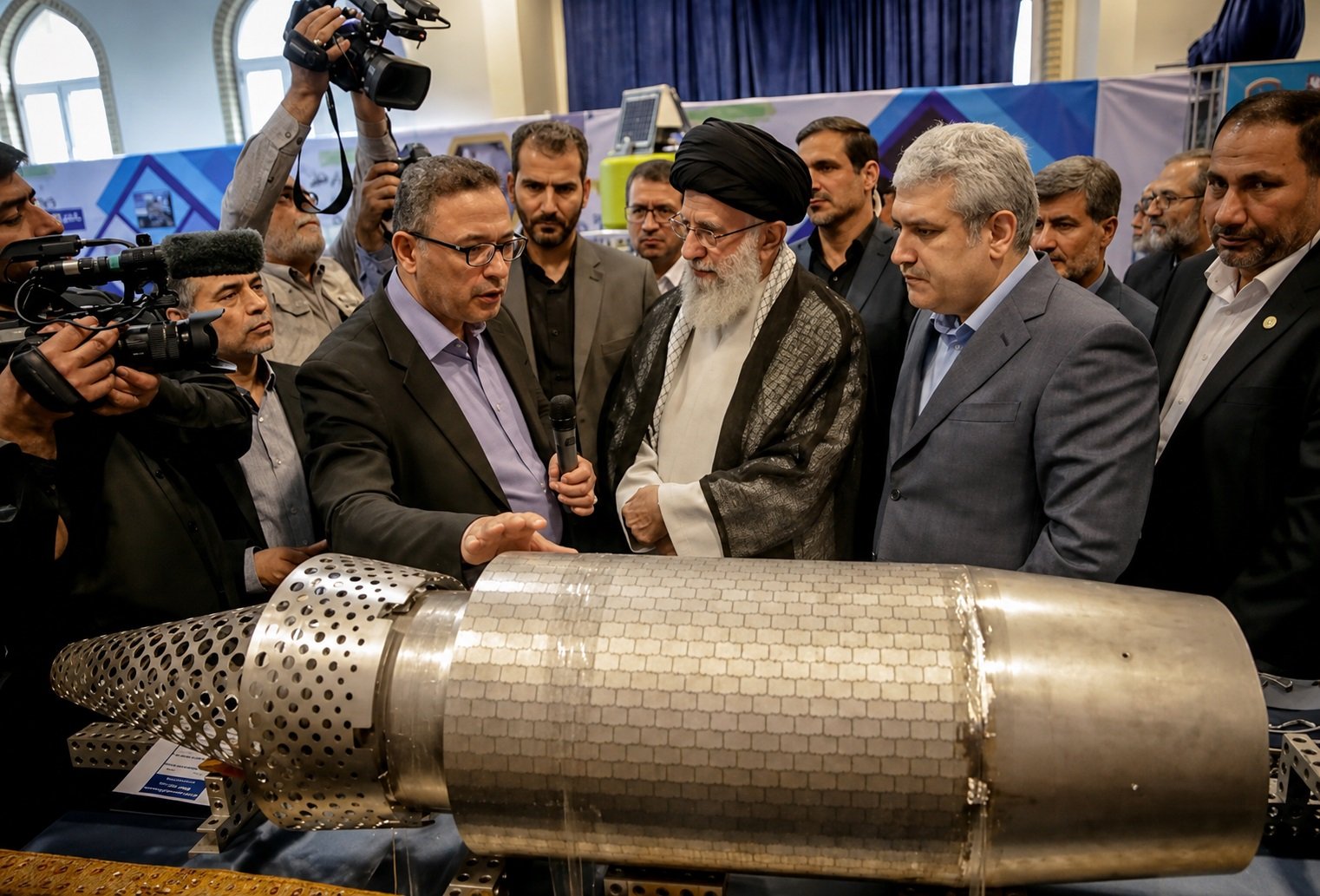
Iran has been working on supersonic anti-ship missile technology for years. In 2016, Iran's then-defense minister announced plans to develop supersonic anti-ship missiles. In 2019, Iranian authorities displayed components of a ramjet during an inspection by Iran's Supreme Leader.
In August 2023, the IRGC-affiliated Tasnim news agency reported that testing had begun on a prototype supersonic cruise missile.
According to the leaked correspondence reviewed by the Financial Times, NPO Mashinostroyenia had received a substantial amount of Iranian technical information on the ramjet by 2025.
Russian engineers examined telemetry from an Iranian flight test. The telemetry stopped transmitting less than a minute after the missile was launched. Russian specialists subsequently sent Iranian counterparts detailed technical questions concerning the engine's fuel system, combustion stability, air intake and nozzle performance.
They also asked whether the ramjet had continued operating after the telemetry transmission ended.
The exchange shows that Russian specialists were involved in examining Iran's test results and identifying technical issues associated with the propulsion system.
Russia Offered Further Technical Assistance
The cooperation continued beyond the exchange of technical data.
In April 2025, Rosoboronexport proposed sending a delegation of approximately two dozen Russian specialists to Iran to provide technical consultations.
A letter from Rosoboronexport dated June 2026 indicates that the two sides were still discussing the next phase of the program and planned further reviews of Russian technical reports.
This indicates that the reported cooperation remained active into 2026 rather than ending after the initial 2023 agreement.
Ramjet Technology at the Center of the Program
The main technical focus of C430L is the development of a ramjet propulsion system.
Unlike a conventional turbojet engine, a ramjet has no compressor or turbine. It relies on the forward movement of the missile to compress incoming air before fuel is burned in the engine. Ramjets are therefore suited to sustained high-speed flight after a missile has reached the required operating conditions.
The reported Russian assistance is focused on helping Iran overcome technical challenges associated with the propulsion system, including fuel delivery, combustion, airflow through the intake and nozzle operation.
The Financial Times reported that Iran has already built and flight-tested a ramjet system. However, there is no public evidence that an operational supersonic cruise missile developed with Russian assistance has entered Iranian service.
Potential Anti-Ship and Land-Attack Applications
The reported program is intended to support missiles for both anti-ship and land-attack missions.
Supersonic cruise missiles can reduce the amount of time available to defensive systems to detect, track and engage an incoming weapon, particularly when combined with a low-altitude flight profile. However, the effectiveness of any specific missile would depend on its final design, flight profile, guidance system and other characteristics that have not been publicly established for the C430L program.
Fabian Hinz of Conflict Armament Research, an expert on Iranian missile programs, said that obtaining this type of technology had been an Iranian objective for decades. Former CIA military analyst Jim Lamson said successful deployment could provide Iran with a new strategic weapon capable of threatening U.S. Navy vessels.
At present, however, the available information does not establish that an operational Russian-assisted missile has been deployed.
Wider Iranian Missile Procurement
The reported Russian cooperation comes alongside Iran's efforts to obtain advanced missile technology from China.
In February 2026, Reuters reported that Iran was nearing an agreement to purchase CM-302 supersonic anti-ship cruise missiles from China. Reuters reported a range of about 290 kilometers for the missile and said negotiations had been underway for more than two years.
The Chinese missile procurement discussions and the C430L program represent separate developments. The C430L program, as described by the Financial Times, concerns Russian assistance with Iran's development of ramjet propulsion technology, while the reported CM-302 deal concerns the potential acquisition of an existing Chinese missile system.
Significance of the C430L Program
The Financial Times described C430L as one of the most significant known transfers of strategic military technology from Moscow to Tehran.
The leaked documents indicate that the cooperation involved more than a conventional arms purchase. Russian specialists reportedly examined Iranian test data, exchanged technical questions, proposed sending engineering teams to Iran and continued discussions on technical reports into 2026.
Iran's ability to develop and produce an operational supersonic cruise missile with this assistance remains unconfirmed. The available evidence instead shows an ongoing effort centered on ramjet propulsion technology, with potential applications in future anti-ship and land-attack missiles.
The disclosures add another dimension to the expanding military relationship between Russia and Iran and come as Tehran continues to pursue high-speed missile capabilities through both domestic development and reported foreign cooperation.
——— End of Article ———