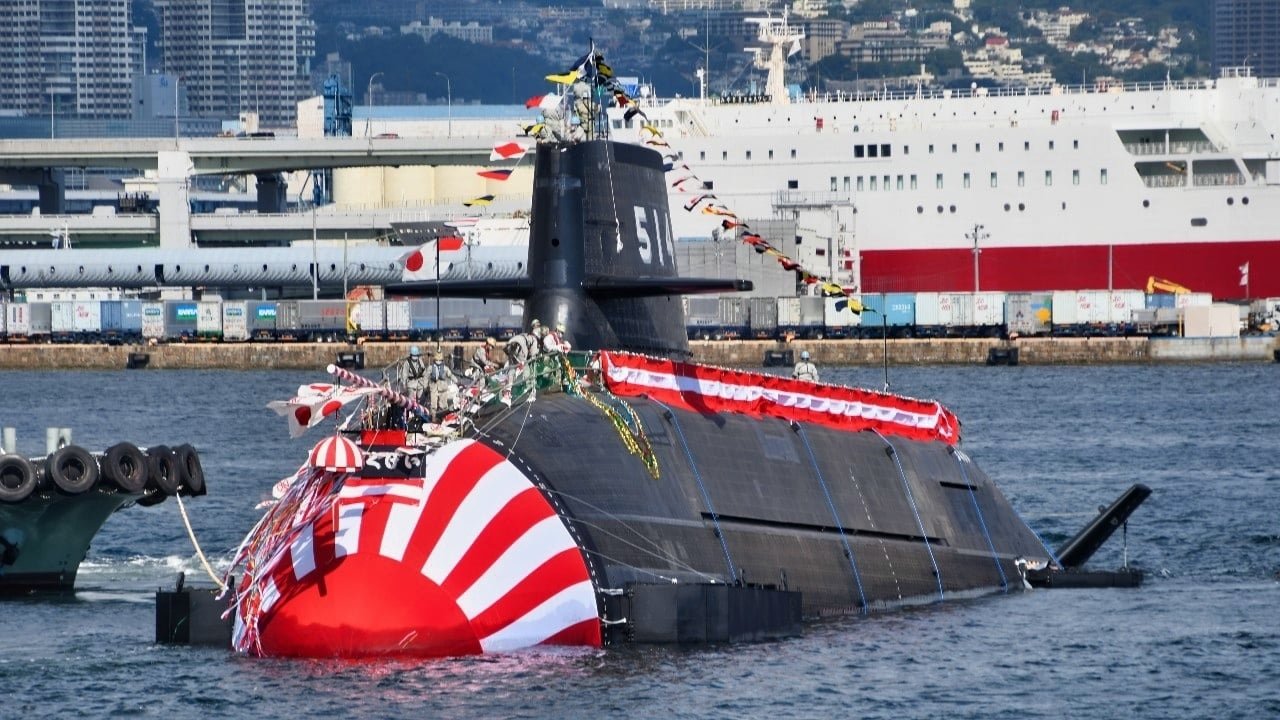
KOBE, Japan — October 8, 2026 — Mitsubishi Heavy Industries (MHI) launched the seventh Taigei-class diesel-electric attack submarine, Shogei , for the Japan Maritime Self-Defense Force (JMSDF) at its Kobe shipyard in Hyogo Prefecture on October 8.
The submarine, assigned SS-519, entered the water during a ceremony attended by about 300 people, including Vice Admiral Yoshihiro Goka, commander of the Kure District. Construction began on April 17, 2024, under the fiscal 2023 defence programme. Its construction cost is about 80.5 billion yen ($509 million), with delivery scheduled for March 2028 after outfitting and sea trials.
The name Shogei means “Soaring Whale.” It is the first JMSDF or former Imperial Japanese Navy vessel to carry the name. It was selected from suggestions submitted by JMSDF units and approved by Defence Minister Shinjiro Koizumi.
Taigei-Class Design and Armament
Shogei has a standard displacement of about 3,000 tonnes, an overall length of 84 metres, a beam of 9.1 metres and a hull depth of 10.4 metres, with accommodation for about 70 personnel.
Like Raigei, Chogei and Sogei, Shogei uses higher-output Kawasaki 12V 25/31 diesel engines combined with large-capacity lithium-ion batteries. The battery system provides longer submerged operation than older lead-acid battery designs. The submarine also features the ZQQ-8 integrated sonar, ZPS-6H surface-search radar and a quieter hull structure intended to reduce machinery and crew-generated noise.
Armament includes six 533 mm HU-606 torpedo tubes capable of launching Japan's Type 18 heavyweight torpedo, which succeeds the Type 89 with improvements in propulsion, target detection and data processing. The tubes can also launch the UGM-84L Harpoon Block II anti-ship missile, with a stated range of 248 kilometres. The class also uses the torpedo countermeasures system fitted to the final four Soryu-class submarines.
The Taigei class succeeds the Soryu class and is constructed by MHI and Kawasaki Heavy Industries in Kobe. Chogei, the fifth boat, was commissioned in March 2026, while sixth boat Sogei, launched in October 2025, is expected to be delivered around March 2027. Shogei is MHI's fourth Taigei-class submarine and the 32nd submarine built at its Kobe yard since the end of World War II. Japan currently operates about 21 submarines, including remaining Oyashio-class boats, Soryu-class submarines and five Taigei-class boats already in service.
Japan Studies VLS-Equipped Future Submarines
Japan is meanwhile studying a new generation of submarines capable of carrying vertical launching systems (VLS) for long-range stand-off missiles, as outlined under the country's national security documents adopted in December 2022.
On July 6, 2026, the Acquisition, Technology & Logistics Agency (ATLA) awarded MHI a contract worth about 3.9 billion yen ($24.6 million) for research into the total-ship optimisation of a next-generation VLS-equipped submarine. The programme runs from fiscal 2026 through fiscal 2029. Kawasaki Heavy Industries has separately received contracts covering research and prototype work on the VLS and associated pressure-hull sections.
Adding VLS could require a larger submarine hull, while advanced sonar systems and unmanned underwater vehicles could increase onboard power requirements. Conventional diesel-electric submarines must periodically snorkel to recharge their batteries, increasing their potential exposure, while battery capacity limits sustained high-speed underwater operation.
Nuclear Propulsion Remains Under Consideration
These requirements have also opened discussion over future propulsion. In September 2025, a Ministry of Defense expert panel recommended further research into VLS-equipped submarines and “next-generation propulsion.”
On September 11, 2026, Defence Minister Shinjiro Koizumi said Japan would not rule out nuclear-powered submarines as the government prepares to revise its three national security documents by the end of the year.
Nuclear propulsion could provide much longer submerged endurance, sustained higher underwater speeds and greater operational flexibility. Koizumi also noted potential benefits for crew safety when avoiding anti-submarine forces.
However, nuclear-powered submarines would bring higher costs, larger hull requirements and the need for specialised nuclear expertise, while their machinery could produce a greater underwater acoustic signature than a conventional submarine operating quietly on batteries. Japan would also need infrastructure for nuclear safety, reactor maintenance, personnel training and long-term reactor operations.
As of October 8, 2026, Japan has made no decision to acquire nuclear-powered submarines. The government is examining future propulsion according to the missions expected of the JMSDF submarine force and crew-safety requirements.
Shogei will meanwhile proceed through outfitting and sea trials before its scheduled entry into JMSDF service in 2028.
——— End of Article ———