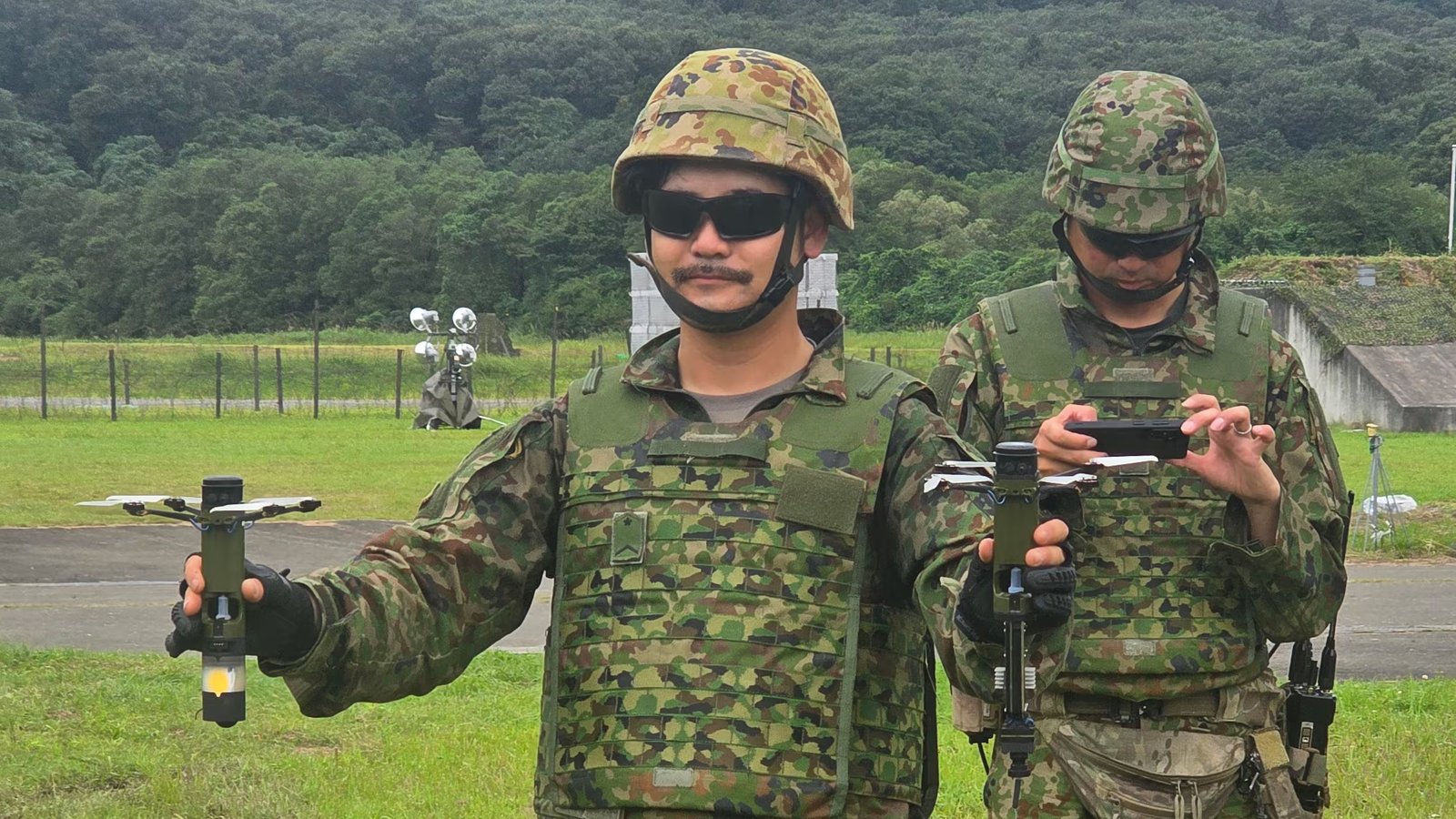
MIYAGI, Japan — Japan’s Ground Self-Defense Force (JGSDF) has publicly displayed a compact attack drone during a joint exercise with the French Army at the Ojojihara Training Area in Miyagi Prefecture, showing its planned use for close-range reconnaissance and strikes against ground targets.
The drone was presented during Brunet-Takamori 26, held from late August to early September 2026. About 120 Japanese personnel from the 20th Infantry Regiment and around 40 French troops from the New Caledonia Marine Infantry Regiment participated. The training focused on counter-guerrilla and urban operations.
Drone Demonstration
The planned scenario involved two soldiers operating the system. One soldier was to launch a reconnaissance drone by hand, while another controlled a second drone carrying simulated ammunition using a portable tablet or smartphone.
A malfunction prevented the planned flight during the main exercise. A separate demonstration was conducted afterward. In that demonstration, one drone located the target using its camera, while a second drone approached at low altitude and used an equipped lamp to simulate neutralizing the target.
Drone40 System
The aircraft is the Drone40, developed by Australian company DefendTex. Japan’s Ministry of Defense has selected it as the Small Attack UAV Type I, with Japanese trading company Marubeni Aerospace holding the contract.
Japan has not officially disclosed the specific system’s weight, range, endurance, payload capacity, propulsion or guidance specifications.
According to company specifications, the Drone40 is about 13 cm long, has a maximum take-off weight of around 400 grams, an endurance of up to one hour and a reported range of up to 35 km. It can be launched by hand or from a 40 mm grenade launcher.
Its modular design allows it to carry electro-optical or infrared sensors for reconnaissance, or strike payloads including fragmentation and explosively formed penetrator warheads. It uses a GPS-based autopilot, encrypted radio data link and portable ground-control station, while multiple units can operate together.
Part of Japan’s SHIELD Program
The Type I drone is one of three attack-drone types being developed for different ranges. Type I is intended for short-range strikes against vehicles, personnel and landing forces near friendly units or critical facilities. Type II covers medium-range missions against boats and lightly armored vehicles, while Type III is a longer-range, vehicle-transported system.
The systems form part of Japan’s SHIELD (Synchronized, Hybrid, Integrated and Enhanced Littoral Defense) coastal defense program. SHIELD is planned to combine more than 10 types of unmanned aerial, surface and underwater systems for surveillance, strike and protection missions.
Japan’s FY2026 defense budget provides significant funding toward establishing the SHIELD system by fiscal year 2027. The program is intended to strengthen Japan’s coastal and island defense capabilities.
Delivery and Deployment
Deliveries of the Small Attack UAV Type I are expected by late May 2027, with sequential deployment to ordinary JGSDF infantry units planned to begin in fiscal year 2027.
The Ojojihara presentation marked the first public showing of the attack drone during a joint exercise with a foreign military.
——— End of Article ———