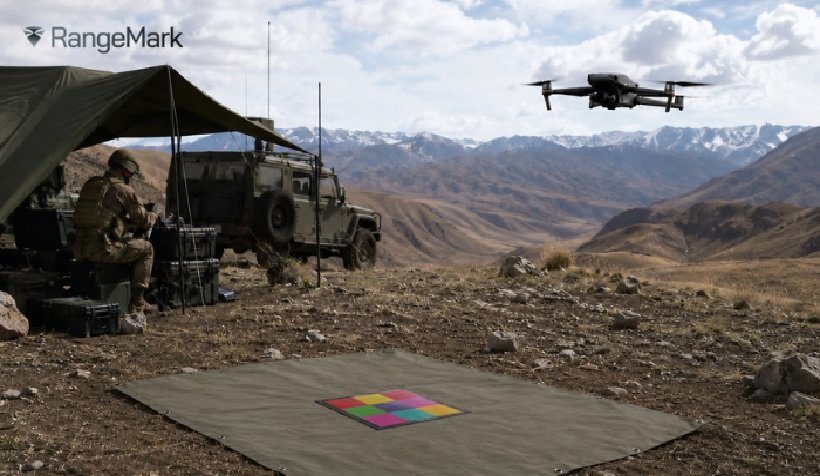
TEL AVIV — Israeli technology company Sodyo Ltd. has introduced RangeMark, a visual identification system designed for drones and autonomous systems to detect and identify passive printed markers from distances of up to 1 kilometer (0.62 miles).
Sodyo presented the technology publicly at Commercial UAV Expo 2026, held September 1–3 at Caesars Forum in Las Vegas. The company exhibited RangeMark at Booth #1005. Sodyo announced the launch on August 5, 2026.
Works Without GPS, RF or Network Connectivity
RangeMark is designed to work using only a standard camera and a printed, battery-free marker. The system does not require GPS, cellular service, radio-frequency (RF) signals or a network connection.
The marker itself requires no power source and does not transmit or emit signals. This allows the system to provide a visual identification method in offline or disconnected environments.
Sodyo distinguishes RangeMark from conventional AI-based object recognition. While AI vision systems can classify objects such as vehicles, buildings or people, RangeMark is designed to identify a specific marked asset or location and provide a deterministic machine-readable identity. The company said this can include identifying designated landing zones, drop points, infrastructure and friendly personnel.
Sodyo's platform describes its recognition process as resolving a visual marker into a verified identity through its computer-vision technology.
Flight Testing Demonstrates Long-Range Detection
According to Sodyo, RangeMark has been tested in real flight conditions.
During flight testing, drones detected a 100 cm (39-inch) marker at distances of up to 500 meters (1,640 feet) and a 50 cm (20-inch) marker at up to 250 meters (820 feet).
The tests covered an area of approximately 20 hectares (49 acres) and included hover, transit and search-pattern operations. Flight speeds reached 20 meters per second, or 72 km/h (45 mph).
Sodyo also reported broader Sodyo Labs testing in which a 120 cm marker was recognized at the maximum 1,000-meter range, while a 12 cm marker was detected at 100 meters.
Two Marker Formats
RangeMark currently supports two physical marker formats.
Color Code is a high-density format designed for standard visible-light conditions, while Carbon Code uses a two-tone design intended for more challenging visibility environments.
Sodyo said additional formats covering other parts of the electromagnetic spectrum are under development.
The company says the technology is based on more than a decade of patented development and has more than 35 global patents, with priority dating to 2012.
Sodyo Targets Drone and Autonomous Systems Market
Sodyo CEO Alon Raz said RangeMark is intended to give autonomous systems a reliable visual reference for identifying marked locations and assets.
“RangeMark turns a marked point anywhere in the physical world into a point of certainty… with nothing but a camera and a printed marker, something no existing visual technology can deliver at that range,” Raz said.
He added that the technology took more than a decade of patented work to reach its current form, saying, “When a machine can be certain, it can be trusted to act on its own.”
Sodyo plans to use a partner-led licensing model, targeting drone manufacturers, autonomy-platform developers, camera suppliers and system integrators. The company said potential applications include defense, infrastructure inspection, emergency response and industrial automation.
RangeMark represents Sodyo's expansion of its visual identification technology into the drone and autonomous-systems market, with the company focusing on machine-readable identification of physical locations and assets without requiring an active communications connection.
——— End of Article ———