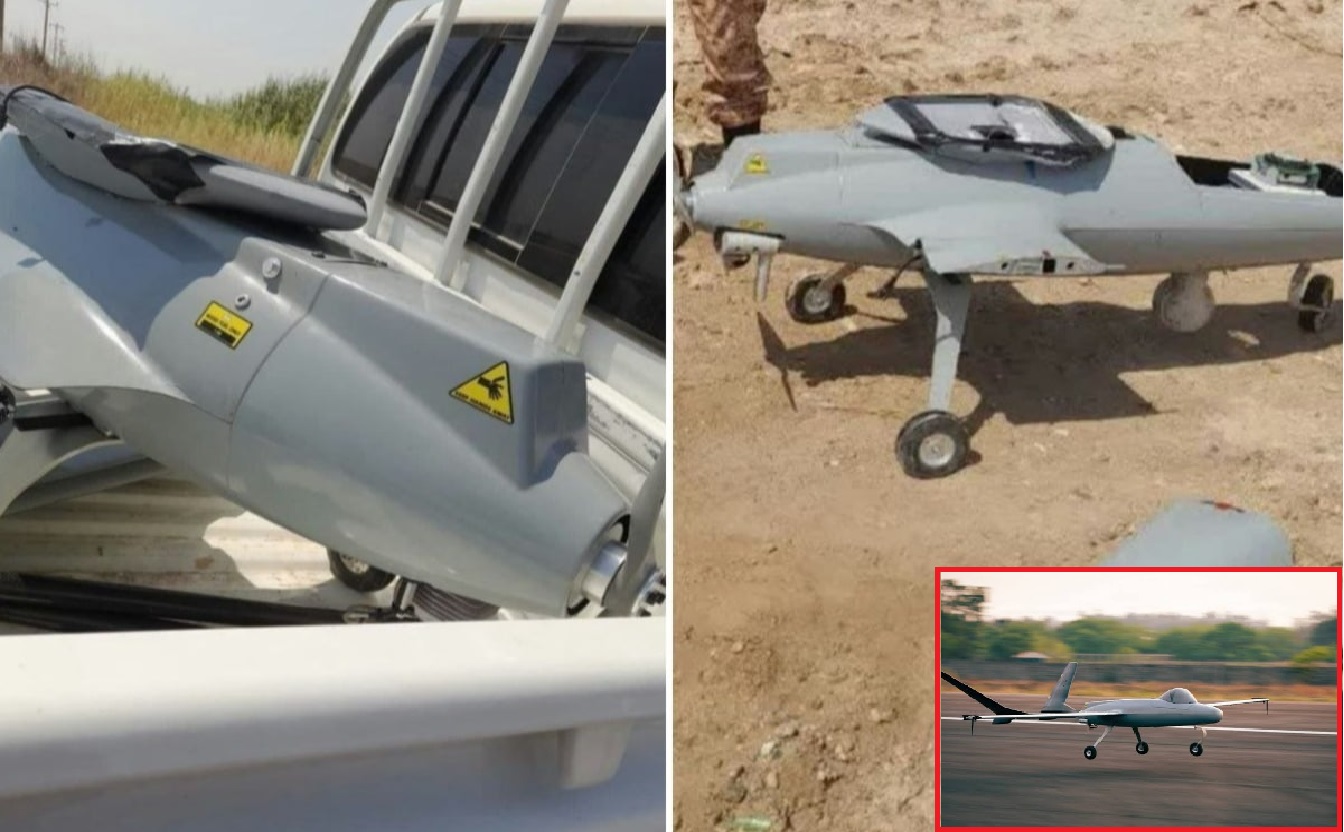
TEHRAN / WASHINGTON — Iran's Islamic Revolutionary Guard Corps (IRGC) has claimed it recovered a Polish-built Tiguar-M tactical unmanned aerial vehicle (UAV) after it was allegedly shot down over southern Iran. Images released by the IRGC Ground Forces' 48th Fath Brigade show the recovered aircraft in Kohgiluyeh and Boyer-Ahmad Province.
According to Iranian officials, the drone was operated by the U.S. Army. However, neither the U.S. Department of Defense nor independent Western sources have confirmed the claim, and the exact operator of the aircraft has not been independently verified.
The drone shown in the released photographs has been identified as the Tiguar-M, a tactical UAV developed by Warsaw-based uAvionics. The platform received wider public attention earlier this year after it was used by U.S. Army Special Forces during Exercise Balikatan 2026 in the Philippines.
Between April 20 and 24, soldiers from the U.S. Army's 1st Special Forces Group (Green Berets) tested the Tiguar-M in Laoag, Philippines, with the exercise focusing on the drone's long-range communication capabilities in areas with limited infrastructure. Images from that exercise showed at least one aircraft equipped with a modified satellite communication system similar to the configuration seen on the recovered drone displayed by the IRGC.
Photographs released by Iranian authorities appear to show the UAV fitted with an improvised Starlink or Starshield satellite communications terminal mounted on the fuselage. The field modification would allow beyond-line-of-sight communications over long distances. Standard production versions of the Tiguar-M are equipped with a conventional SATCOM antenna.
The Tiguar-M is designed as a long-endurance tactical reconnaissance platform. It measures approximately 2.32 meters in length, has a 4.1-meter wingspan, and a maximum takeoff weight of 25 kilograms. Powered by a hybrid propulsion system, the drone has a claimed endurance of more than 20 hours and a maximum range of up to 1,800 kilometers. It can carry up to 11 kilograms of intelligence, surveillance, and reconnaissance (ISR) payloads, including electro-optical and infrared sensors for day and night operations.
The platform also features a triple-redundant flight controller, a recovery parachute, and a modular design that allows it to be transported in compact cases for rapid deployment. According to the manufacturer, it complies with civil aviation standards in Poland and the United States for drones in its weight category and is not subject to certain U.S. export restrictions.
Open-source defense analyst Babak Taghvaee of The Crisis Watch has reported on the IRGC's identification of the recovered aircraft as a Tiguar-M. However, visual identification of the drone model alone does not confirm who was operating it at the time it was brought down.
BREAKING: The IRGC has released images of a Polish-built Tiguar M UAV allegedly operated by the U.S. Army and shot down over southern Iran by the IRGC Ground Forces' 48th Fath Brigade in Kohgiluyeh and Boyer-Ahmad Province.
— Babak Taghvaee - The Crisis Watch (@BabakTaghvaee1) July 19, 2026
The Tiguar M is the military version of the… pic.twitter.com/reYaF53PJ6
If the aircraft was operated by U.S. forces, it would indicate the use of small, relatively low-cost ISR drones for missions such as intelligence gathering, target support, and battle damage assessment. Compared with larger reconnaissance aircraft, platforms such as the Tiguar-M are less expensive to operate and easier to replace while providing persistent surveillance capabilities.
The claim comes amid continuing military operations between the United States and Iran. The United States resumed military strikes against Iran on July 8, and by July 17, U.S. Central Command (CENTCOM) said it had completed a seventh consecutive night of strikes targeting Iranian surveillance facilities, military logistics sites, underground weapons storage locations, and maritime infrastructure using fighter aircraft, drones, warships, and naval forces.
Iran has also announced several claimed drone interceptions during the past two weeks. Iranian state media, including IRNA and Tasnim, previously reported that the IRGC Aerospace Force had shot down a U.S. MQ-9 Reaper over the Ahvaz and Persian Gulf region using a newly deployed air defense system. Those claims have likewise not been confirmed by U.S. officials.
At present, the circumstances surrounding the reported recovery of the Tiguar-M remain unverified outside Iranian statements. While the released images appear to show a Tiguar-M UAV, they do not independently establish who operated the aircraft or the circumstances under which it was recovered. Further confirmation from official sources has not yet been provided.
——— End of Article ———