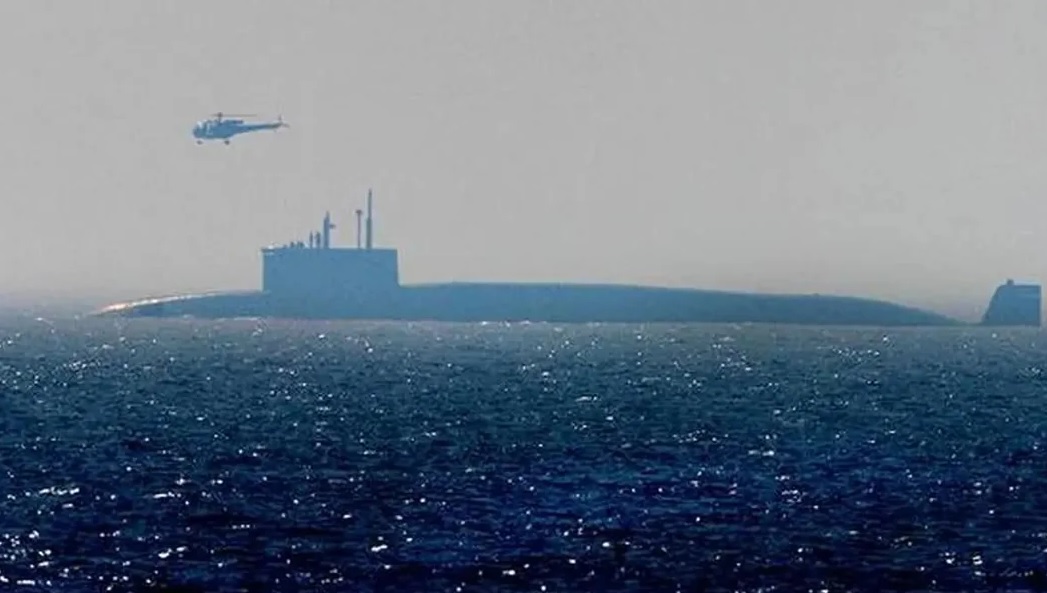
VISAKHAPATNAM, — May 19, 2026 : India’s fourth and final Arihant-class nuclear-powered ballistic missile submarine (SSBN), currently designated S4* and expected to be commissioned as INS Arisudan, is undergoing advanced sea trials following its launch at the Ship Building Centre (SBC) in Visakhapatnam in October 2024. The submarine is expected to formally enter service with the Indian Navy around 2027, completing the first production series of India’s indigenous SSBN fleet under the classified Advanced Technology Vessel (ATV) programme.
The submarine was launched on October 16, 2024, in the presence of Defence Minister Rajnath Singh. Following harbour integration and system validation trials, the vessel reportedly departed Visakhapatnam in late December 2025 to begin sea trials, a phase expected to continue through 2026 before commissioning preparations are finalized.
Expanded Arihant-Class Design
The S4* is the second “stretched” Arihant-class submarine and incorporates a larger hull section dedicated to missile storage and launch systems. The submarine is estimated to displace around 7,000 tonnes, compared to the 6,000-tonne displacement of the lead boat INS Arihant. The extended configuration increases the submarine’s missile carrying capacity while maintaining reduced acoustic signatures and survivability features designed for long-duration strategic patrols.
Constructed with an indigenous content level estimated at 75–80 percent, the submarine reflects continued progress in India’s domestic nuclear submarine construction programme. The vessel was built at the Ship Building Centre in Visakhapatnam with support from Indian defence research, naval engineering, and heavy industrial sectors operating under the ATV programme.
Missile Capability and Armament
A major upgrade introduced with INS Aridhaman and S4* is the expansion of the vertical launch system (VLS) configuration. Earlier submarines in the class — INS Arihant and INS Arighaat — were equipped with four VLS tubes primarily optimized for K-15 Sagarika submarine-launched ballistic missiles.
The later stretched variants feature eight VLS tubes, enabling the submarine to carry up to eight K-4 submarine-launched ballistic missiles (SLBMs). Developed by the Defence Research and Development Organisation (DRDO), the K-4 missile has a reported strike range of approximately 3,500 kilometres, significantly extending India’s sea-based deterrence reach.
The submarine can alternatively carry up to 24 K-15 Sagarika SLBMs with a shorter range of around 750 kilometres.
| Specification | Details |
|---|---|
| Class | Arihant-class SSBN (Stretch Variant) |
| Displacement | Approx. 7,000 tonnes |
| Propulsion | 83 MW Compact Light Water Reactor |
| Primary Armament | 8 × K-4 SLBMs |
| Alternative Armament | 24 × K-15 Sagarika SLBMs |
| Torpedo Tubes | 6 × 533 mm |
| Expected Commissioning | Around 2027 |
The integration of the K-4 missile allows the submarine to operate from relatively secure patrol zones in the Bay of Bengal and wider Indian Ocean while retaining the ability to engage distant strategic targets.
Completion of India’s First SSBN Fleet
India currently operates three Arihant-class submarines. INS Arihant (S2), the country’s first indigenous SSBN, was commissioned in August 2016. INS Arighaat (S3) entered service in August 2024, while INS Aridhaman (S4), the first stretched variant, was commissioned on April 3, 2026.
The commissioning of S4* will complete the four-submarine Arihant-class production line.
According to reports from January 2026, the Indian Navy’s ship-naming committee proposed the name INS Arisudan for the vessel. Final approval remains subject to clearance from the Defence Ministry and the President of India.
All Four Arihant-Class SSBNs Reportedly Observed Together
On January 27, 2026, all four Arihant-class submarines — S2, S3, S4, and S4* — were reportedly observed simultaneously at the Ship Building Centre in Visakhapatnam in imagery assessed by the International Institute for Strategic Studies (IISS).
The reported sighting marked the first known instance in which all four Arihant-class submarines were identified together at the facility, highlighting the advanced stage of India’s indigenous SSBN programme and the near-completion of the class.
Strategic Importance of the Arihant-Class
The Arihant-class forms the sea-based leg of India’s nuclear triad alongside land-based ballistic missiles and air-delivered nuclear systems. Operating under India’s “No First Use” nuclear doctrine, the SSBN fleet provides a survivable second-strike capability designed to ensure deterrence credibility.
Indian naval planners generally consider a fleet of at least four SSBNs necessary to maintain a Continuous At-Sea Deterrent (CASD) posture. Such a structure enables one submarine to remain on deterrence patrol while others rotate through maintenance, transit, training, or crew preparation cycles.
Broader Submarine Modernization Programme
Alongside the SSBN programme, India is expanding its nuclear-powered attack submarine capabilities. In late 2024, the Indian government approved Project 77, a ₹40,000 crore programme to construct the first two indigenous nuclear-powered attack submarines (SSNs) at Visakhapatnam.
To bridge capability requirements before indigenous SSNs enter service in the mid-2030s, the Indian Navy is also expected to receive a leased Russian Akula-class nuclear-powered attack submarine by 2028.
Development work is additionally continuing on the next-generation S5-class ballistic missile submarines, which are expected to feature larger displacement, increased missile capacity, and longer-range strategic systems beyond the current Arihant-class design.
——— End of Article ———