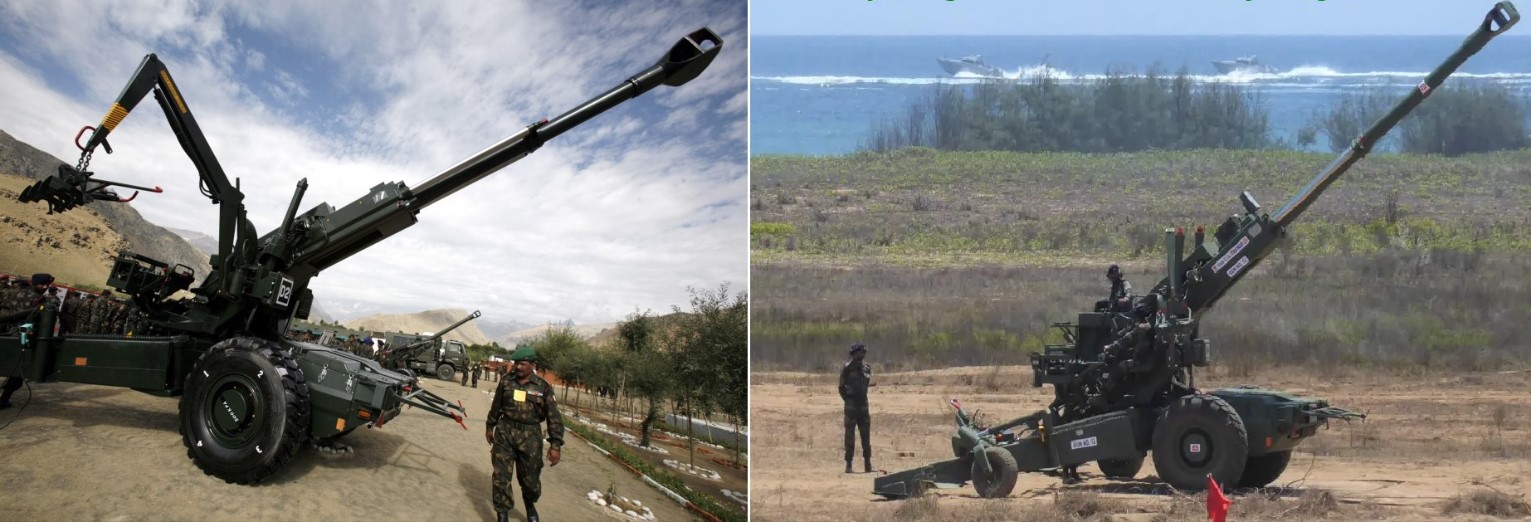
The Indian Army has successfully restored a 155mm/45-calibre Sharang artillery gun to full mission readiness, following a comprehensive overhaul carried out by the 506 Army Base Workshop under the Corps of Electronics and Mechanical Engineers (EME). The development highlights the Army’s growing focus on indigenous sustainment, repair capability, and life-cycle management of critical combat systems alongside ongoing artillery modernisation.
Officials familiar with the activity stated that the restoration involved detailed inspection, repair, and recalibration of major mechanical, hydraulic, and recoil systems, along with checks on the carriage, trail mechanisms, and firing safety assemblies. After completing mandatory workshop trials and safety clearances, the gun was formally declared fit for operational deployment, reaffirming its readiness for frontline artillery units.
Why the Sharang Matters
The 155mm Sharang is an indigenously upgraded artillery system derived from the legacy 130mm M-46. The upgrade converts the gun to the NATO-standard 155mm calibre, enabling the Indian Army to standardise ammunition, enhance lethality, and significantly improve battlefield reach while optimising existing assets.
Following the upgrade, the Sharang achieves an effective firing range of 39 kilometres, compared to roughly 27 kilometres for the original M-46 configuration. This increase in range strengthens the Army’s counter-battery capability and allows deeper engagement of enemy targets without relocating gun positions.
History of the Sharang Programme
India inducted the 130mm M-46 artillery gun in large numbers starting in the late 1960s, where it served as a backbone of Indian artillery for decades. As global artillery standards shifted toward the 155mm calibre, the Indian Army initiated multiple efforts to modernise its existing gun fleet rather than replace it outright.
This led to Project Sharang, an indigenous up-gunning initiative driven by India’s ordnance and defence manufacturing ecosystem. In October 2018, the Ministry of Defence approved the upgrade of 300 M-46 guns to the 155mm/45-calibre Sharang configuration, with deliveries planned over a four-year period. The first upgraded guns began entering service around 2020, following extensive proof-firing trials at the Long Proof Range near Jabalpur. The name “Sharang” symbolises long-range precision, drawing from Indian mythology.
Role of 506 Army Base Workshop
The latest restoration underscores the importance of 506 Army Base Workshop, a major EME sustainment facility located in Jabalpur, one of India’s historic artillery and ordnance hubs. The workshop is responsible for deep overhauls, major repairs, and life-extension programmes for complex weapon systems across the Army.
By restoring the Sharang gun entirely within Army infrastructure, the workshop demonstrated its ability to rapidly return high-value artillery systems to service without dependence on external manufacturers. This capability reduces downtime, improves fleet availability, and enhances operational preparedness.
Operational Significance
As the Indian Army balances new artillery inductions with upgraded legacy systems, the ability to sustain and restore guns has become a critical element of combat readiness. The successful return of a 155mm Sharang to full mission readiness reflects a broader shift toward self-reliance, technical depth, and institutional capability within the Army’s maintenance ecosystem.
With 300 Sharang guns planned to form a substantial part of India’s towed artillery strength, the performance of Army Base Workshops like 506 ABW will directly influence the availability, reliability, and combat effectiveness of India’s artillery arm in future contingencies.
——— End of Article ———