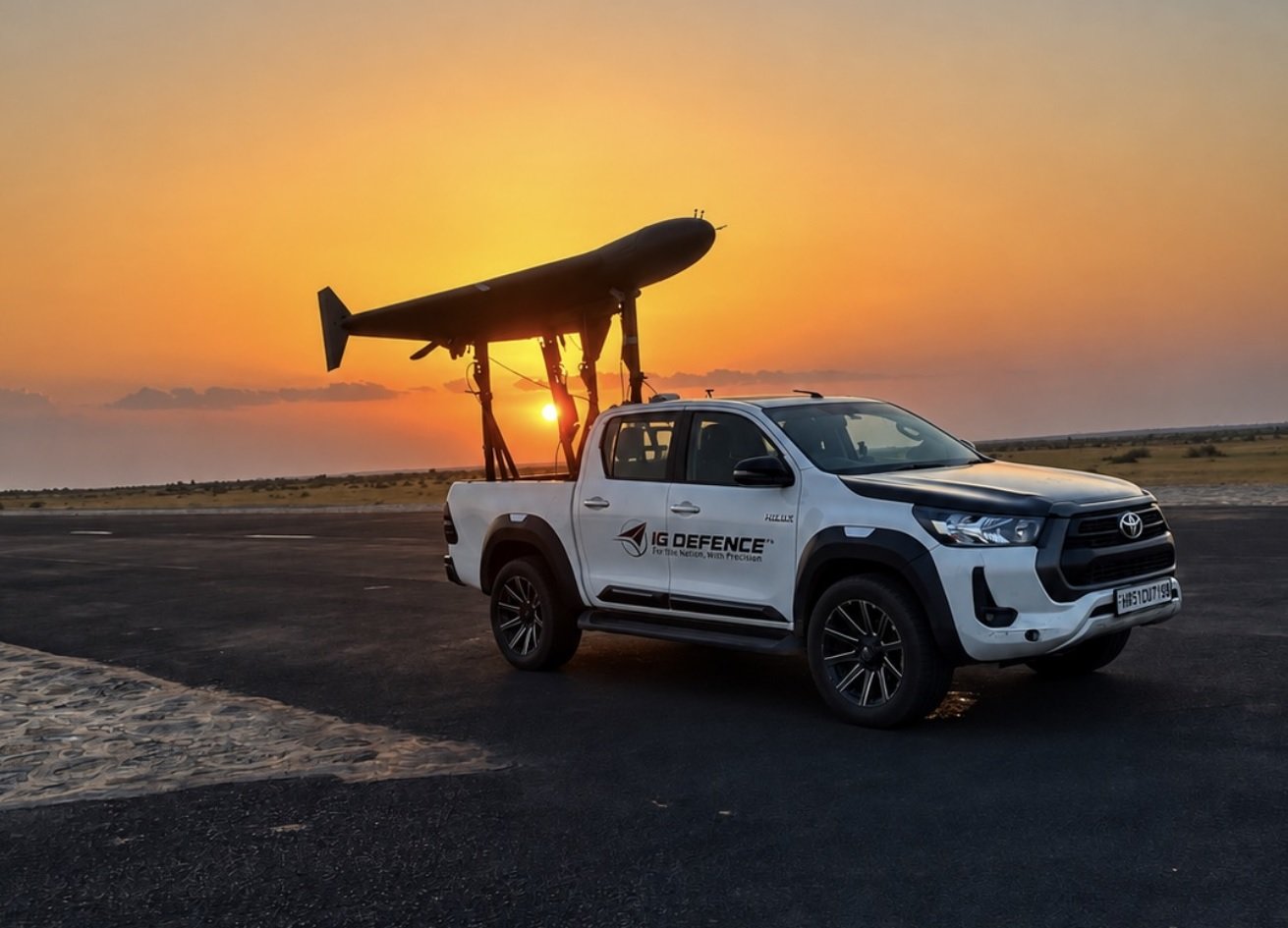
NEW DELHI — India has successfully flight-tested the KAL long-range one-way attack drone, developed by Noida-based aerospace and defence company IG Defence, at the Pokhran Field Firing Range in Rajasthan.
The drone was launched from a vehicle-mounted platform. The trial validated the integrated performance of its airframe, propulsion, avionics, navigation and mission systems.
KAL Drone Specifications
KAL is a long-range one-way attack drone, a category that also includes systems commonly described as loitering munitions or kamikaze drones. According to IG Defence, the system has:
- Range: Up to 1,000 kilometres
- Endurance: 7–8 hours
- Payload: Up to 50 kg
- Maximum take-off weight: Around 200 kg
- Cruise speed: About 160 km/h
- Top speed: Nearly 200 km/h
- Operating altitude: Up to 5,000 metres above mean sea level
- Operating temperature: -20°C to 60°C
The drone is intended for precision strikes against designated targets, including infrastructure, radar sites and air-defence systems, depending on mission configuration and operational clearances.
Navigation, Sensors and Communications
KAL combines multi-band GNSS satellite navigation with an Inertial Navigation System (INS). IG Defence describes its navigation system as hardened against electronic warfare.
The platform uses an encrypted RF datalink with SATCOM relay for beyond-line-of-sight communication. Its sensor suite includes a 4K day camera and a thermal electro-optical/infrared camera for day-and-night targeting.
The drone is launched using an inclined rail with rocket-assisted take-off.
GRID STRIKE Integration
KAL is part of IG Defence's GRID STRIKE long-range precision-strike portfolio. It can be integrated with the company's GRID Battle Management System, an AI-powered C5ISRT architecture designed to coordinate unmanned platforms and battlefield data.
Development and Production
IG Defence first publicly disclosed Project KAL in March 2026, when the planned endurance was stated as three to five hours. The system was later displayed at the North Tech Symposium 2026 in Prayagraj in May.
The company says major systems were developed in India. Production is planned at facilities in Ghaziabad, Uttar Pradesh, with a reported capacity of up to 100 units per month.
IG Defence has also said that Gulf countries have shown interest in KAL. Any exports would be subject to the required Indian government approvals.
Role of Long-Range Attack Drones
Long-range one-way attack drones have become an important part of recent conflicts. Systems such as the Iranian Shahed-136 and Russian Geran-2 have been extensively used in the Russia-Ukraine conflict. Shahed-class systems have also appeared in Middle East operations and against maritime targets in the Red Sea.
IG Defence founder and CEO Bodhisattwa Sanghapriya said the successful Pokhran trial is a milestone for the company's effort to develop a sovereign Indian capability in advanced long-range unmanned strike systems. He said recent conflicts have demonstrated the growing importance of such drones for precision strike and air-defence operations.
IG Defence's Other Unmanned Systems
Beyond KAL, IG Defence is developing interceptor drones, FPV combat drones, autonomous UAVs, counter-UAS systems, electronic warfare systems, AI-enabled swarm technologies, tactical robotics and logistics drones.
The successful Pokhran trial provides a flight-test milestone for the company's indigenous long-range one-way attack drone programme.
——— End of Article ———