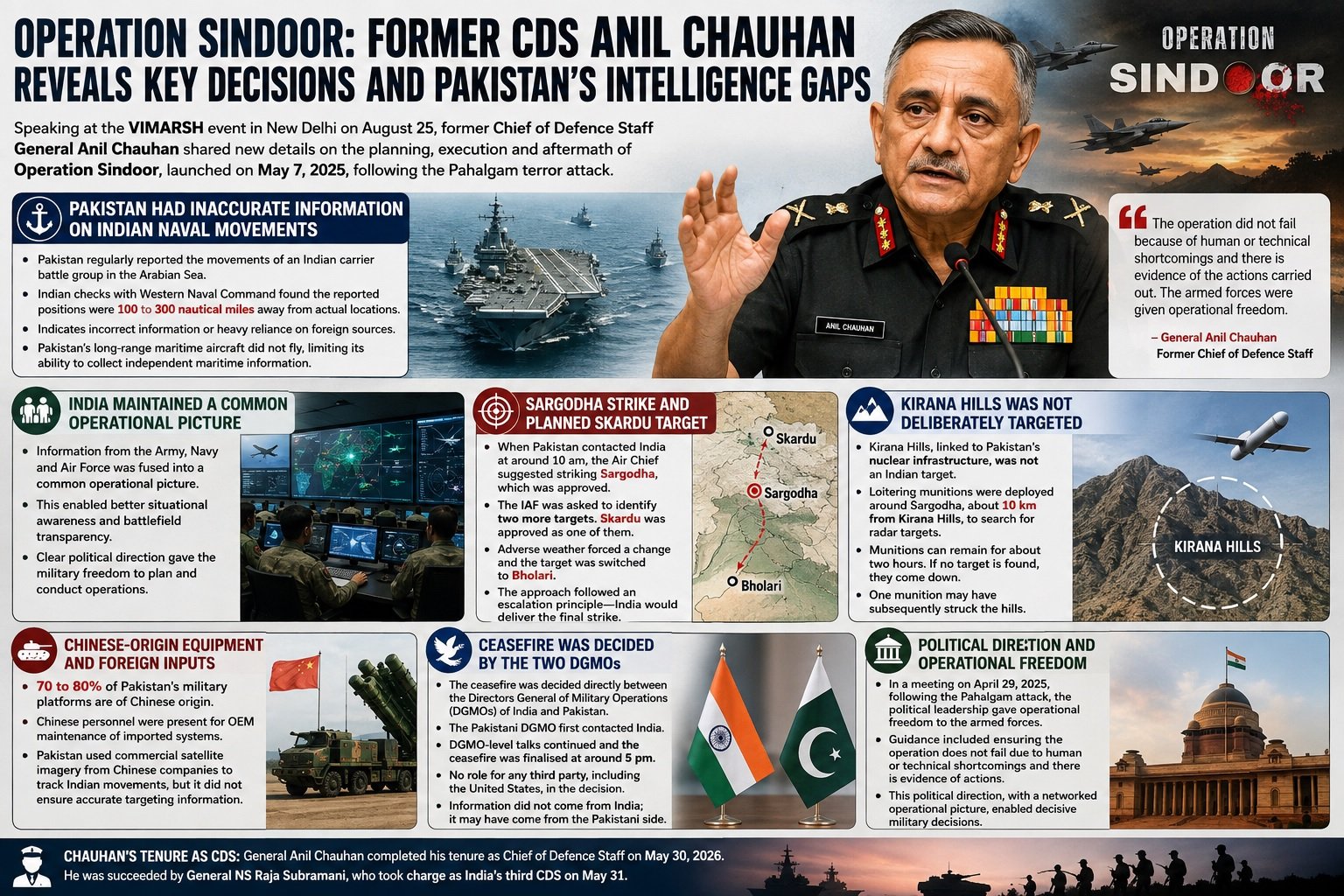
NEW DELHI — India Former Chief of Defence Staff General Anil Chauhan has provided new details about the planning and execution of Operation Sindoor, including Pakistan’s intelligence gaps, India’s decision-making during the escalation and the circumstances surrounding reported activity near Kirana Hills.
Chauhan, who was serving as CDS during the operation, spoke at the VIMARSH event on Operation Sindoor and its aftermath organised by the Vivekananda International Foundation in New Delhi on August 25.
Operation Sindoor was launched by India on May 7, 2025, following the April 22, 2025, Pahalgam terror attack, in which 26 people were killed. Indian forces targeted terrorist infrastructure in Pakistan and Pakistan-occupied Jammu and Kashmir. The military confrontation later ended with a ceasefire agreement between the two countries.
Pakistan had inaccurate information on Indian naval movements
Chauhan said Pakistan’s understanding of the battlefield was poor, including in the maritime domain.
He said Pakistani military briefings regularly reported the movements of an Indian carrier battle group in the Arabian Sea. However, when Indian assessments were checked with the Western Naval Command, the reported positions were found to be 100 to 300 nautical miles away from the actual locations.
Chauhan said this indicated that Pakistan was either receiving incorrect information or relying heavily on foreign sources. He also said Pakistan’s long-range maritime aircraft did not fly during the operation, limiting its ability to independently collect maritime information.
India maintained a common operational picture
Chauhan attributed India’s performance during the operation partly to better situational awareness and battlefield transparency.
According to him, information from the Army, Navy and Air Force was available through a common operational picture. This allowed commanders to make decisions using information from across the three services rather than operating with separate assessments.
He also identified clear political direction as another factor. Chauhan said the military was given freedom to plan and conduct operations within the political objectives set for the mission.
Sargodha strike and planned Skardu target
Chauhan also described a decision taken after Pakistan indicated that it wanted to open talks.
He said that when Pakistan contacted India at around 10 am, the Air Chief asked whether the Indian Air Force should strike Sargodha. Chauhan said he authorised the strike.
He then asked the Air Force to identify two additional targets. Skardu was selected as one of them and received approval. However, adverse weather conditions later forced a change in the plan, and the target was switched to Bholari.
Chauhan said the approach was linked to an escalation principle under which India would deliver the final strike rather than leave the last action to Pakistan.
Kirana Hills was not deliberately targeted
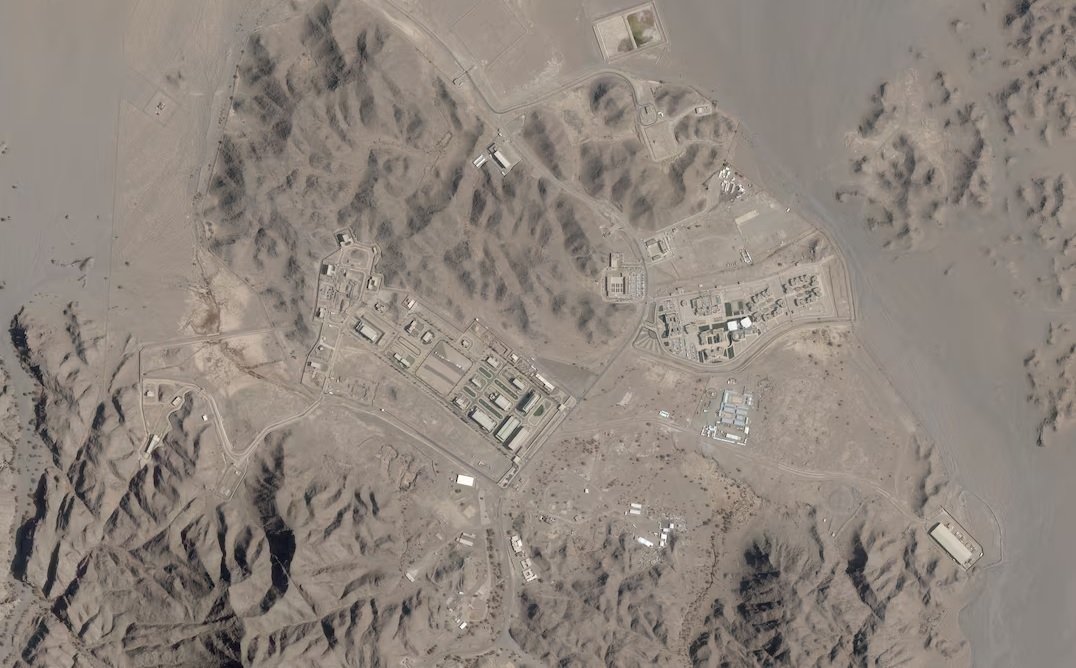
Chauhan also addressed reports about activity around Kirana Hills, an area associated with Pakistan’s nuclear infrastructure.
He said Kirana Hills was not a deliberate Indian target. According to his explanation, loitering munitions were deployed around Sargodha, approximately 10 km from Kirana Hills, to search for radar targets.
Chauhan said the munitions could remain in the area for about two hours. If they failed to locate a target during that period, they would eventually come down. He said one of the munitions may have subsequently struck the hills.
His explanation is consistent with earlier comments by Air Marshal A.K. Bharti, who had denied that Kirana Hills was deliberately targeted during Operation Sindoor.
Chinese-origin equipment and foreign inputs
Chauhan also discussed Pakistan’s military equipment and its dependence on external sources. He said around 70 to 80 percent of Pakistan’s military platforms are of Chinese origin.
He acknowledged that Chinese personnel were present in Pakistan during the conflict but linked their presence to normal original equipment manufacturer maintenance arrangements for imported military systems.
He also said Pakistan attempted to use commercial satellite imagery from Chinese companies to track Indian movements, but this did not necessarily translate into accurate targeting information.
Ceasefire was decided by the two DGMOs
Chauhan disputed claims that the United States had brokered the India-Pakistan ceasefire.
He said the ceasefire was decided directly between the Directors General of Military Operations (DGMOs) of India and Pakistan. According to his account, the Pakistani side initially contacted India and the DGMO-level discussions continued before the ceasefire was finalised at around 5 pm.
Chauhan said he did not see a role for any third party in the military-level ceasefire decision. He also said he was confident that India had not leaked the ceasefire information to the United States before the announcement and suggested that the information may have come from the Pakistani side.
Political direction and operational freedom
Chauhan also referred to a meeting on April 29, 2025, following the Pahalgam attack. He said the political leadership provided the armed forces with operational freedom to determine the timing and manner of the response.
According to his account, the guidance included ensuring that the operation did not fail because of human or technical shortcomings and that there should be evidence of the actions carried out.
Chauhan said this political direction, combined with the military’s networked operational picture, contributed to India’s ability to make decisions during the operation.
Chauhan’s tenure as CDS
Chauhan completed his tenure as Chief of Defence Staff on May 30, 2026, after serving as CDS during Operation Sindoor. He was succeeded by General NS Raja Subramani, who took charge as India’s third CDS on May 31.
His latest remarks provide additional details on how Indian military commanders assessed the battlefield, selected targets and managed escalation during Operation Sindoor, while also highlighting gaps that he said affected Pakistan’s understanding of Indian military movements.
——— End of Article ———