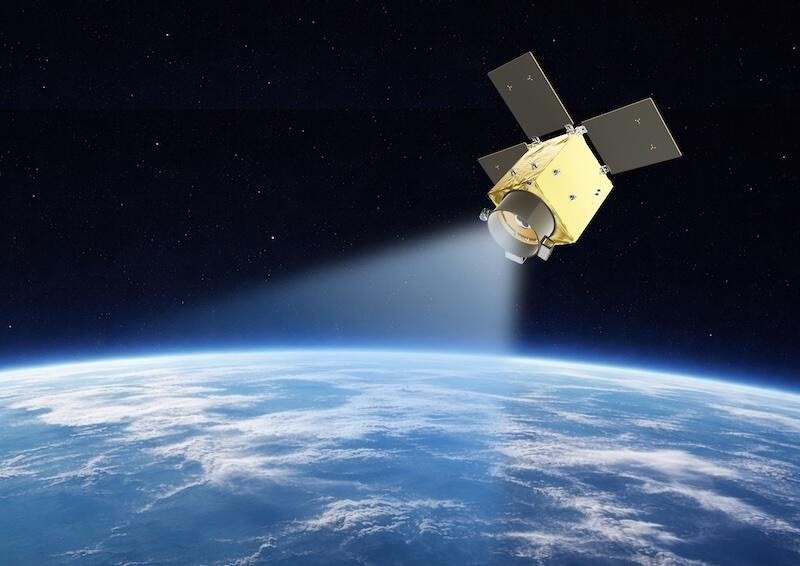
TEL AVIV, Israel — Israeli satellite company ImageSat International (ISI) has unveiled its new EROS NOVA Earth observation satellite, introducing a platform that combines very high-resolution imaging, short-wave infrared (SWIR) sensing, video collection and onboard artificial intelligence.
According to ISI, EROS NOVA is designed to provide imagery at less than 30 centimeters of resolution, while the company has described the satellite's capability as reaching 25 centimeters. ISI's current product information lists the satellite with multiple imaging modes, including spot, strip, mosaic, stereo, video and SWIR video.
Multiple Sensors on One Satellite
EROS NOVA combines several sensing capabilities on a single spacecraft. Its optical imaging system is designed for very high-resolution Earth observation, while the SWIR sensor can provide additional information that is not available from standard visible-light imagery.
SWIR sensing can help distinguish different materials and identify certain changes on the ground, including some forms of camouflage and recent surface disturbances. The satellite also supports video collection, allowing users to observe movement rather than relying only on individual still images.
ISI lists EROS NOVA with Pan, multispectral true-color, near-infrared and SWIR capabilities, along with a 10-kilometer swath and a satellite mass of 425 kilograms.
Onboard AI Processing
A key feature of EROS NOVA is its use of artificial intelligence and processing capabilities directly on the satellite.
Instead of sending all collected data to Earth before analysis, selected information can be processed while the satellite remains in orbit. This allows the system to identify and prioritize relevant imagery before transmission, helping reduce the amount of data that needs to be sent to ground stations and potentially shortening the time between collection and analysis.
ISI has previously demonstrated onboard AI and edge-processing technologies on its satellite platforms. The company says these capabilities are being developed to support faster processing of space-based intelligence data.
“EROS NOVA represents the next generation of space-based intelligence, bringing together advanced imaging, multiple sensing capabilities and onboard intelligence in a single satellite platform,” said Noam Segal, CEO of ImageSat International. He said the system is designed to help intelligence organizations obtain greater value from each collection and respond more rapidly to operational requirements.
Part of ISI's Growing Satellite Portfolio
EROS NOVA expands ISI's existing family of Earth observation satellites and is not intended to replace the company's other platforms.
ISI's current portfolio also includes KNIGHT, which provides high-resolution imaging, SWIR and video, and RUNNER, a smaller satellite platform offering high-resolution imagery and video. The company says EROS NOVA is part of its broader GlobalEye satellite architecture.
The EROS series has been operated by ISI since the launch of EROS A in 2000. The company later introduced the EROS B and EROS C series, with the EROS C3 satellite launched in December 2022. ISI's earlier EROS satellites progressively improved imaging resolution, leading to the much higher-resolution capabilities offered by its newer systems.
Focus on Sovereign Space-Based Intelligence
ISI describes its business model as providing sovereign space-based intelligence capabilities. Rather than only supplying satellite imagery, the company develops complete systems that can include satellites, ground infrastructure, command-and-control systems and AI-based analytics.
Its current product portfolio includes satellite systems as well as platforms such as GeoImpact, which is designed to combine satellite and other intelligence data with AI-based analysis.
With EROS NOVA, ISI is combining higher-resolution Earth observation with multiple sensors and onboard processing in a single platform, continuing the company's development of satellite systems intended for defense and intelligence users.
——— End of Article ———