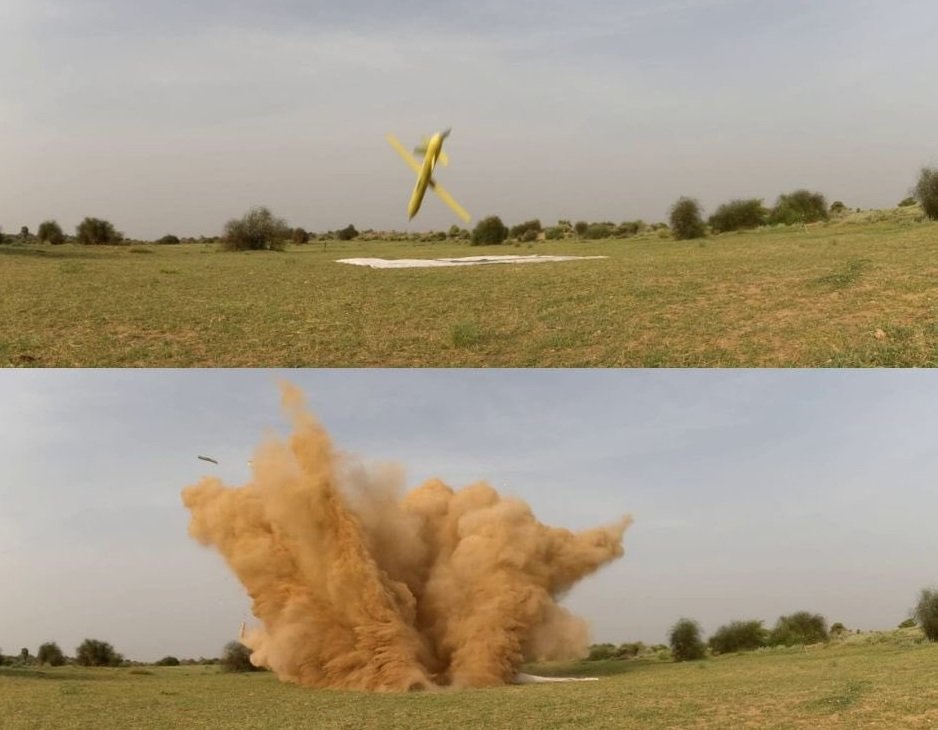
New Delhi, — The Indian Air Force (IAF) successfully conducted the drop trial of the indigenously designed and developed Khagantak-243 Long Range Glide Bomb (LRGB) on September 2. The IAF said the trial met all its stated objectives.
The Khagantak-243 is a 300-kg-class stand-off precision-guided glide bomb jointly developed by Nagpur-based JSR Dynamics and Bharat Electronics Limited (BEL). JSR Dynamics is responsible for the weapon body and control systems, while BEL provides the electronics and guidance subsystems.
The weapon has a cylindrical body, swivel-type mid-body glide wings and five aft control surfaces. It carries a 125 kg Mk-81 general-purpose blast-fragmentation warhead. Its mid-course guidance uses an inertial navigation system (INS) along with GNSS.
The Khagantak-243 has a reported range of more than 140 km when released from an altitude of around 12,000 metres. Its glide design allows the launching aircraft to engage targets from a stand-off distance rather than flying directly over the target area.
The trial was conducted from a Su-30MKI fighter aircraft, which has been identified as the initial integration platform. Future integration with other aircraft, including the MiG-29K and Mirage-2000, has also been reported.
The IAF had earlier placed an order with BEL for an unspecified number of Khagantak-243 munitions. The exact quantity and contract value have not been disclosed. The successful trial adds another indigenous stand-off precision weapon to India's developing domestic air-launched weapons capability.
——— End of Article ———