BRNO, CZECH REPUBLIC — Honeywell Aerospace’s engineering team in Brno has successfully integrated the main subsystems of a hydrogen fuel-cell power source designed to generate and supply electricity for an aircraft.
The milestone is part of Project NEWBORN, a European initiative focused on developing a megawatt-class hydrogen-electric propulsion system for low-emission aviation.
Project NEWBORN
Launched in 2023, Project NEWBORN is supported by the European Union through the Clean Aviation Joint Undertaking. The project has a total cost of about €44 million, including approximately €33.3 million in EU funding, and involves 18 companies and research organizations from 10 European countries.
The project aims to develop an aerospace-qualified hydrogen fuel-cell propulsion system. It targets an overall propulsion-system efficiency of 50 percent by the end of 2026.
The technology is designed around scalable 1 MW modules that can be combined to exceed 3 MW. The project is intended to support future applications in CS-23 aircraft with up to 19 seats around 2030, followed by larger regional aircraft around 2035.
Hydrogen Power System Integration
The latest milestone combined hydrogen fuel cells with electrical and supporting systems into a single working power source.
Engineers tested the integrated system for:
- Electrical functionality
- Leak tightness
- Fluid operating parameters
- Communication between subsystems
- Control algorithms
- Protection mechanisms
Further testing will focus on expanding the system’s power range while improving its stability and resilience.
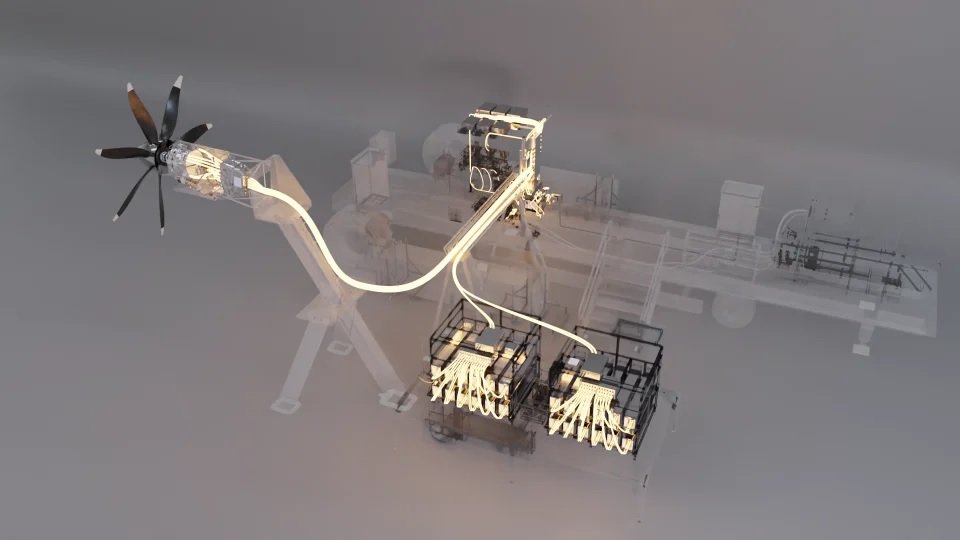
Honeywell developed a dedicated test platform at the ÚJV Řež research and engineering facility near Prague. The platform can reproduce various aircraft functions and includes power-generation, fluid-distribution, electrical and control, safety and heat-rejection systems.
European Industry Collaboration
Project NEWBORN's development covers hardware, software, modelling, simulation and integration work.
PowerCell supplied the aviation-grade proton exchange membrane fuel-cell technology. Fraunhofer and Test-Fuchs contributed elements of the electrical power source and related technologies.
Siemens Industry Software, KU Leuven, Friedrich-Alexander-Universität Erlangen-Nürnberg and CIRA supported modelling, simulation and integration analysis.
PowerCell has also validated its 300 kW fuel-cell stack, with multiple stacks able to be combined to reach megawatt-level power.
“Project NEWBORN is not only a demonstration of new technology, but also proof that European industry, universities and research organisations can jointly pursue ambitious technological visions and turn them into functioning systems,” said Miroslav Matoušek, NEWBORN project coordinator at Honeywell Aerospace.
Ondřej Kotaba, chief technology expert and technical leader of the NEWBORN project at Honeywell Aerospace, said the development involves interconnected technologies covering air supply and conditioning, hydrogen management, thermal management, electrical power distribution, power electronics, control, communications and safety monitoring.
Next Phase in Italy
Following the integration work in Czechia, the hydrogen power source will be transported to Gorizia, Italy, for the next phase.
There, it will be connected to battery systems supplied by Pipistrel and a megawatt-class electric propulsion system jointly developed by the University of Nottingham, Honeywell Aerospace and Pipistrel.
During the planned ground demonstration, the hydrogen fuel cells and batteries will supply electricity to the electric motor that drives an aircraft propeller.
The integrated system is targeted to reach Technology Readiness Level 4 by the end of the current project phase in 2026. The project is being developed through cooperation between European industry, universities and research organizations, with key development work and intellectual property retained in Europe.
——— End of Article ———