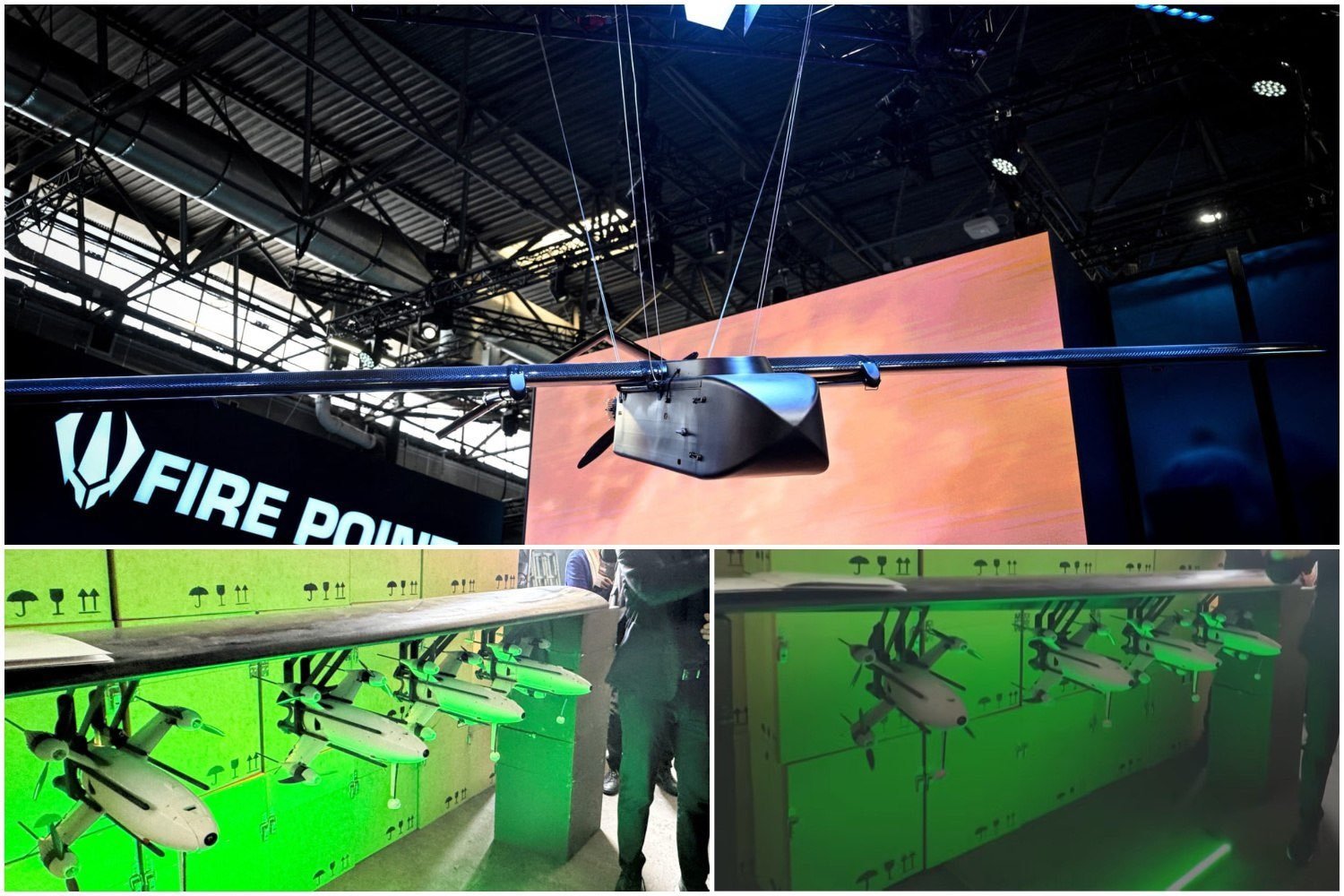
Berlin, Germany — German-Ukrainian joint venture Quantum WIY Industries has demonstrated a concept for air-launching its SPYS interceptor unmanned aerial vehicles (UAVs) to counter incoming aerial threats.
Air-launch configuration
Images of the concept show eight SPYS interceptors, with four mounted under each wing of a carrier aircraft. The exact carrier has not been officially confirmed, but its wing configuration closely matches the FP-1 and FP-2 long-range UAVs produced by Ukrainian company Fire Point.
The FP-series drones are associated with deep-strike missions and have reported ranges of up to 1,600 km.
The concept follows a memorandum between Quantum Systems and Fire Point covering cooperation on unmanned technologies and systems to counter modern aerial threats. The memorandum was signed during a defence industry roundtable attended by German Chancellor Friedrich Merz and Ukrainian President Volodymyr Zelenskyy.
SPYS interceptor
Quantum WIY Industries was established by German company Quantum Systems and Ukrainian company WIY Drones. WIY Drones first presented the SPYS interceptor in July 2026.
According to the manufacturer's current specifications, SPYS has:
- Maximum speed: 480 km/h (298 mph)
- Earlier reported speed: 600 km/h (373 mph)
- Cruising speed: 200–250 km/h
- Tactical range: approximately 15 km (9.3 miles)
- Maximum flight distance: 30 km
- Maximum altitude: 4 km (2.5 miles/4,000 m)
- Maximum flight time: around 10 minutes
- Rate of climb: 55 m/s
- Warhead: 0.3 kg (300 g/0.7 lb)
Guidance and targeting
SPYS uses radar guidance to reach the designated target area before switching to a terminal homing system. It supports automatic take-off and autonomous navigation to the interception zone, with AI-assisted terminal guidance.
The interceptor can be equipped with a daylight or thermal-imaging camera. It can also receive target information from radar sources and software such as SkyMap.
Testing and deployment
SPYS is currently undergoing testing and has reportedly been used to intercept a Russian Geran-5 jet-powered UAV. An initial batch was delivered to Ukrainian units earlier in 2026 for combat evaluation.
The interceptor can be launched from the ground and from other carrier platforms, including helicopters, aircraft and larger drones. A hand-launched version is also under development.
SPYS uses Ukrainian-made Motor-G engines and electronic components designed for high-load conditions. It is intended to engage high-speed manoeuvring aerial targets, including jet-powered strike and reconnaissance UAVs, while protecting positions, mobile units and critical infrastructure.
The demonstrated air-launch concept combines a long-range carrier UAV with multiple SPYS interceptors. The eight-interceptor configuration remains a concept under demonstration.
——— End of Article ———