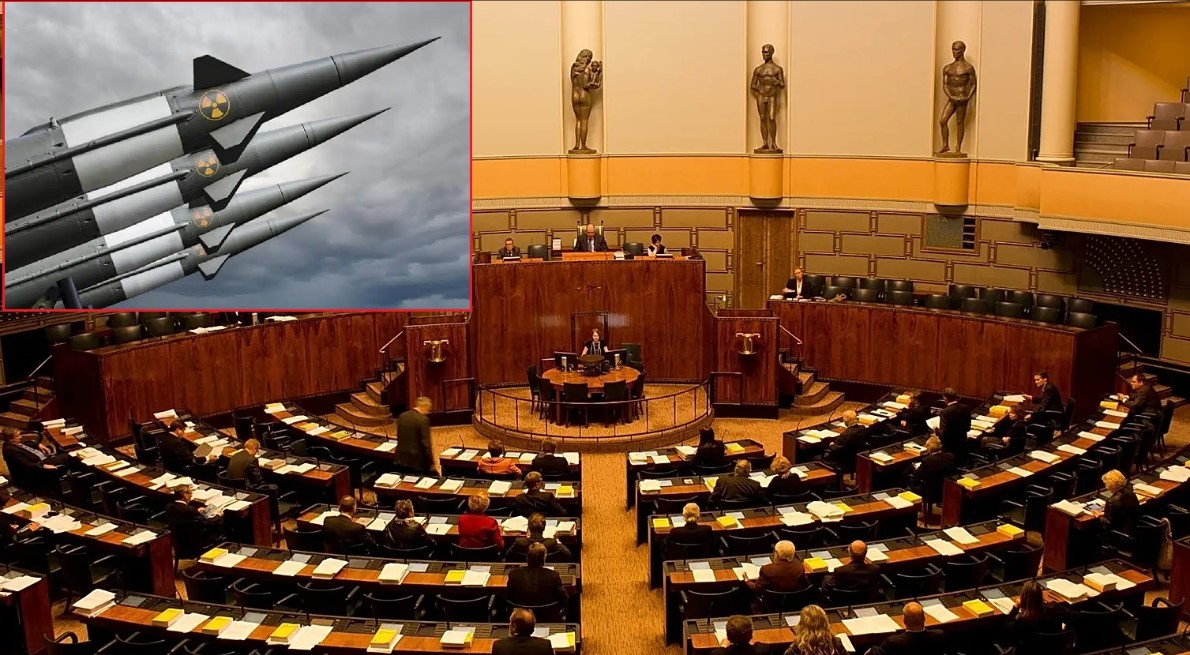
HELSINKI, — June 18, 2026 : Finland's parliament has approved legislation that removes the country's decades-old ban on the presence of nuclear weapons on its territory, marking a significant change in national defense policy as the country continues to integrate into NATO following its accession to the alliance in April 2023.
The legislation was passed on Wednesday by a vote of 125 in favor and 61 against, while 13 lawmakers were absent. The bill repeals provisions contained in Finland's Nuclear Energy Act, which had prohibited the import, production, possession, transport, supply, and detonation of nuclear explosives since the late 1980s.
The reform also includes amendments to the Finnish Criminal Code, creating exceptions that allow the transport, supply, and possession of nuclear weapons when connected to Finland's military defense, NATO collective defense obligations, or defense cooperation activities. The legislation now awaits formal approval by President Alexander Stubb before entering into force.
Strengthening NATO Integration
Finnish officials said the legislative changes are intended to align Finland's legal framework with NATO's deterrence and defense policies.
Defense Minister Antti Häkkänen described the measure as a "historic reform," stating that it will enable Finland to fully utilize NATO's deterrence capabilities and strengthen both national and allied security. According to the government, the amendments were developed following extensive studies and consultations with NATO partners.
The legislation does not authorize Finland to manufacture or detonate nuclear weapons and maintains compliance with the Nuclear Non-Proliferation Treaty (NPT). Finnish leaders have also stated that there are currently no plans to permanently station nuclear weapons in the country during peacetime.
Potential Role in NATO Nuclear Sharing
The removal of the ban creates the legal framework for Finland to potentially participate in NATO's nuclear-sharing arrangements in the future.
The United States currently maintains nuclear-sharing agreements with several NATO members, including Germany, Italy, Belgium, the Netherlands, and Turkey. Under such arrangements, U.S. nuclear weapons can be stored in host countries, while local air forces are trained to deliver them in the event of a major conflict.
Finland is widely viewed as a potential candidate for such an arrangement. In December 2021, Helsinki signed a contract to acquire 64 F-35A Lightning II fighter jets, which are capable of performing nuclear delivery missions and are designed to carry B61-series nuclear gravity bombs internally.
On April 1, 2025, U.S. Chairman of the Joint Chiefs of Staff Gen. Dan Caine indicated that Washington was open to expanding nuclear-sharing agreements and identified Finland and Poland as leading candidates for future participation.
If a nuclear-sharing agreement were established, U.S. Air Force B61 nuclear bombs could potentially be stored in Finland, with Finnish personnel receiving training for nuclear delivery missions under NATO procedures.
French Nuclear Cooperation Discussed
In addition to possible cooperation with the United States, Finnish Prime Minister Petteri Orpo recently referred to discussions regarding participation in a French-led nuclear deterrence framework.
French President Emmanuel Macron has advocated expanding France's nuclear deterrence role within Europe and has proposed deploying French nuclear assets to allied countries as part of a broader European security strategy.
However, defense analysts note that significant challenges exist. France's nuclear arsenal consists of approximately 290 warheads, and French nuclear weapons are not currently integrated with Finland's future F-35 fleet. Implementing such a framework would likely require the deployment of French Rafale fighter aircraft to Finnish bases and additional infrastructure, making the option more complex and time-consuming than a U.S.-led arrangement.
Strategic Impact in Northern Europe
Finland's accession to NATO significantly altered the alliance's strategic geography by adding approximately 1,340 kilometers (830 miles) of border with Russia, more than doubling NATO's direct land border with the country.
The possibility of nuclear-capable aircraft operating from Finnish territory has drawn attention because of Finland's proximity to the Arctic region and several key Russian military, industrial, and population centers.
Military analysts note that F-35A fighters equipped with B61-12 or B61-13 nuclear bombs could reach targets deep inside Russian territory while benefiting from the aircraft's stealth characteristics. Such capabilities could influence regional deterrence calculations and broader NATO defense planning.
Russian Response
Russian officials have repeatedly criticized Finland's legislative changes and deeper integration into NATO's security structures.
Earlier this year, Kremlin spokesman Dmitry Peskov warned that removing the nuclear weapons ban could increase tensions in Europe. He stated that the deployment of nuclear weapons on Finnish territory would be viewed by Moscow as a direct security threat and would prompt a response.
Opponents of the legislation within Finland have also expressed concerns that allowing nuclear weapons on Finnish territory could increase security risks and potentially make the country a target during a major conflict.
Supporters, however, argue that the reform strengthens deterrence while preserving Finland's long-standing policy of not developing its own nuclear weapons.
The parliamentary vote represents one of the most significant defense policy changes undertaken by Finland since joining NATO and reflects the country's continuing efforts to adapt its security framework to the evolving European security environment.
——— End of Article ———