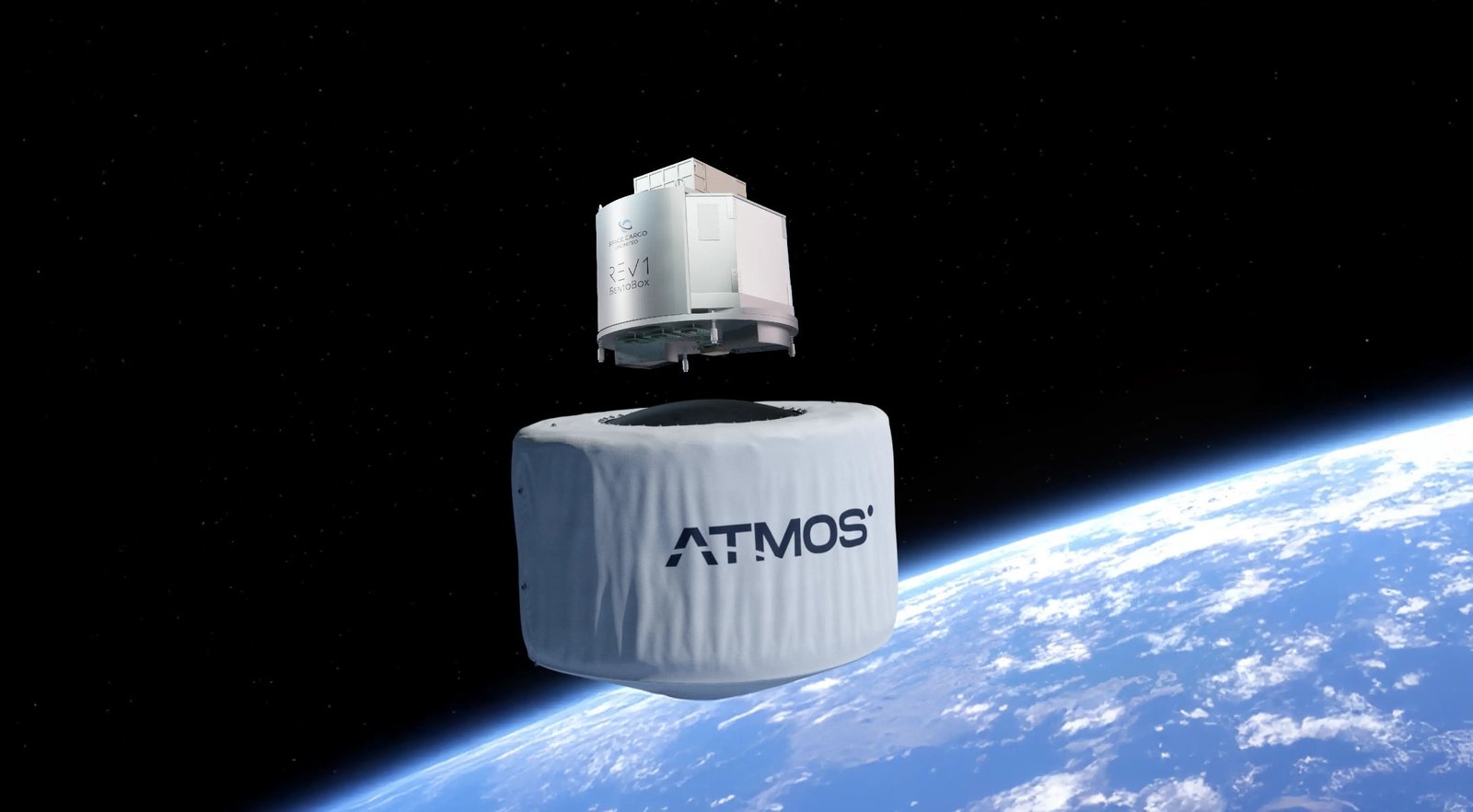
LICHTENAU, Germany — European missile manufacturer MBDA Deutschland and German space company ATMOS Space Cargo have signed a cooperation agreement to study a conventional military strike system capable of delivering payloads from orbit to targets on Earth.
Announced on November 18, 2026, the agreement focuses on a concept called Precision Orbital Deep Strike (PODS). The proposed system would combine ATMOS's orbital transportation and atmospheric reentry technology with MBDA's expertise in missile guidance, warhead engineering and military payload integration.
The initial study will examine technical feasibility, system design, payload integration and possible demonstrations. No project budget, hardware testing schedule or deployment decision has been announced.
MBDA and ATMOS Divide Technical Responsibilities
Under the agreement, MBDA Deutschland will contribute defence systems expertise, including guidance technologies and military payload integration. MBDA is jointly owned by Airbus, BAE Systems and Leonardo.
ATMOS Space Cargo, through its ATMOS WORKS unit, will provide technologies for transporting cargo into low Earth orbit and returning it through Earth's atmosphere.
MBDA Deutschland Managing Director Thomas Gottschild said the partnership aims to provide European armed forces with a sovereign capability. ATMOS CEO Sebastian Klaus highlighted the importance of developing and operating critical defence infrastructure through European industry.
ATMOS Phoenix Reentry Technology
ATMOS's contribution will draw on its Phoenix family of reusable orbital return vehicles. These spacecraft use an inflatable structure that functions as a heat shield and aerodynamic brake during atmospheric reentry.
The company tested the technology with its Phoenix 1 prototype in April 2025 aboard a SpaceX Falcon 9 rideshare mission. The vehicle successfully inflated its heat shield during reentry and collected flight data.
The Phoenix 2 is designed to carry approximately 100 kilograms and operate in orbit for periods ranging from a few hours to 12 months.
In April 2026, ATMOS secured €25.7 million in Series A funding to support an initial Phoenix 2 fleet and develop the Phoenix 3, which is planned to carry approximately one metric tonne. The company is also studying Phoenix 3 with the European Space Agency.
Strategic Purpose and Technical Challenges
PODS is being examined as a potential addition to Europe's conventional long-range strike and deterrence capabilities. The concept involves positioning conventional military payloads in low Earth orbit before returning them through the atmosphere when required.
ATMOS clarified that its civilian Phoenix spacecraft, designed for orbital logistics and returning research or industrial cargo, remain a separate product line.
Any future deployment would have to comply with applicable international laws. Under Article IV of the 1967 Outer Space Treaty, nuclear weapons and other weapons of mass destruction cannot be placed in orbit. The treaty does not specifically prohibit conventional weapons in Earth orbit.
However, significant challenges remain. Launching and maintaining military payloads in orbit could be considerably more expensive than using conventional land-, sea- or air-launched missiles. Spacecraft in predictable orbits could also become vulnerable to anti-satellite weapons during a conflict.
For now, PODS remains at the study stage. MBDA and ATMOS have not announced a development budget, testing timeline or decision to build an operational system. The current agreement covers technical assessment and possible demonstration activities.
——— End of Article ———