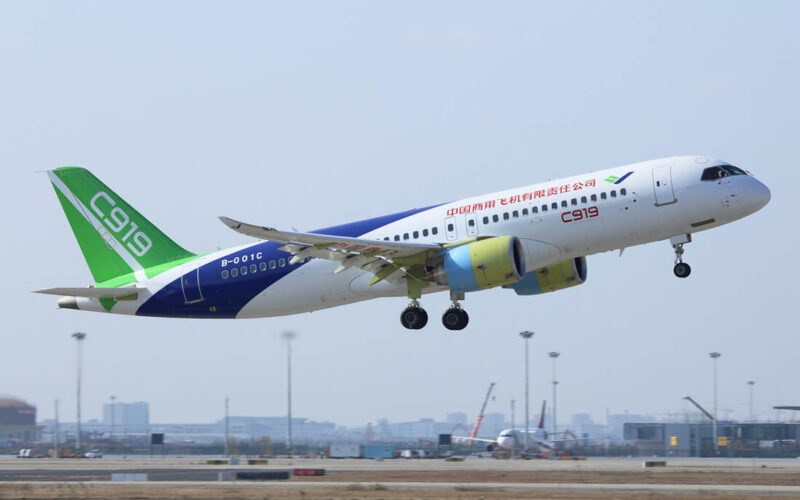
China’s C919, the country’s first homegrown narrowbody civilian aircraft, made aviation history as it touched down at Lhasa Gonggar Airport in Tibet. This airport, one of the highest in the world, is located at an elevation of 3,650 meters (11,979 feet) above sea level in the Himalayan region, often referred to as the "roof of the world." The flight from Chengdu, Sichuan Province, lasted about two hours, and the C919’s successful landing at this challenging location signals a new era for Chinese aviation.
Lhasa Gonggar Airport poses unique challenges for any aircraft. The region’s thin air due to the high altitude creates difficulties for jet engines, as lower air pressure makes it harder for jet fuel to burn efficiently. This can reduce the thrust needed for takeoff and landing, demanding a higher level of aircraft performance. Despite these challenges, the C919’s smooth arrival marked a key achievement in China’s ambition to challenge Western aircraft giants like Boeing and Airbus.
The flight wasn’t just a test of altitude adaptability. According to reports from Xinhua, China’s official news agency, the C919’s mission in Tibet included vital research and development tests on the plane’s avionics and other key systems. These tests are essential for ensuring the aircraft’s reliability in high-altitude environments like the Tibetan plateau. In fact, COMAC (Commercial Aircraft Corporation of China), the company behind the C919, has already begun working with Tibet Airlines to create a specialized model of the aircraft designed for such conditions.
In addition to its 158-192 passenger capacity, the C919 is often compared to Boeing’s 737 and Airbus’s A320, both popular narrowbody jets used worldwide. However, the C919 is distinct in its focus on high-altitude performance. For instance, it is equipped with high-performance engines that provide extra speed during takeoff and landing, critical in low-air-density conditions like those found in Lhasa. Winglets on the aircraft reduce drag, improving overall efficiency during flights at elevated altitudes. These features make the C919 well-suited for difficult terrains such as the Himalayan region, where operational demands are far higher than at sea-level airports.
The aircraft’s high-altitude adaptability is part of China’s broader goal of developing more plateau-suited aviation technologies. Tibet Airlines, in particular, is a key player in these efforts, with a deal to acquire 40 C919 aircraft specifically tailored for plateau operations. This strategic partnership underscores China’s intention to dominate its domestic aviation industry while also competing globally.
In fact, the C919 is just the beginning. COMAC’s smaller ARJ21 regional jet has already been used to carry out demonstration flights across the Qinghai-Tibet Plateau, operating from bases in Lhasa, Chengdu, and Xining. This smaller aircraft even reached Daocheng Yading Airport in Sichuan province, the highest civilian airport in the world, located at an elevation of 4,411 meters (14,472 feet).
Though relatively new, the C919 has already begun commercial operations in China. In May of last year, COMAC delivered its first C919 jets to Air China and China Southern Airlines, and China Eastern Airlines had previously ordered seven. On its maiden voyage, China Southern Airlines flew the C919 between Guangzhou and Shanghai’s Hongqiao International Airport, marking its debut in the busy domestic market.
The flight to Lhasa, however, represents more than just a technical achievement; it’s a demonstration of China’s growing ambition in global aviation. While Boeing and Airbus continue to dominate the international market, China’s C919 is seen as a significant step toward changing that balance. With plans for international sales already in motion, the C919 could soon be a competitive player in global aviation markets.
In conclusion, the C919’s flight to Lhasa underscores China’s growing capabilities in aircraft manufacturing, particularly in creating models suited for challenging environments. With more specialized tests and developments in the pipeline, the C919 is poised to become not only a staple in China’s domestic fleet but also a competitor in the global market.
——— End of Article ———