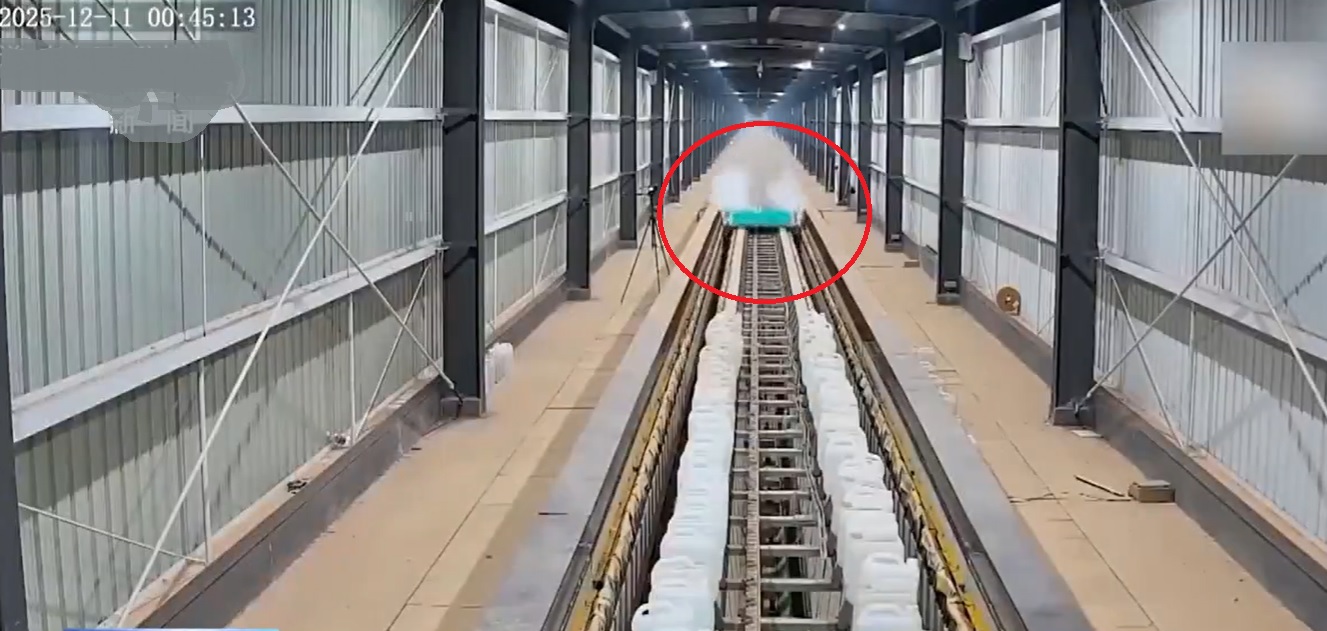
China has recorded a major breakthrough in ultra-high-speed ground transportation, successfully accelerating a one-ton superconducting maglev test vehicle to an extraordinary 700 km/h in just 2 seconds, the fastest acceleration and peak speed ever achieved in a controlled maglev test environment.
The landmark trial was conducted on a 400-metre experimental maglev track by researchers from the National University of Defense Technology (NUDT). Beyond achieving the headline speed, the team also confirmed the vehicle’s ability to decelerate and stop safely, a critical requirement for future real-world applications.
Extreme Acceleration on a Short Test Track
Reaching 700 km/h (194.4 m/s) in 2 seconds implies an average acceleration close to 9.9 g, underscoring that the experiment was designed to test propulsion power, electromagnetic stability, and control systems, rather than passenger comfort. Officials clarified that this was a technology demonstrator, not a passenger vehicle, aimed at validating the limits of superconducting magnetic levitation under extreme conditions.
The test vehicle weighed approximately 1,000 kilograms, making the achievement notable not only for speed but also for the mass involved, as higher loads significantly increase propulsion and stability challenges.
Key Technologies Behind the Breakthrough
According to Chinese state media, the success follows nearly 10 years of sustained research. The team reportedly overcame several long-standing engineering challenges, including ultra-high-speed electromagnetic propulsion, high-precision electric suspension and guidance, high-power transient energy-storage inverters, and strong-field superconducting magnets capable of remaining stable during rapid acceleration and braking.
Researchers said the experiment validated system-level integration, proving that propulsion, levitation, guidance, power delivery, and braking can function reliably at extreme speeds within a compact test environment.
Opening the Door to Vacuum Tube Maglev Transport
The breakthrough is being widely linked to China’s ambitions in vacuum tube maglev transportation, where reduced air pressure inside sealed tubes drastically cuts aerodynamic drag — the primary barrier to speeds above 600–800 km/h in open air.
Chinese scientists say the new results provide a technical foundation for future near-supersonic ground transport concepts, potentially enabling train speeds of 1,000 km/h and beyond. Such systems could eventually connect major cities hundreds of kilometres apart in under an hour.
How It Compares Globally
It’s difficult to compare records cleanly because “record” can mean peak speed, sustained speed, crewed vs uncrewed, or full-system demonstrations. Still, China’s 700 km/h in 2 seconds test stands out for acceleration and peak speed on a very short line, not for passenger operation.
For broader context, the widely cited crewed maglev speed record is 603 km/h, set by Japan’s L0 Series in 2015.
China has also showcased other rapid-acceleration maglev testing in 2025: CGTN reported that researchers at Donghu Laboratory accelerated a 1.1-tonne test vehicle to 650 km/h in about 7 seconds, reaching that speed over a 600-meter run on a 1,000-meter test track, with a stated speed/positioning accuracy of up to 4 millimeters and the ability to decelerate to zero in 200 meters.
What Comes Next
Researchers say the focus will now shift to repeatability, system endurance, and scaling up test distances, especially for low-vacuum or vacuum-tube environments. Further trials are expected to explore longer runs, thermal management, and emergency response systems, all essential before any commercial deployment.
For now, the achievement cements China’s position at the forefront of next-generation maglev and ultra-high-speed transport research, signaling that the race toward near-supersonic trains is accelerating faster than ever.
——— End of Article ———