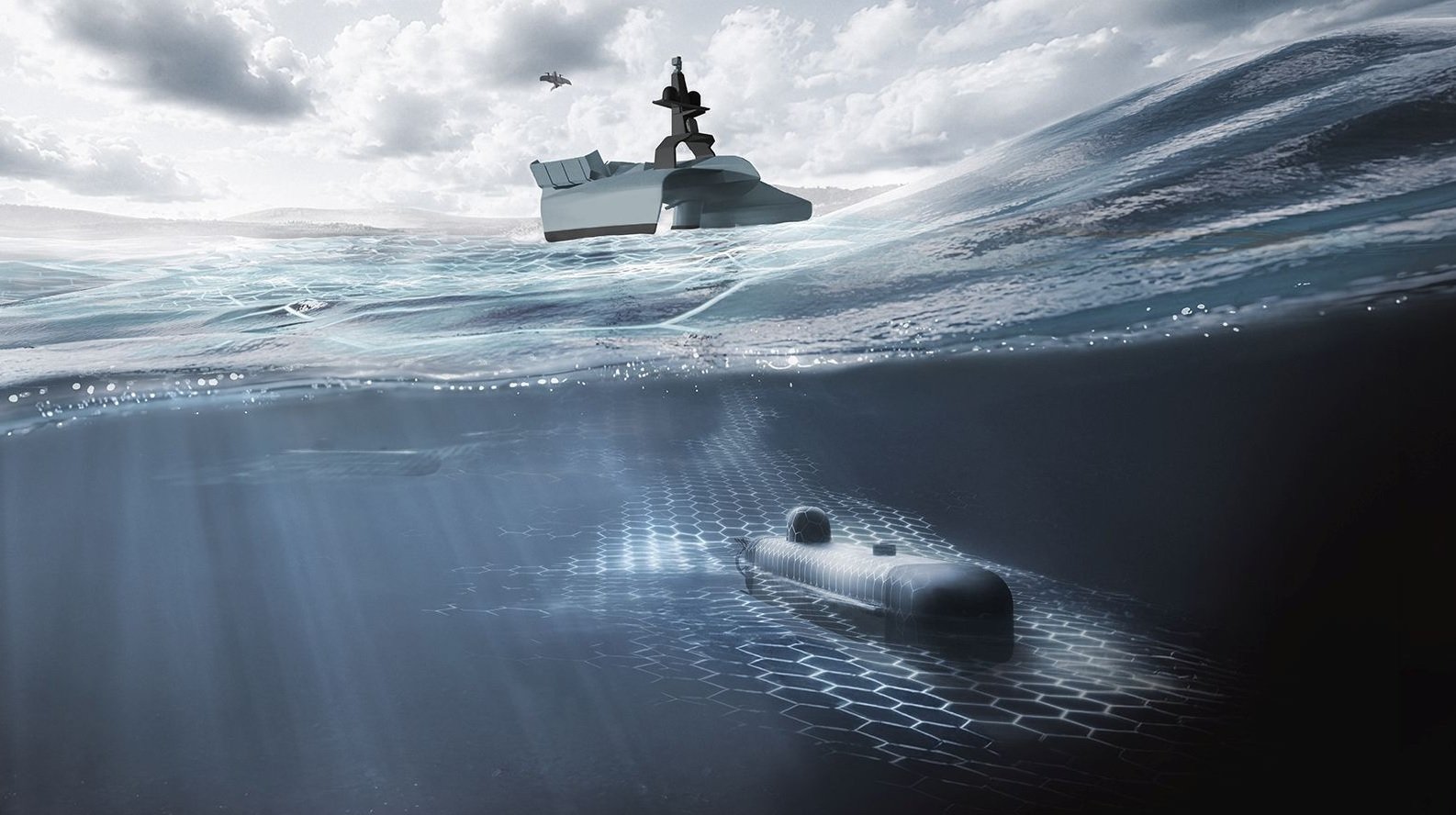
SHANGHAI — Commercial satellite imagery has revealed a previously unseen naval vessel under construction at the Hudong-Zhonghua shipyard in Shanghai. Open-source defense analysts and Naval News assess the ship as the world’s first purpose-built mothership designed to deploy, recover and support full-sized uncrewed submarines.
The vessel is linked to China’s development of extra-extra-large uncrewed underwater vehicles (XXLUUVs) and is expected to provide a mobile platform for transporting, maintaining and deploying them at sea.
Unique Design for Uncrewed Submarines
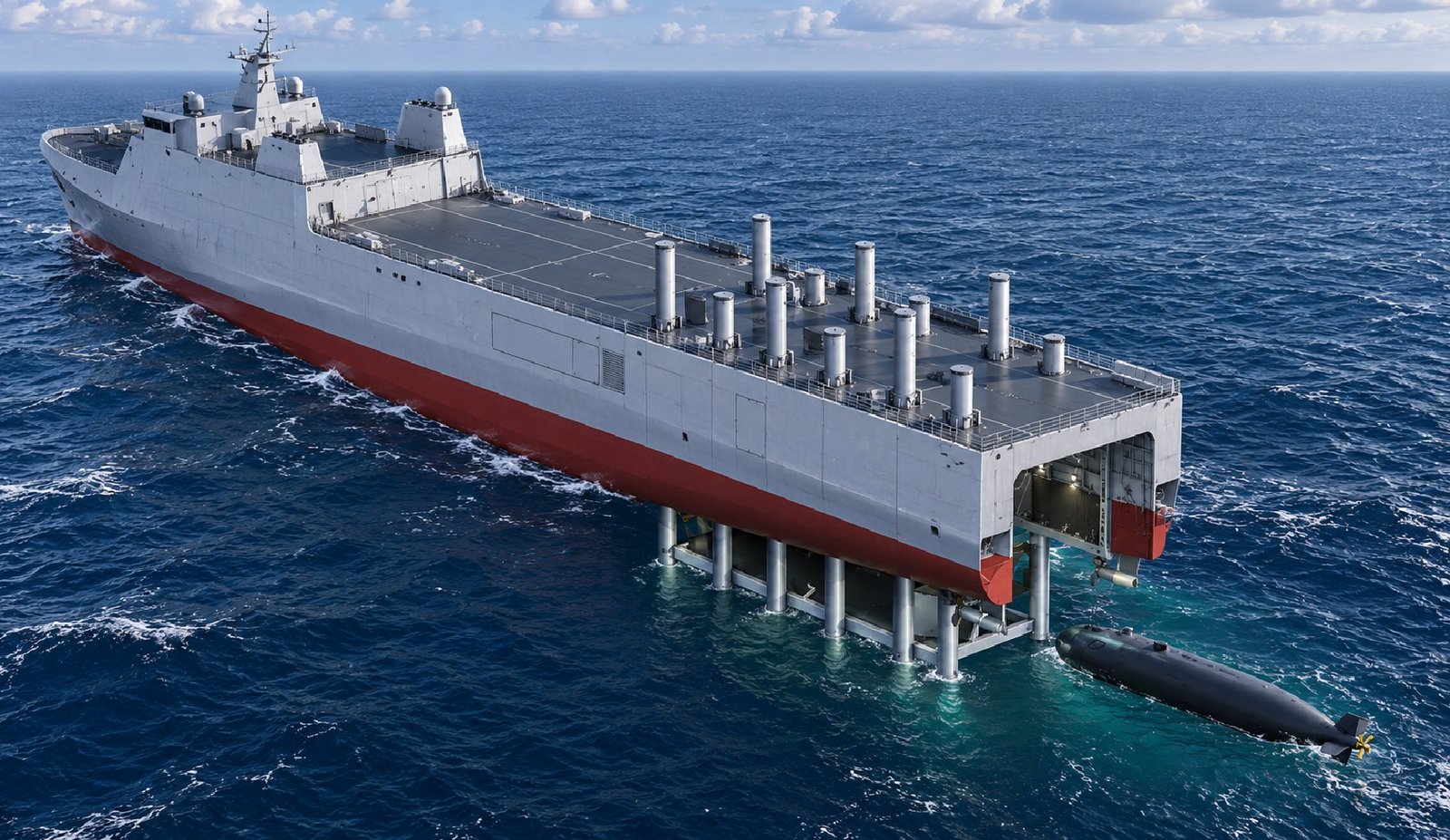
The ship resembles an amphibious transport dock (LPD), but its layout is significantly different. It is approximately 205 meters (673 feet) long and 27 meters (89 feet) wide and uses steerable azimuth thruster pods for low-speed maneuvering during launch and recovery operations.
At the stern is a wet well-deck measuring about 55 by 13 meters. The bottom of this area is open, allowing a large deployment cradle to extend below the hull. The cradle is supported by 12 vertical lifting arms, enabling an uncrewed submarine to be recovered or deployed while underwater.
Forward of the well-deck is an enclosed hangar measuring approximately 95 by 17 meters. Analysts assess that it could accommodate up to four full-sized XXLUUVs, or more smaller underwater systems. The enclosed space could also support maintenance and other technical work.
The forward superstructure includes a helicopter hangar and flight deck for rotary-wing or logistics support. Naval analyst H. I. Sutton has also released an analysis-based illustration showing the vessel's major features, including the cradle and enclosed hangar.
China’s Large XXLUUV Program
China has built and tested at least two large XXLUUV designs at naval facilities on Hainan Island. One is about 35 meters (115 feet) long and the other about 45 meters (148 feet). Both are considerably larger than the U.S. Navy's Boeing Orca XLUUV, which is about 26 meters (85 feet) long with its payload module.
The Chinese vehicles have been observed without traditional sails and use X-form rudders. They have previously been housed and launched from specialised floating docks, including a facility built in 2024 near Gangmen Harbour, west of the Sanya naval base.
The new ship would provide a more mobile support platform for these vehicles instead of relying only on fixed or floating facilities.
A similar cradle-elevator concept appeared in a 2025 Chinese proposal for an undersea research vessel, but that design used an open working deck. The much larger Shanghai vessel's enclosed hangar and specialised underwater recovery arrangement have led analysts to assess a military support role.
Other Chinese Uncrewed Underwater Vehicles
China has also developed smaller extra-large uncrewed underwater vehicles. At a military parade in Beijing on September 3, 2025, eight were displayed: five AJX002 vehicles, estimated at 18–20 meters long and associated with mine-laying, and three HSU100 vehicles equipped with retractable sensors.
The smaller systems are considered operational, while the two larger XXLUUV designs remain under testing and appear to be competing development approaches.
Analysts have estimated that the larger vehicles could potentially have a range of around 10,000 nautical miles, based on their size, published concept models and diesel-electric propulsion concepts. Potential missions include long-distance transit, mine-laying, reconnaissance, seabed surveillance and carrying sensors or torpedoes, although China's authorities have not publicly announced their exact operational doctrine.
The new mothership remains under construction at Hudong-Zhonghua. Its development, alongside China's ongoing XXLUUV testing, indicates that Beijing is developing not only large autonomous underwater vehicles but also a dedicated surface platform to transport, maintain, launch and recover them.
——— End of Article ———