TOKYO — Boeing plans to offer its MQ-28 Ghost Bat unmanned combat aircraft to Japan’s Ministry of Defense as Tokyo develops a new coastal defense strategy centered on unmanned systems, according to a report by Nikkei.
Steve Parker, president of Boeing’s Defense, Space & Security division, told Nikkei that Boeing will propose the MQ-28. The aircraft is designed to operate alongside crewed fighter jets, share sensor data through networks and extend the operational reach of manned aircraft without putting additional pilots at risk.
Airbus is also considering entering Japan’s unmanned aircraft market, while U.S., European and Japanese defense companies are competing for opportunities connected to Tokyo’s coastal defense plans.
MQ-28 Ghost Bat
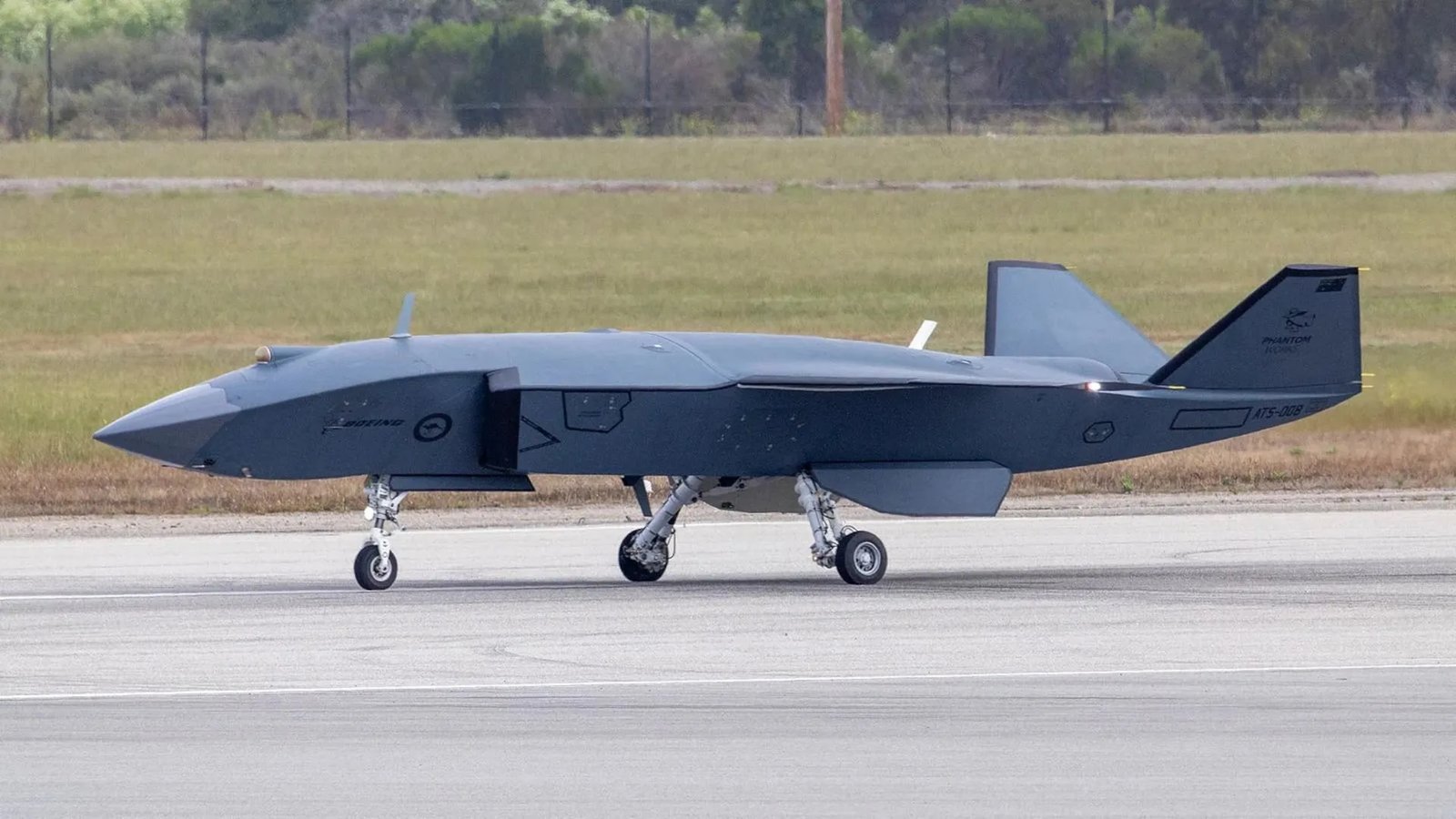
The MQ-28 is a stealthy collaborative combat aircraft (CCA), also known as a loyal wingman. It measures approximately 11.7 to 12 meters in length and was developed by Boeing Australia in partnership with the Royal Australian Air Force (RAAF).
The aircraft has a reported range of more than 2,000 nautical miles (about 3,700 kilometers), can reach speeds of up to Mach 0.9 and operate above 40,000 feet. Its modular nose can accommodate different mission equipment, including sensors, electronic warfare and communications systems.
Australia had operated eight Block 1 aircraft by late 2024. They completed more than 100 flight-test hours and conducted live weapons drops. In December 2025, an MQ-28 successfully conducted an air-to-air engagement using an AIM-120 AMRAAM while operating with an E-7A Wedgetail and F/A-18F Super Hornet.
Boeing is now producing nine Block 2 aircraft, while a more capable Block 3 is planned. The upgraded version is expected to feature a larger wing for greater fuel and payload capacity, an internal weapons bay, beyond-line-of-sight communications and increased takeoff weight.
International Testing
Boeing has partnered with Rheinmetall to offer the MQ-28 to Germany as a collaborative combat aircraft, with potential introduction targeted around 2029. Rheinmetall would handle system integration for German requirements.
In 2026, the Ghost Bat participated in Exercise Valiant Shield from the Northern Mariana Islands, operating alongside U.S. and allied aircraft, including F-35 variants and F-15EX, as well as battle-management and support platforms.
The aircraft also completed operational flight testing at Naval Air Station Point Mugu, California, in 2026. These were its first flights outside Australia, with some configurations using an infrared search and track (IRST) sensor in the nose.
Japan’s Existing MQ-28 Cooperation
Japan already has experience working with Boeing on manned-unmanned teaming. In 2025, Japan’s Ministry of Defense awarded Boeing a contract worth about ¥155 million (approximately $997,000) for manned-unmanned teaming simulations linked to the Global Combat Air Programme (GCAP), Japan’s next-generation fighter program with the United Kingdom and Italy.
Tokyo has also joined aspects of the U.S. Collaborative Combat Aircraft effort. In April 2026, Australia and Japan signed an implementing arrangement for collaborative combat aircraft activities involving the MQ-28, including research and training in Australia during Japan’s fiscal 2026.
Japan’s SHIELD Coastal Defense Concept
Japan’s coastal defense effort is being developed under the Synchronized, Hybrid, Integrated and Enhanced Littoral Defense (SHIELD) concept.
The Ministry of Defense allocated approximately ¥100.1 billion (around $640 million) in the fiscal 2026 budget to establish a network of unmanned air, surface and subsurface systems connected with existing sensors and long-range effectors. Tokyo aims to field the architecture during fiscal 2027.
The MQ-28’s range, modular design and ability to operate alongside crewed fighters such as the F-35 or future GCAP aircraft make it a candidate for Japan’s planned unmanned defense network, including operations around the country’s southwestern approaches.
However, Japan has not finalized procurement of the MQ-28, and details of the competition and acquisition process remain undecided.
——— End of Article ———