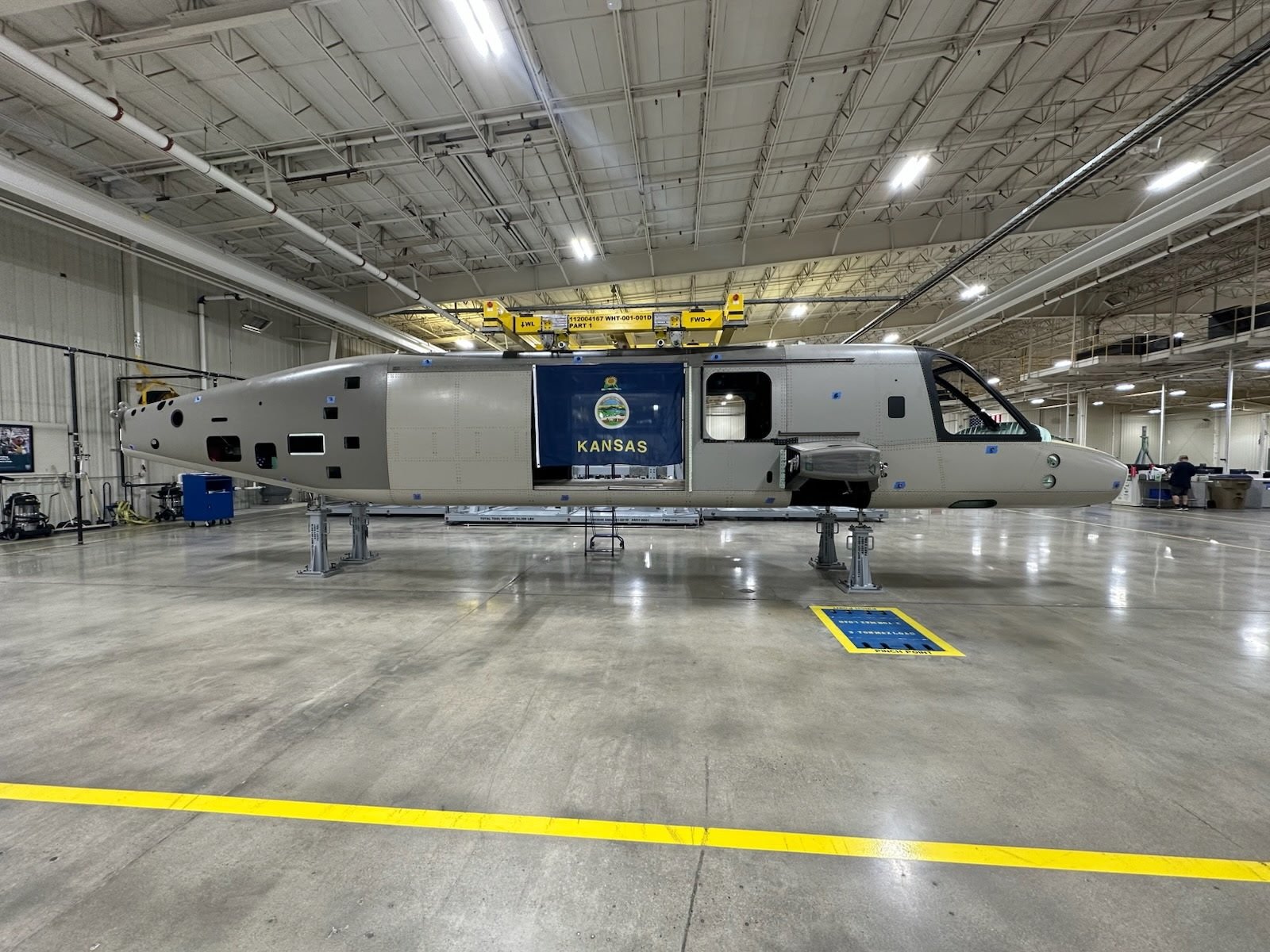
WICHITA, Kansas — Bell Textron has completed the first fuselage of the MV-75 Cheyenne II, marking a major manufacturing milestone in the U.S. Army’s Future Long-Range Assault Aircraft (FLRAA) program. Announced on November 16, 2026, the fuselage was assembled at Bell’s Wichita facility in Kansas and has now been transported to its Amarillo Assembly Center in Texas.
The completed structure includes the forward, middle and aft sections, joined together with exterior skins installed. Bell selected Wichita for fuselage production in 2024, began operations in October 2025 and officially opened the purpose-built facility in April 2026. The plant uses automated drilling equipment and advanced manufacturing technologies to improve production speed, quality and safety.
At Amarillo, the fuselage will be integrated with the wing and nacelle assemblies. Bell completed the first two wing structures by June 2026 and the first nacelles in October 2026. The assembled airframe will then undergo full-scale structural proof-load testing, including instrumentation and strain-gauge calibration, to evaluate its structural integrity and safety.
MV-75 Flight Testing Targeted for 2027
Bell is manufacturing six test aircraft, which are currently at different production stages. Initial flight testing is planned for 2027, followed by low-rate initial production in 2028. The U.S. Army expects the aircraft to enter operational service in 2031.
The MV-75 Cheyenne II is based on Bell’s V-280 Valor technology demonstrator, which first flew in December 2017. The Army officially designated the aircraft in April 2026. Its name honours the Cheyenne Tribes and recalls the historic Lockheed AH-56 Cheyenne compound helicopter program.
The aircraft features a fixed-engine tiltrotor design, with tilting proprotors and drive shafts while the engines remain fixed. It is powered by two Rolls-Royce AE 1107F turboshaft engines and incorporates fly-by-wire controls and a Modular Open Systems Approach (MOSA) digital architecture.
Its key performance specifications include:
-
Cruise speed: 280–300 knots (320–345 mph).
-
Combat radius: 500–800 nautical miles.
-
Ferry range: Up to 2,100 nautical miles.
-
Personnel capacity: Four crew members and 14 additional personnel.
-
External cargo capacity: Up to 10,000 pounds.
Replacement for the UH-60 Black Hawk
The U.S. Army plans to use the MV-75 to replace a substantial portion of its UH-60 Black Hawk fleet. With roughly twice the cruising speed of conventional utility helicopters, the tiltrotor is designed to improve troop transport and long-range assault capabilities.
The Army has selected the 101st Airborne Division (Air Assault) at Fort Campbell as the first operational unit expected to receive the aircraft.
Adam Blackford, general manager of Bell’s Wichita Assembly Center, said the fuselage completion reflects the dedication and agility of the Bell and MV-75 teams in establishing production infrastructure and assembling the first unit. Bell said delivering the aircraft to the Army while maintaining quality and safety remains its top priority.
——— End of Article ———