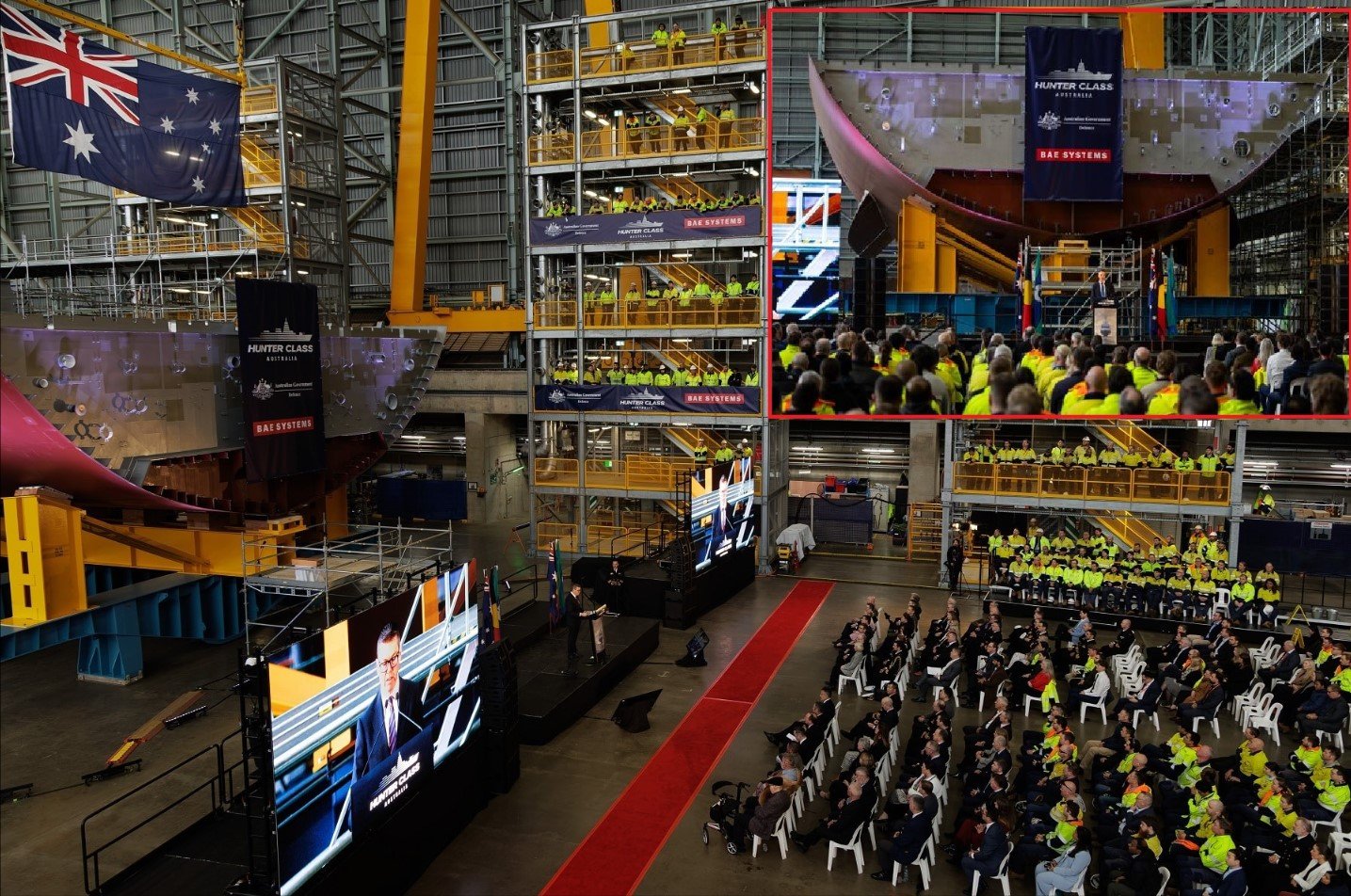
Adelaide — Australia has laid the keel of NUSHIP Hunter, the first Hunter-class frigate, at the Osborne Naval Shipyard in South Australia, marking a major milestone in the construction of the Royal Australian Navy’s next-generation anti-submarine warfare fleet.
The ceremony on August 24 followed naval tradition, with Defence Industry Minister Pat Conroy and Chief of Navy Vice Admiral Matthew Buckley joining BAE Systems shipbuilders to place a coin beneath two structural blocks forming part of the ship’s keel. The two sections will now be joined with additional blocks to form the ship’s base.
BAE Systems Maritime Australia is delivering the program under Australia’s continuous naval shipbuilding policy. Construction is currently under way on 20 of NUSHIP Hunter’s 22 primary blocks. The first steel was cut in June 2024, while work on the second ship, NUSHIP Flinders, is preparing to move into fabrication. Delivery of the Hunter class to the Royal Australian Navy is scheduled for the early 2030s.
Australia plans to build six Hunter-class frigates, with contracts signed for the first three. The vessels will replace the Anzac-class frigates. The program was originally planned for nine ships but was later reduced to six following schedule delays and a projected A$15 billion cost increase.
Type 26-Based Australian Frigate
The Hunter class is based on BAE Systems’ Type 26 Global Combat Ship design but incorporates major modifications for Australian requirements. The Australian variant has a displacement of approximately 10,500 tonnes and combines Australian CEAFAR2 phased-array radar technology with advanced U.S. combat-system elements, including the Aegis combat system with an Australian interface developed by Saab Australia.
The frigates are primarily designed for anti-submarine warfare and will be able to operate with allies and partners in complex maritime environments. They will also feature a modular mission bay, providing flexibility for missions beyond their primary submarine-hunting role.
Deputy Prime Minister Richard Marles said the keel-laying demonstrates tangible progress toward a more capable and resilient surface combatant fleet and said the Hunter class will provide a “world-class anti-submarine warfare capability.”
BAE Systems Australia – Surface Ships Managing Director David Shepherd said the ships’ weapons, sensors and modular mission bay will allow them to perform a wide range of missions. He also said the Hunter program has established foundations for a continuous naval shipbuilding and sustainment capability in Australia.
Jobs and Industrial Impact
The Hunter-class program directly supports more than 2,500 jobs, mainly in South Australia, with another 5,000 positions across the national supply chain. BAE Systems has almost 600 tradespeople assigned to the project at Osborne, including young workers trained through technical colleges.
South Australian Premier Peter Malinauskas highlighted the program’s local employment impact, while Pat Conroy said the project is supporting thousands of high-skilled and well-paid jobs and demonstrates Australia’s skilled workforce capability for complex naval programs.
The keel-laying therefore represents both the start of a major assembly stage for NUSHIP Hunter and continued development of Australia’s domestic naval shipbuilding capability at Osborne.
——— End of Article ———